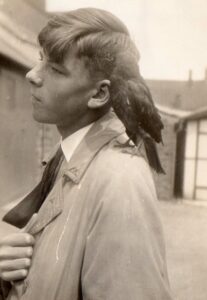
Peter Hogg (1913-2000) was born in Surrey but lived most of his early childhood in Egypt where his father worked as a civil servant. He was thus brought into early contact with the Arab world, which was the focus of his first career. From his father he inherited a love of all things natural, especially wild birds, which lasted throughout his life and helped to sustain him even in sad and difficult times such as the loss of his mother when he was just twelve and about to move on from prep school to Sherborne. Peter loved to enjoy life. Activities and adventures in his school and student days included swimming and sailing. He was always grateful to ‘Teacher’ O’Hanlon, his housemaster, for the care taken of him as a boy with family overseas, and for the holidays he went on with Teacher and other boys. At New College, Oxford, he read Classics and rowed with both College and University eights. Twice in the Boat Race, he earned himself the nickname of ‘Slogger Hogg’ and the ‘Smiley One’!
After graduation Peter trained for the Sudan Political Service, learning Arabic and Administration, and embarked as Assistant District Commissioner on a career that he only left twenty years later when the Sudan gained its independence. Moving around different provinces he was eventually promoted to Director of Local Government in the Khartoum HQ. During this time, after the War, he married Joanna Hardy. William and Meg were born and the family were all in Sudan for a few years.
After the freedom and the adventure of the desert, it must have been hard indeed for Peter to exchange the excitement of trekking and camel-riding for the repetitive routine of the commuter train. But for the sake of the family he turned down a job at an outdoor centre that would have suited his temperament and his love of the wild, and settled into a second career with the Personnel Department of BP in London, which was better paid and enabled him to be more generous in providing for Joanna and the children’s education.
Peter threw himself into every aspect of life, continuing to enjoy his sport, his birdwatching, and holidays at home and abroad, which often included walking and swimming. He developed an interest in conservation and became a keen and accomplished photographer, using his slides and photos to bring pleasure and interest to the family and others.
Eventually retirement released time for a host of voluntary and leisure activities – the Kent Conservation Trust, the Parish Church of Seal, the British Ornithological Society, Henley Regatta. William married Annie, Meg married Mike, grandchildren arrived; and it was a great pride and pleasure for Peter and Joanna to entertain them as also so many others in the family, and friends of all ages, in the house and lovely garden in Sevenoaks.
When Joanna died suddenly in 1992, Peter was bereft, but had not yet lost his zest for life and adventure. He took and early and typically impetuous decision to marry again. He was lucky enough to meet and marry Jane Stephens who has been a wonderful wife and companion to him in these last years of his life. She shared so many of his interests and commitments. It was a tragedy that they were only able to enjoy a few brief years before Peter succumbed to Alzheimer’s. James remained a wonderful companion to him, only with the greatest reluctance accepting finally last December that he needed to go into residential care.
Alzheimer’s is a terrible disease, but each person with Alzheimer’s is still themselves, albeit a different and reduced version of what they have been before. The wonderful thing was that love and faith which were always so much a part of Peter’s personality triumphed over everything else, and right at the end in the nursing home he seemed to emerge from the confused and difficult time and was just full of peace and love and a quiet, gentle appreciation of all that was being done for him. His last words, often repeated to anyone listening, were just the simple message ‘God bless’, a fitting farewell from one who lived life to the full, loving God and neighbour in many ways, a generous and kindly Christian gentleman who will be well remembered and much missed by family and friends.
The Revd. William Hogg (h 62-67)
Old Shirburnian Annual Report, 2001.

Peter Hogg (1913-2000)
Born 28 March 1913
Attended Sherborne School (Westcott House) September 1926-July 1931: School Prefect, Head of House, XXX Blazer, Class Leader with Badge, CSM in OTC, Trebles (1929, 30, 31), Member of Duffers, Editor of The Shirburnian, Marson Greek Prize and Greek Prose Prize 1931.
New College, Oxford. Rowed for Oxford University in the boat race in 1933 & 1934, and for the Leander Club in the men’s eights winning the Grand Challenge Cup in 1934.
Sudan Political Service 1935-1955, Director of Local Government 1954-1955.
BP Co. Ltd., 1955-1973.
Died 1 June 2000.
See also:
The Battle of the Blues: the Oxford and Cambridge Boat Race
Transcripts of letters held in the Turing Archive held at King’s College, Cambridge:
- Letter from Geoffrey O’Hanlon to Alan Turing, 4 August 1931, informing Turing that both he and Peter Hogg have been awarded the Goodman Scholarship. (ref. AMT/A/26)
- Letter from Geoffrey O’Hanlon to Alan Turing, 4 March 1936, in which he mentions that he has received a letter from Peter Hogg in Kordofan. (ref. AMT/A/27)
- Letter from Peter Hogg to Mrs E.S. Turing, 20 December 1959, thanking Mrs Turing for sending him a copy of her biography of Alan Turing. Hogg admits that he did not realise at Sherborne what ideas and discoveries Alan was making as he himself was useless at mathematics. Hogg has been to see the BP computer and is amazed to think that Alan was responsible for creating it. (ref. AMT/A/20)