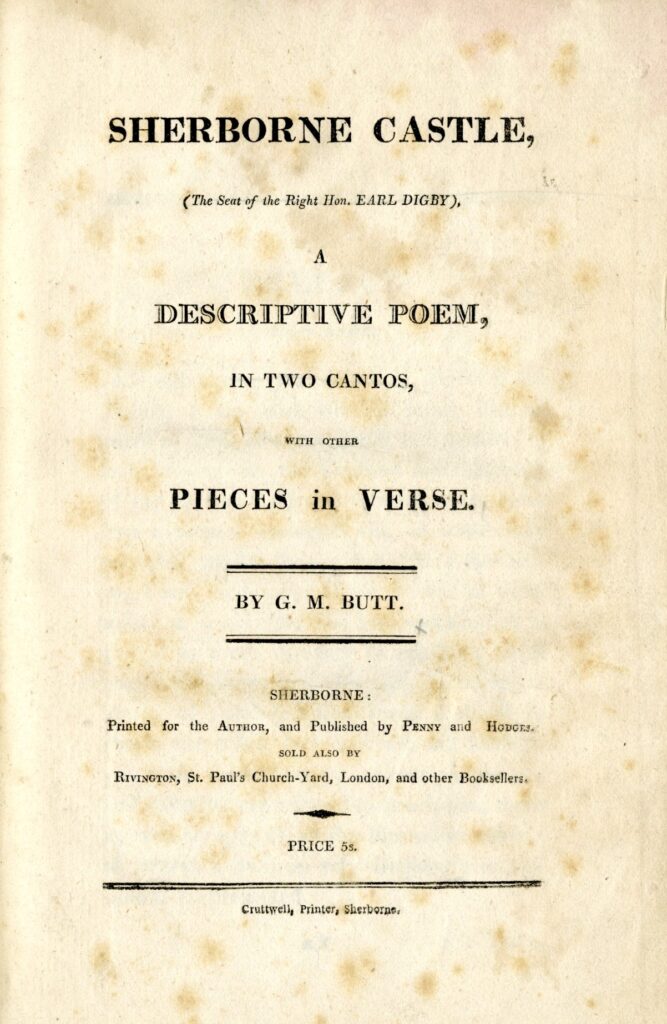
In October 1815, a volume of poetry written by an 18-year-old Sherborne boy called George Medd Butt (1797-1860) was printed by Cruttwell of Sherborne and published by subscription by Penny and Hodges.
Sherborne Castle, A Descriptive Poem, in Two Cantos, with other pieces of Verse was written by George Butt while he was working as an apprentice at the printing office of Cruttwell’s Journal and contains the following poems: ‘Sherborne Castle’, ‘Henry and Anna, A Ballad’, ‘To a Gentleman, on his presenting the author with the poems of Cowper’, ‘Sorrow, Pity, and the Muse’, ‘Lines occasioned by H.R.H. the Princess Charlotte’s visit to Earl Digby, at Sherborne Castle, November 9, 1814’, ‘The Tear of the Brave’, ‘Strephon and Love’, ‘Lines on the Conclusion of Peace with America, December, 1814’, ‘Waterloo’, ‘The Celestial Decree’.
In the preface to the volume, George Butt writes:
‘In submitting the following pages to the Public, I am most sensibly aware that no merit of their own can justify my confidence; but, relying on the kindness and liberality of my readers, I deem it unnecessary to enter into a tedious apology: yet, as some may probably censure the arrangement of the leading Poem, and object to the division of time, suffice it to say, that this plan was adopted to give it as much diversity as possible; for it must be allowed, that although, in the actual survey of rural beauties, there is much to charm the mind, and captivate the feelings, yet, when these beauties, however picturesque and splendid, are reduced to description, there is, even in spite of all the illustrative charms of poetry, a dullness very frequently impossible to be prevented.
Thus, in commencing the Poem with Evening, it was considered that many objects which first engage the attention of the Muse, and which might then appear to a poetical advantage, would, if beheld at another time, be deprived of half their power to please; and, on the other hand, those views which are included in the last Canto, would not have been so prominent if taken in the Evening.
But I cannot conclude this short address without returning my most grateful acknowledgements to those who have so kindly honoured me with their support; and it will ever be one of the proudest moments of my life, to look back on that period when their cheering smile first beamed upon the early effort of my Muse.
G.M.B. Sherborne, October 1815′
The volume, which apparently raised £100, contains a list of subscribers.
Five copies of the volume are known to exist: two are held at Sherborne Castle (both covered with grey boards), one in the historic library at Sherborne School, one at the Bodleian Library at Oxford University and another in the British Library.
Who was George Medd Butt?
George Medd Butt was born in Sherborne on 18 January 1797 to John Butt [a cordwainer?] and Frances Butt of Hound Street. He was christened at Sherborne Abbey on 25 February 1797. He attended a writing school in Sherborne and was then bound as an apprentice at the printing office of Cruttwell’s Journal. At some point he moved to London where he became and editor to one of the minor London papers which supported his establishment in the legal profession and in 1830 he was called to the bar by the Hon. Society of the Inner Temple, and went on the Western Circuit, where he soon rose into reputation, and acquired an extensive practice.
On 7 September 1830 George Butt was married by licence at Sherborne Abbey to Frances Jane Ffooks (1808-1887), daughter of Thomas Ffooks (1775-1845) and Frances Sophia (née Woodforde) (1777-1842) of Greenhill House, Sherborne. Thomas Ffooks was a solicitor, Clerk of the Peace, Governor & Warden of Sherborne School, Steward of the Sherborne Hundred. The marriage was conducted by the Rev. Thomas Woodforde.
In 1843, during the Chancellorship of Lord Lyndhurst, George Butt was made a Queen’s Counsel (QC), and shortly afterwards was elected a bencher of the Inner Temple. In July 1852 he was elected as Conservative MP for Weymouth and Melcombe Regis.
By his last will and testament made 9 December 1858 by George Medd Butt of 17 Eaton Square, Middlesex, left to his wife the dwelling house, stable, coach house and premises at 17 Eaton Square for life. After her death the same to his godson, Alan George Howell. He gave his wife all his household furniture, plate, linen goods, chattels and effects belonging to the dwelling house, stable, coach house and premises, and £100 immediately after his decease free of legacy duty. To his brother Thomas Butt, his trustee, he left £500. To his sister Susan Butt, £400. To his sister Frances Elizabeth Storey, widow, £500. To his sister Jane, the wife of John Jeanes of New Bond Street, £400, for her sole and separate use free from the control of her husband. To Susan Salter, his wife’s maid, £50 free and clear of legacy duty. He appointed his wife and his brother Thomas Butt executrix and executor, and left the residue of his estate and effects to Thomas Butt upon trust to pay the interest and annual proceeds to his wife for her life and after her death or remarrying, to be paid in equal share to: Thomas Butt, Susan Butt, Frances Elizabeth Storey and Jane Jeanes for life. One moiety of the residue to Alan George Howell and his sister Gertrude Lucy Howell. The will was witnessed by Charles Lempriere of the Inner Temple, Barrister, and William Henry Smith, 3 Tanfield Court Temple. On 31 May 1860, George added a codicil to his will (witnessed by F.J. Butt and George Morris of 17 Eaton Square) giving the following additional legacies: to his brother Thomas Butt, £200; to his sister Susan Butt, £200; and to his sister Frances Storey, £200.
George Medd Butt died on 11 November 1860 at 17 Eaton Square, London. Probate was granted to his widow, Frances Jane Butt, and his brother, Thomas Butt of 46 Bedford Row, gent.
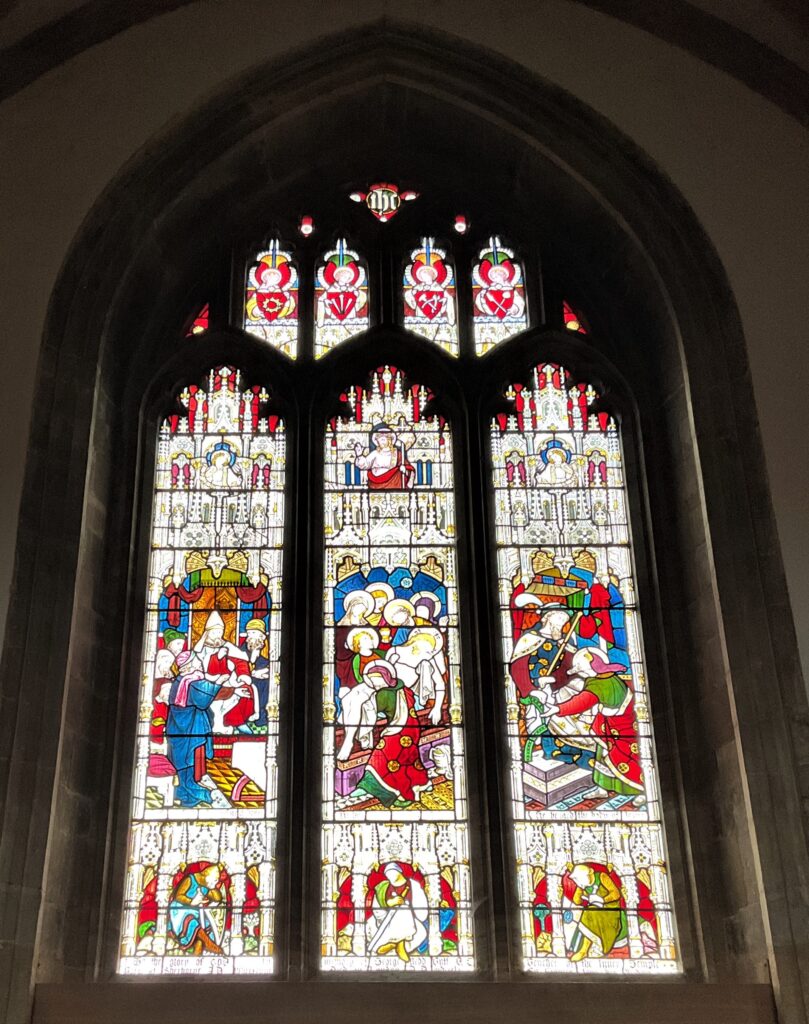
George’s widow Frances Jane Butt (née Ffooks) gave to Sherborne Abbey in her husband’s memory a stained glass window in the south aisle, designed by Clayton & Bell depicting the History of St. Joseph of Arimathea.
Two obituaries for George Medd Butt were published in local newspapers:
Devizes and Wiltshire Gazette, 15 November 1860
Death of Mr G.M. Butt, Q.C. We regret to announce the death of Mr George Medd Butt, Q.C. formerly M.P. for Weymouth, which event occurred at his residence in Eaton Square on Sunday last. The deceased gentleman was the son of Mr John Butt, of Sherborne, and in early life practised for some years with great success as a special pleader. In 1830, being then 33 years of age, he was called to the bar by the Hon. Society of the Inner Temple, and went to the Western Circuit, where he soon rose in reputation, and acquired an extensive practice. In 1843, during the Chancellorship of Lord Lyndhurst, Mr Butt was made a Queen’s Counsel, and shortly afterwards was elected a bencher of the Inner Temple. At the general election in July, 1847, Mr Butt offered his services to the electors of Weymouth, but was defeated, losing his election, however, by only three votes. In July, 1852, he again stood for Weymouth, and this time with more success, as he was at the head of the poll, the other candidates being Colonel W. Freestun and Mr Oswald. Mr Butt during the time he was member for Weymouth was rarely absent from his Parliamentary duties, and was a frequent speaker, although he never addressed the House at any great length. He protested adherence to the Conservative party, but was opposed to the re-imposition of a duty on foreign corn. He was in favour of Mr Spooner’s annual motion for an inquiry respecting Maynooth, and was so far a Reformer that he desired the removal of all serious blots and anomalies in the representative system. It was confidently expected that Mr Butt would have been raised to the judicial bench during Lord Derby’s tenure of office, but his chance never came. In private life and in the profession of which he was a member, Mr Butt was held in high esteem.
Dorset County Chronicle, 15 November 1860:
George Butt (for so he was called at Sherborne) was the self-taught architect of his own fortune. He was born in that town, of poor but respectable parents, who gave him the education they could afford at a long established writing school, over-shadowed by the venerable old Abbey Church. Being naturally studious and plodding, he spent his evenings at home in eagerly reading whatever books he could procure. His mother was anxious that he should be early bound as an apprentice at the printing office of Cruttwell’s Journal. Here he began his literary career when about 13 years of age, and in his leisure hours at the office devoted himself to studies of all kinds. He had a taste for poetry, and this he fostered by copying into a common-place book every scrap of verse that passed through his hands in setting up the types. After this training he aspired to be himself an author and wrote a creditable poem, entitled “Sherborne Castle,” which was published by subscription, and patronised by the whole town and neighbourhood. The amount realised was £100, a great sum for George in those days, and which he richly deserved, from his unwearied assiduity. To make the best interest of his fortune, one of his patrons, Peter Batson, prevailed on a Quaker of unbounded reputation for honesty to take, as a great favour, the lad’s riches at five per cent., on his own security; but Obadiah soon after failed in business, and cheated George, and many other hard-working youths, of the fruits of their industry. The event was not without its moral, and its ultimate advantage – Tu ne cede malis, sed contra audentior ito. George acted upon this advice, and struggled manfully against his misfortune, and years after, when he had been admitted as a barrister at the Temple, Peter Batson, the father of the Dorsetshire attorneys, gave him his first brief. The stepping-stone to the long robe was the press, for, on leaving Sherborne, he became editor to one of the minor London papers, by which he raised funds for his support until he was established in the legal profession. This was at length accomplished by close application to business, and taking pupils for instruction at his chambers, in Tanfield Court; and then he ventured on the Western Circuit, with what result we need not here detail, as his position in society, and his title Q.C., are the best proofs of his success. When in his zenith, Mr Butt offered himself as a candidate on the Conservative interest, to represent Weymouth, and sat for that borough during two consecutive Parliaments, but failed in again obtaining the honour, after the dissolution in 1857. Mr Butt, in 1830, was married to Frances, eldest daughter of Thomas Ffooks, esq., many years Clerk of the Peace for the county of Dorset, but leaves no issue to inherit his fortune and his good name.
Rachel Hassall
School Archivist
6 July 2022
See also:
- Subscribers to G.M. Butt, Sherborne Castle, A Descriptive Poem (1815)
- Historic Library & Rare Book Collection at Sherborne School
For further information about the Sherborne School Archives please contact the School Archivist
Return to the School Archives homepage