Lewis Carroll and Alan Turing probably aren’t two names you would associate with one another, but we know that the arithmetical and logical allusions contained in Lewis Carroll’s literary works played an important role in Alan Turing’s development as a mathematician and WW2 codebreaker.

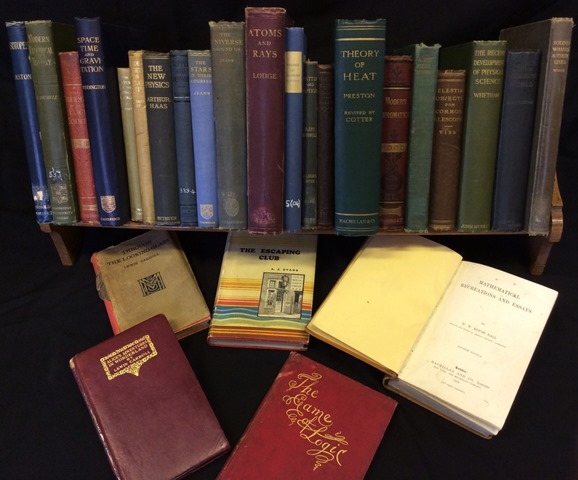
In the Sixth Form at Sherborne School Alan Turing was taught mathematics by Donald Eperson. Donald Eperson was an advocate of the value of ‘Recreational Mathematics’, believing that it allowed children to investigate problems and puzzles on their own, and introduced his pupils to the literary works of Lewis Carroll. Undoubtedly inspired by this inspirational teacher, in November 1930 Alan Turing borrowed three books by Lewis Carroll from Sherborne School library – The Game of Logic, Alice in Wonderland and Through the Looking Glass. This love of puzzles and ciphers fostered at Sherborne School would eventually lead Alan Turing in 1939 to the Government Code and Cypher School at Bletchley Park.
In later life Donald Eperson recalled his time teaching Alan Turing:
‘In one sense he was difficult to teach, as he preferred his own independent methods, and was less interested in learning “book-work” and developing a good style of written work. On the other hand he was an industrious member of the class, who needed no stimulus to exert himself mentally, and could readily appreciate the solution that I showed him to any problem that he could not solve “by the light of nature”, i.e. by discovering alternative methods of his own devising that are sometimes “clumsy and cumbersome” and sometimes brilliant but unsound. All that I can claim is that my deliberate policy of leaving him largely to his own devices and standing by to assist when necessary, allowed his natural mathematical genius to progress uninhibited.’
Alan Turing’s ‘independent methods’ of learning took him to the School library. In 1930, the School library held between 8,000 and 10,000 volumes and the Board of Education report stated that the library played ‘an important part in the intellectual life of the School’. The library loans registers reveal that between October 1928 and May 1931 Alan borrowed thirty-three titles. However, he was evidently not a great reader of fiction with only three of the titles coming from that category, these being Lewis Carroll’s Alice in Wonderland and Through the Looking Glass, and A.J. Evans’s The Escaping Club. The remainder of the titles were for subjects relating to mathematics, chemistry, physics and astronomy, some of which Alan borrowed on several occasions, including Thomas Preston’s The Theory Heat which he borrowed five times between February 1930 and June 1931. Other titles, such as J.H. Jean’s The Universe Around Us and T.W. Webb’s Celestial Objects for Common Telescopes, he took away in December 1929 for the Christmas holidays.

In July 1931, Alan Turing received the equivalent of his A level results and was awarded a Higher School Certificate A in physics and chemistry and a distinction in mathematics. Donald Eperson predicted Alan’s exam success, writing in his end of term report, ‘He has gone on with his reading as well as revising the elementary work for the Higher Certificate, and I expect him to get a Distinction with ease. He has my best wishes for an equally successful career at Cambridge.’
Donald Eperson was author of Patterns in Mathematics (Basil Blackwell, 1988), Reminiscences of Barchester in the Twentieth Century (2000) and Music and Mathematics (The Book Guild Ltd., 2002).
Rachel Hassall
Archivist, Sherborne School.
Find out more about Alan Turing’s time at Sherborne School
For further information about the Sherborne School Archives please contact the School Archivist.
Return to the School Archives homepage.