
Robert Boyle FRS (1627-1691) was a chemist and physicist and is credited with having invented the modern experimental method. He was also a natural philosopher, a founding member of the Royal Society, promoter of the translation of the Bible into native languages, and author of over forty books. He is known for his ideal Gas Law, subsequently termed Boyle’s Law, and also for the Boyle Lectures which were established by the terms of his will.
From 1645 to 1655, Robert Boyle lived at Stalbridge House in Dorset, having inherited the estate from his father. The years Robert spent at Stalbridge, between the ages of 18 and 28, were, according to his biographer Michael Hunter, a formative period in his life when he began writing and conducting scientific experiments.
Born on 25 January 1627 at Lismore Castle in Munster, County Waterford, Ireland, Robert Boyle was the fourteenth child and seventh and youngest son of Richard Boyle, first earl of Cork (1566-1643), lord high treasurer of Ireland, and his second wife Catherine Fenton (c.1599-1630).
Robert attended Eton College from 1635 until 1638 when his father placed him under the Rev. William Douche (c.1582-1648), a graduate of Trinity College, Oxford who from 1621 was rector of Stalbridge. Robert initially boarded with the Rev. Douche ‘to avoid the temptations to idleness, that home might afford… though it was not distant from his father’s house above twice a musket-shot’. Later he moved into Stalbridge House where he was taught by French tutor Isaac Marcombes. During this time Robert would, according to his own biographical notes, ‘very often steal way from all company, and spend four or five hours alone in the fields, and think at random, making his delighted imagination the busy scene, where some romance or other was daily acted.’
From 1639 until 1644, Robert and his brother embarked with Isaac Marcombes on a continental tour, visiting France, Switzerland and Italy. Returning to Stalbridge in 1645, Robert spent the next ten years living at Stalbridge House. It was here that he began studying the two subjects to which he devoted the remainder of his life – biblical scholarship and scientific research based on his own experimentation and observation.

During his time at Stalbridge, Robert Boyle became acquainted with Nathaniel Highmore M.D. (1613-1685), a surgeon and anatomist who in 1651 published a treatise on anatomy, Corporis humani disquisitio anatomica, which he dedicated to William Harvey, physician to King Charles I. This important work was not only the first anatomical textbook to accept William Harvey’s theory of the circulation of the blood, but also contained the first description of the antrum highmorianum (maxillary sinus) and of the corpus highmori (mediastinal testis).
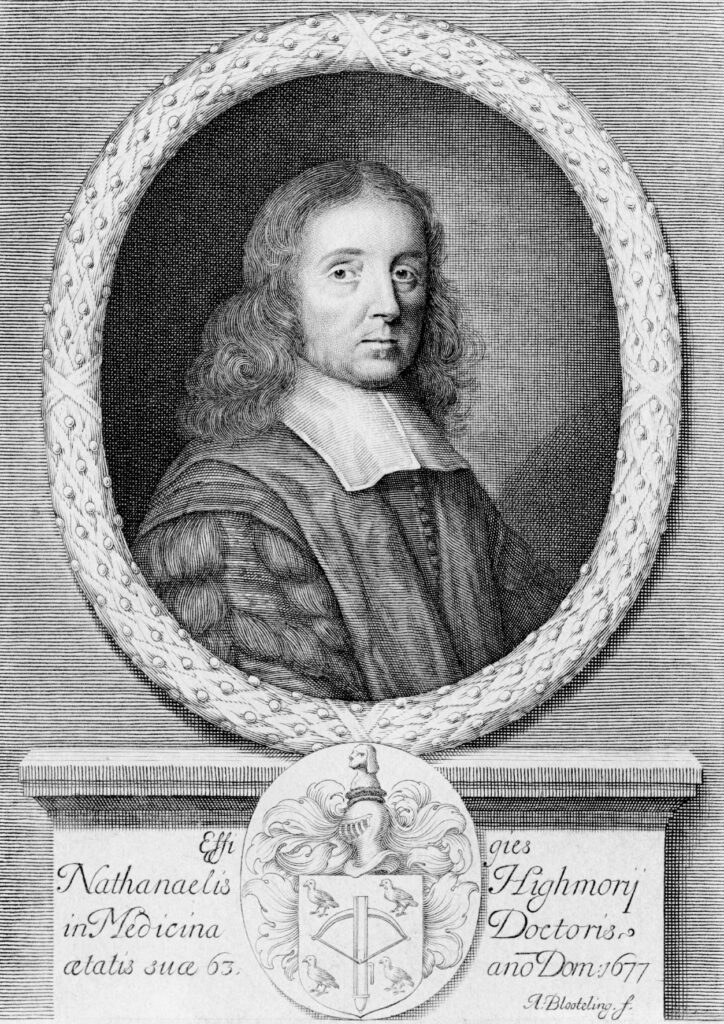
Nathaniel Highmore was educated at Sherborne School (c.1625) and Trinity College, Oxford, from where he graduated BA in 1635 and MA in 1638. On 30 December 1640 he was married at Salisbury to Elizabeth Haydock, daughter of the physician and engraver Dr Richard Haydock (1569/70-c.1642). He returned to Oxford to study medicine and in 1643 received his M.D. under the ‘Caroline Creations’, possibly for attending to the young Prince Charles during a bout of measles at Reading in November 1642. His studies were cut short by the English Civil War and by 1645 he had returned to Sherborne and set up a medical practice which he ran for the next forty years.
In 1651 Nathaniel Highmore published The History of Generation which contained the first reference in English to the use of the microscope and which he dedicated from Sherborne on 15 May 1651 ‘To the honourable Mr Robert Boyle, son to the right honourable the earl of Corke, my much honoured friend.’ Which begins:
‘Noble Sir, Where virtue shall be found in conjunction with nobility in such black, the last and worst times, it no less invites and amazes the eyes and hearers of beholders, than some new star or blazing comet; but with this difference, the one is cause of their fear, the other gives life to their hopes and joy. You have, Sir, so enriched your tender years with such choice principles of the best sort, and even to admiration managed them to the greatest advantage, that you stand both a pattern and wonder to our nobility and gentry…’
Robert Boyle evidently also held Nathaniel Highmore in high esteem, describing him in a letter written to Henry Oldenburg from Oxford on 29 August 1664 as ‘the ingenious Dr Highmore’, and adding that he had received from him ‘some odd anatomical observations, wherewith I may hereafter acquaint you. I shall rather tell you now, that he is a great florist and finds by experience which, I remember, has been likewise taught me by another eminently skilled in husbandry, that there is scarce any mould comparable for flowers to the earth which is digged from under old stacks of wood or other places where rotten wood has long laid.’
Despite his busy medical practice and scientific research, Nathaniel Highmore found time to serve from 1654 as both a governor of Sherborne School and as a brother of Sherborne Almshouse. He was also active in church affairs, a Justice of the Peace, and in 1681 served as treasurer for subscriptions to build a town hall in Half Moon Street.
In 1675 Nathaniel Highmore was appointed warden or chair of the Governors of Sherborne School and was given responsibility for furnishing the new school library [now the School House Oak Room]. According to Hutchins’ History of Dorset (2nd ed., 1815), the library contained many rare and valuable books given to the School by local benefactors including Robert Boyle.
Robert Boyle was deeply interested in religion and sponsored the translation of the Bible into several languages. In 1662 he was appointed governor of the Company for the Propagation of the Gospel in New England, a missionary society which aimed to promote Christianity among the North American Indians, and in 1685 he financially backed the publication of the Bible in Gaelic. Although no list survives of the books Robert Boyle donated to the school library, it is possible that they included two volumes of the New and Old Testament translated into Cherokee (Cambridge, 1661 & 1663), and also William Bedel’s translation of the Old Testament into Gaelic (London, 1685). The two volumes of the Bible in Cherokee were sold by Sherborne School in about 1920, but William Bedel’s translation of the Old Testament into Gaelic, one of only 500 copies printed, remains in the school library.

W.B. Wildman in his Short History of Sherborne from 705 A.D. (Sherborne, 1896) suggests that Robert Boyle may also have donated to Sherborne School library the following books which were formerly part of the library of Boyle’s friend the book collector and politician Arthur Annesley, 1st Earl of Anglesey (1614-1686):
- Christiani Becmani Manuductio ad Latinam Linguam. (Hanover: Clementis Schleichii & vidua Danielis Aubrii, 1629). Inscribed on the title page: ‘Anglesey March 30 1673’.
- Commentarii in C. Val. Catullum, Albium Tibullum et Sex. Aur. Propertium. Ed. Joannes Passeratius. (Paris, 1608). Inscribed on the title page: ‘Anglesey Aug.2.1681. 9-6.’
- Petri Gassendi Animadversiones in decimum librum diogenis laertii, qui est de vita, moribus, placitisque Epicuri. 3 vols. (Leyden: G. Barbier, 1649). Vol.1 is inscribed on the title page: ‘Anglesey May 28 1670. 3 vol. 1st-5th’.
- Homeri gnomologia, duplici parallelismo illustrata : uno ex locis S. Scripturae, quibus gnomae Homericae aut prope affines, aut non prosus absimiles : altero ex gentium scriptoribus … Ed. Jacobus Duportus. (Cambridge, 1660). Inscribed on title page: ‘Anglesey June 1682 2-3.’
- Joannis Meursi Miscellanea Laconica, sive Variarum antiquitatum Laconicarum libri IV. Ed. Samuel Pufendorfii. (Amsterdam, Jodocum Pluymer, 1661). Inscribed on the title page: ‘Anglesey Aug. 2. 1681. 2-8.’
- Gerardi Joannis Vossii Etymologicon Linguae Latinae: praefigitur ejusdem De literarum permutatione tractatus. (Amsterdam: Ludovicum & Danielem Elzevirios, 1662) Inscribed on the title page: ‘Anglesey Aug. 14. 1672. 20.’
In late 1655 or early 1656, Robert Boyle moved to Oxford. On 28 November 1660 he attended the inaugural meeting in London of what became the Royal Society which followed a lecture at Gresham College by Christopher Wren. The suggestion that Nathaniel Highmore should be elected a fellow of the Royal Society was for some reason never fulfilled, and although he contributed articles about medicinal salt springs at Farrington (Dorset) and East Chinnock (Somerset) to the Society’s Philosophical Transactions (vol.4, no.56), he never became a member.
In 1668 Robert Boyle left Oxford and lived for the rest of his life with his sister Katherine Jones, Viscountess Ranelagh, at her house on Pall Mall in London. In 1680 he was offered the presidency of the Royal Society, but declined.

Nathaniel Highmore died at Sherborne on 21 March 1685 and was buried on the south side of the chancel of Purse Caundle church. In his will he endowed from the rents of his properties in Newland in Sherborne £5 p.a. for an exhibition for 76 years for a ‘poor boy’ from Sherborne School to study for six years at Oxford University, and £50 towards the building of a workhouse in Sherborne. He left to the Physic School at Oxford his ‘long table of muscles’ and to the Royal Society twenty-one copper plates engraved with anatomical figures ‘at the charge of Dr Haydocke’ [presumably by his father-in-law Dr Richard Haydock].
Robert Boyle died on 31 December 1691 and was buried on 7 January 1692 in the chancel of St Martin-in-the Fields, Westminster, London. In his will he left his raw and unprepared minerals to the Royal Society and his best microscope and best lodestone to Robert Hooke. In relation to his estates in Stalbridge, he bequeathed to John Nicholls, steward of the courts of the manor of Stalbridge, a piece of plate to the value of £10 as a testimony of ‘my remembrance and affection’; to Nicholas Watts, bailiff of the manor of Stalbridge, a piece of plate to the value of £10; and money to be distributed to the poor of the parishes of Stalbridge and Fermoy. He also left a bequest to establish what became known as the Boyle Lectures, the first of which was delivered in 1692 by Richard Bentley, a protégé of Sir Isaac Newton. A charity school in the village of Yetminster near Sherborne was also endowed under Boyle’s will to teach reading, writing and arithmetic to twenty poor boys. Although Boyle’s School is now closed Boyle’s Educational Foundation still distributes the remaining funds for the benefit of young people in Yetminster, Leigh and Chetnole.
The Historic Library and Rare Book Collection at Sherborne School contains approximately 900 volumes published between the 15th and 20th centuries. The collection includes the first complete edition of The Works of the Honourable Robert Boyle, published in London in 1744, and a number of other books on the subject of natural science and philosophy.
See also
For further information about the Sherborne School Archives please contact the School Archivist
Return to the School Archives homepage