
In October 1851, a battle of wills took place between a retired Shakespearian actor and the headmaster of Sherborne School. Both men were new to Sherborne and both wanted to make their mark. But who would triumph?
The retired Shakespearian actor was 58-year-old William Charles Macready (1793-1873). The son of an actor-manager, Macready was educated at Rugby School and had intended studying for the law, but had to leave school at the age of 15 when his father’ s theatrical management business ran into financial difficulty, and he inevitably took to the stage. As both an actor and theatre manager, Macready achieved great success, improving standards of acting and restoring the respectability of the theatre. He moved in literary and artistic circles and included amongst his friends Charles Dickens[1], Alfred Tennyson, William Thackeray, Thomas Carlyle, and Robert Browning. In 1824, he married his first wife the actress Catherine Francis Atkins (1806-1852), with whom he had ten children.
Following a disastrous tour of the USA, Macready decided it was time to retire and in August 1849 he visited Dorset hoping to find an affordable family house to rent. On 4 August 1849 he travelled from Dorchester to Sherborne on top of a stagecoach and enjoying the countryside, writing afterwards ‘was very much pleased with my ride, particularly with the view of Cerne Abbas and the view of the Vale of Blackmore from the heights, which is really superb.’[2]
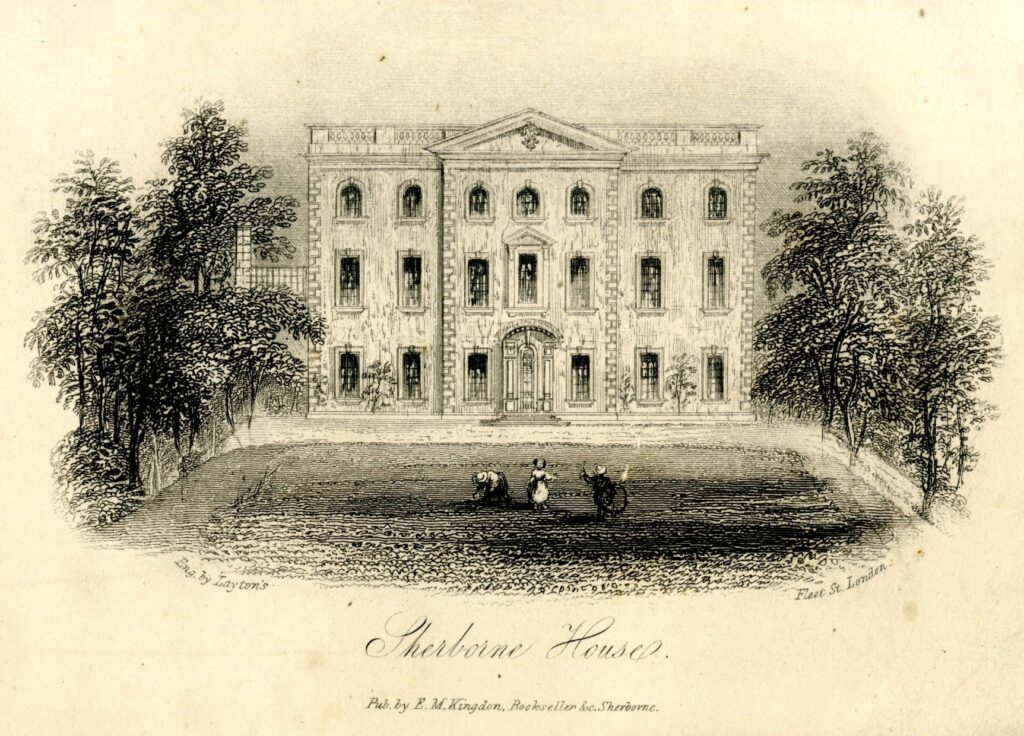
On arriving in Sherborne, Macready booked into the Antelope Inn on Greenhill and then set off to explore the town. In Newland, he came upon an auction taking place at Sherborne House of the ‘household furniture, handsome china, glass and ware, valuable painting and engravings, about 400 vols of books, and other effects’[3] of the banker Samuel Pretor, who was leaving the town.[4]
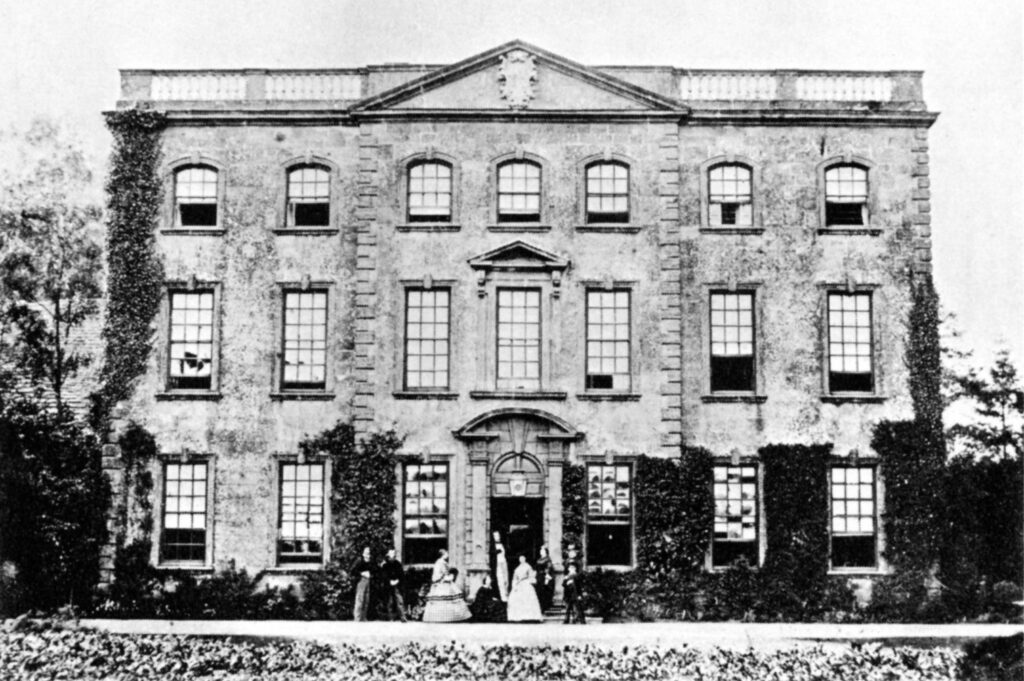
Sherborne House had been built in about 1720 by Henry Seymour Portman MP (c.1637-1728). Described by Pevsner as ‘the town’s best individual house’ with ‘seven-bay ashlar façade of great height and considerable noblesse’[5], the architectural grandeur of Sherborne House, together with Sir James Thornhill’s (1675-1734) staircase mural depicting the Calydonian Boar Hunt from Ovid’s Metamorphoses, must have appealed to Macready’s lifelong desire to be considered a gentleman as well as his sense of theatre.
From 1816 Sherborne House had formed part of the Digby Estate[6] and so on 6 August 1849, despite considering the house ‘old-fashioned in its adaptation to the needs of a family; there is no attempt at commodiousness or contrivance, but I think, at a very cheap rate it might suit us’, Macready called on Lord Digby’s steward William Ffooks (1815-1873)[7] and agreed to rent the property. On giving his name, Macready was delighted when Mr Ffooks asked him whether he was connected with ‘the Macready?’, to which Macready responded that ‘if he chose so to designate me, I was the Macready.’[8]
News soon spread of Macready’s intended move to Sherborne, and on 25 August 1849 the Sherborne Mercury newspaper reported that ‘Mr Macready, the eminent tragedian, has taken Sherborne House (late in the occupation of S. Pretor, Esq.,) for a term; and we understand that if he should approve of it as a residence, he will continue to reside in Sherborne on his retirement from the stage, which will take place at the close of the season.’[9]
The lease for Sherborne House was duly signed on 6 November 1849 between William Charles Macready of Clarence Terrace, Regents Park, Middlesex, gent., and Edward Earl Digby. The property was described in the lease as ‘All that mansion and offices called Sherborne House with the garden surrounding it and the small field opposite thereto situate in Newland in Sherborne, lately in the possession of Samuel Pretor esq.’ The rent of £60 p.a. was payable in four equal payments on Lady Day, Midsummer Day, Michaelmas Day and Christmas Day. Macready was responsible for maintaining ‘the glass of the windows, together with the windows, shutters, doors, locks, fastenings, bells, partitions, ceilings, floors, chimney pieces and all other internal parts of the mansion and premises’, and Edward Earl Digby was responsible for ‘papering and painting, both within and without, when and as often as need shall repair and keep the roof and all external parts of the mansion in good and proper repair.’[10]

Alongside cheap rental prices, Sherborne held another attraction for Macready in the form of Sherborne School. Known locally as the ‘King’s School’ because it had been re-founded in 1550 by King Edward VI, the School’s charter entitled local day boys to free education in ‘Grammatica’ (Latin and Greek). By 1849, Macready had eight surviving children, four of whom were boys (another son was born on 24 March 1850) and, having been educated at Rugby School, he knew the benefits of a good education[11] which he hoped would make gentlemen of his sons and lead them into respectable careers, i.e., not the stage!
The headmaster of Sherborne School in 1849 was the Rev. Charles Thomas Penrose (1816-1868). Like Macready, Penrose was educated at Rugby School and was in fact nephew of Rugby’s famous headmaster Dr Thomas Arnold (1795-1842). It is therefore not surprising that Penrose’s greatest contribution to Sherborne School was the introduction of Rugby-style football.[12] Unfortunately, Penrose was not a well man and in December 1849 he resigned his headmastership due to ill-health.
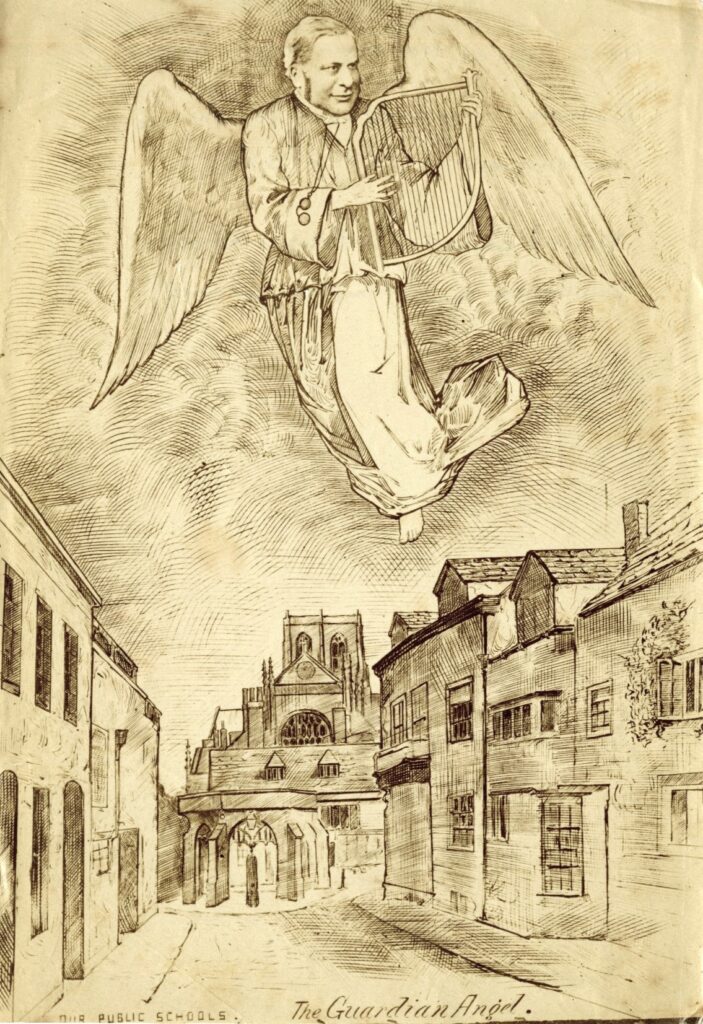
The man who succeeded Penrose as headmaster of Sherborne School was 29-year-old Hugo Daniel Harper (1821-1895). Harper’s credentials were impressive: educated as Founder’s Kin at Christ’s Hospital, he went on to Oxford where he was considered one of the best mathematicians of his generation[13] and was made a Fellow of Jesus College. In 1847 he was appointed headmaster of Cowbridge Grammar School where, in three short years, he transformed the failing school and increasing the roll from 12 to 80 pupils. Possibly encouraged by Glamorganshire landowner Old Shirburnian John Bruce-Pryce (1784-1872), Harper applied for the headmastership of Sherborne School and on 19 March 1850 was elected headmaster.
Even before he was officially sworn in as headmaster, Harper was making plans to transform Sherborne School, discussing with the Governors changes to the School Statutes and suggesting that his salary should be set at £125 p.a. with an additional £5 for each scholar he admitted above the number of twenty-five. He also proposed modernising the curriculum with the addition of mathematics and modern languages, and pointed out the need for better school buildings. Seven years after his appointment, Harper recalled his first impressions of the School: ‘Upon my first acquaintance with the school, it was, I think, in every way behind the age. The buildings you perhaps recollect – very closely packed round a small court; some very old and dilapidated, some belonging to the previous headmaster situated in the “Church Lane,” scarcely fit for boys. There were two schoolrooms, and two masters provided by the Foundation, all others being provided by the headmaster; and all that they were required to teach was Latin and Greek and some little ‘Divinity’: nothing else being taught – not even writing and arithmetic – as a necessary part of school work.’[14]
On 22 May 1850 Macready returned to Sherborne from London, full of doubts about the life he was leaving behind. That evening he wrote in his diary, ‘My spirits were rather low, thinking of the society I was leaving, the varied, brilliant, and powerful minds I should perhaps never meet again after parting from them; the narrow limits within which I must, in prudence, endeavour to keep expenditure… God grant that it may be for the good and happiness of my beloved wife and children, and that our lives may be fruitful of good and sweet in peace here.’[15]
Sadly, Macready’s move to Sherborne did not result in the happy family life he had hoped for. Over the course of the next eight years three of Macready’s children died at Sherborne House and his wife Catherine died at Plymouth[16]. However, during the summer of 1850 the family spent a happy time together at Lyme Regis, making occasional visits to Sherborne in preparation for their move.
When Harper took over the headmastership of Sherborne School in 1850 he immediately set about boosting the numbers on the school roll. On 25 July 1850 an advertisement appeared in the Sherborne Mercury newspaper listing the credentials of the School’s teaching staff which comprised himself (MA, scholar and Fellow of Jesus College, Oxford), the Under-Master the Rev. Thomas James (MA, St John’s College, Cambridge), two assistant masters Maurice Day (BA, Ireland Scholar and Hertford Scholar of the University of Oxford) and John Holdsworth Morgan (formerly Senior Assistant Observer at the Cambridge Observatory), and the French and German master Monsieur Phillipe Villars (Premier Licencie ès Lettres of the University of Paris). The advertisement also announced that ‘necessary arrangements have been made to enable Boys intended for the Army to meet the Examination for Commissions, the Military Academy, &c.’[17]
Along with an influx of local day boys attracted to Sherborne School by Harper’s arrival, he also brought with him about 30 boys from Cowbridge Grammar School, including Cecil Beadon (1838-1913) who went on to serve as Assistant Commissioner of the Punjab, and Lewis Morris (1833-1907) who became a famous poet of the Anglo-Welsh school. By Christmas 1850 Harper was delighted to announce that in just four months he had doubled the school roll from 40 to 84[18]. Two of the new local day boys admitted as Foundationers on the 6 August 1850[19] were Macready’s sons, Edward Neville Bourne Macready (1836-1907), who had previously attended Westminster School[20], and Walter Francis Sheil Macready (1840-1853).
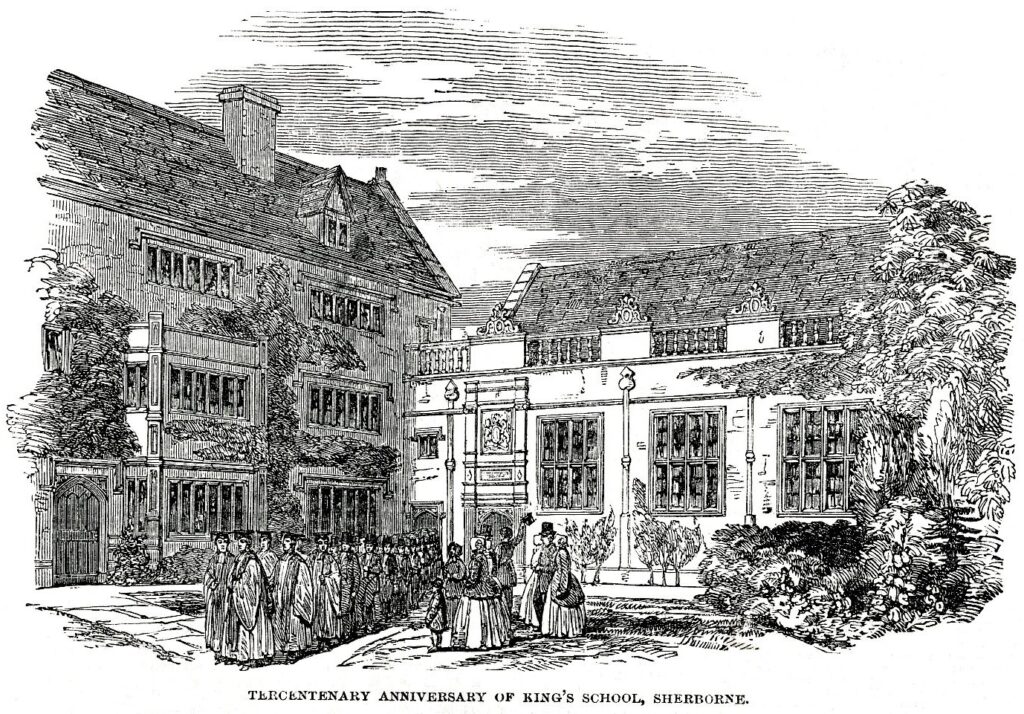
Macready spent his first night at Sherborne House on 4 September 1850. Meanwhile, Harper was intent on relaunching the School and on 23 October 1850 he staged a grand event to celebrate the 300th anniversary of the School’s re-foundation. An account of this occasion appeared in the Illustrated London News on 2 November 1850 which described the guests, who were of the ‘highest respectability’, assembling in the School Room [now the Old School Room], and a procession headed by the beadles, followed by the Governors, the boys and masters, and two or three hundred ladies and gentlemen, proceeding to Sherborne Abbey for a service during which a sermon was preached by former headmaster Dr Ralph Lyon. The guests then returned to the School Room where Harper delivered a commemorative address in which he told ‘at considerable length, the rise and progress of the School, from its foundation to the present time, and claiming a great number of celebrated men, as well in the world at large as in the universities, as having been educated at the School.’[21] Afterwards, a champagne luncheon was served in the Town Hall in Half Moon Street, followed in the evening by a dinner in the King’s Arms.
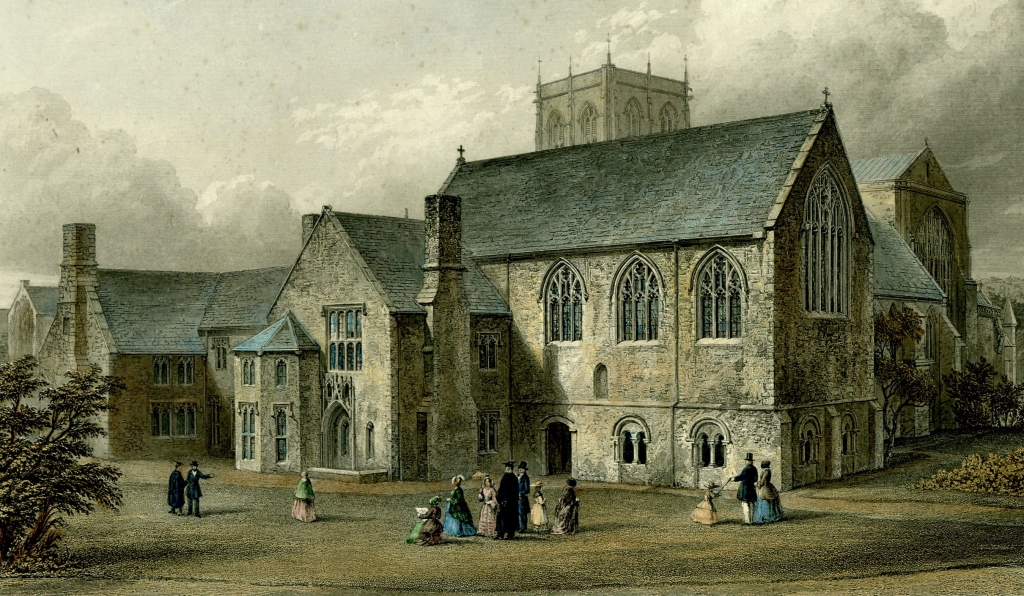
The day after the celebrations, Edward Earl Digby conveyed to the School Governors the former monastic buildings on the northside of Sherborne Abbey.[22] The deed stated that they were ‘for the purpose of extending and advancing the benefit of the said Foundation & increasing & improving the facilities for the Education, Teaching & Instruction of the said Boys and young Men’. Harper’s vision of transforming Sherborne School into one of the great public schools was beginning to take shape.
On 19 December 1850, Harper was married at All Saints’ church in Knightsbridge to Mary Charlotte Harness (1829-1908), daughter of Capt. Henry Drury Harness (1804-1883), Deputy Master of the Royal Mint.[23] The ceremony was conducted by Mary’s uncle, the Rev. William Harness (1790-1869). While the Harpers honeymooned in Devon, Macready spent Christmas 1850 with his family at Sherborne House, before leaving to undertake his farewell tour of the provinces and London. Macready was therefore away from Sherborne on 20 February 1851 when Harper sent a letter to all parents asking for subscriptions towards the cost of converting the former monastic buildings given to the School by Edward Earl Digby. Harper had used a subscription appeal to raise funds for the restoration of college buildings at Jesus College, Oxford,[24] and hoped the same approach would work at Sherborne.
Macready gave his farewell performance of Macbeth at Drury Lane on 26 February 1851[25] and on 1 March 1851 attended a farewell banquet at the Hall of Commerce arranged in his honour by his friend Charles Dickens.[26] He soon began to worry about how he would manage financially after retirement and, on doing his accounts on 21 March 1851, reckoned that his income that year had amounted to £1,285 and, with £882 in expenses, he would be left with £403 to pay for his eldest son William’s college fees and other sundries.[27]
Macready returned to Sherborne on 22 May 1851 and 17 days later replied to Harper’s request for subscriptions towards the cost of converting the former monastic buildings.[28] In his letter Macready intimated that Harper’s request for money, so soon after his appointment as headmaster, was not only bad mannered but also suggested something of the ‘indecent haste’ of the marriage of Hamlet’s mother, writing that had Harper waited a couple of years before requesting subscriptions he ‘would have met with a response far more general and cordial’. Nevertheless, Macready wished Harper well with his ‘efforts for the advancement of the interest of the school’ and, despite his own financial concerns, subscribed £15 towards the fund. As a result of his appeal Harper raised about £700 towards the cost of converting the former monastic buildings which today house the School library, the chapel and the Headmaster’s office.
On 21 April 1851, Macready and his eldest son Willie attended a soirée at Sherborne’s Literary and Scientific Institution, after which Macready wrote in his diary that he had been ‘Amused with the proceedings, and shall take an interest in the society.’[29] By 25 September 1851, Macready had accepted the position of president of the Institution, feeling that it was his ‘duty to do my best in such a cause’, and agreed to give a lecture on the poetry of the poor.[30] Alongside their new president, the vice-presidents of the Institution were John Willmott, Mr Falwasser, Dr Williams, and headmaster Hugo Daniel Harper.
As Foundationers (or day boys) at Sherborne School, Edward and Walter Macready were entitled to a free education of Latin and Greek (a fee was payable for additional subjects such as mathematics and French) and free schoolbooks which, if taken care of, pupils could take with them when they left the School. The other class of boy at the School were boarders, known as Tablers, who paid for their education and accommodation.

In September 1851 it was brought to Harper’s attention that the schoolbooks of two Foundationers had been purposefully damaged.[31] The books belonged to William Scott (1840-1906), son of Alexander Scott a grocer in Cheap Street, and Charles Edward Hammond (1837-1914), son of Major T.J. Hammond of Abbey Grange in Hospital Lane [now the Headmaster’s residence]. Harper decided to tackle the issue before it escalated, but with no boy owning up to the crime he punished the entire school ‘in the hope of creating sufficient sensation on the subject to prevent the recurrence of the evil.’ Every boy was given an imposition of additional schoolwork and a fine of one penny to cover the cost of replacing the damaged books, but he exempted the sixth form from the charge on account that ‘I trust their own sense and their position in the school make it quite impossible that they should be concerned in the matter.’ [32]
Edward and Walter Macready had by September 1851 attended Sherborne School for a year and were both doing well. As part of his attempt to raise the academic profile of the School Harper had instituted an annual midsummer examination by examiners from Oxford University[33]. The first of these examinations took place in June 1851[34] when 11-year old Walter Macready came top of Form V in French and his 15-year old brother Edward came joint second of the Upper Remove in Classics and was promoted to the sixth form.[35]
Edward Macready’s promotion to the sixth form meant he was exempt from paying Harper’s fine for the damaged books, but Walter Macready was expected to pay. However, when Harper collected the boys’ pennies on 1 October 1851 Walter told him that his father would not allow him to pay his penny. Harper was flabbergasted that his authority had been challenged and wrote to Macready for confirmation that he had told Walter not to pay the fine.[36]
And so began an acrimonious exchange of letters between Macready and Harper that lasted until 3 December 1851 and saw Macready withdraw both Walter and Edward from the School.[37] The dispute is best told in Macready and Harper’s own words, as revealed in the following letters and extracts from the Governor’s minutes held in the School Archives, which tell the story of a clash between two highly principled men, neither of whom was prepared to back down[38]:
Letter from H.D. Harper to W.C. Macready, 1 October 1851[39]
King’s School, Oct. 1st 1851.
Dear Sir,
A book was placed in my hands on Monday evening by one of the Masters which had been so ill-used, in having had a large number of leaves torn out, that it was necessary some notice should be taken of it – the more so as a somewhat similar circumstance had come before me very recently. As I was unable to find out who was the guilty one of the boys my only alternative was to punish all in the hope of creating sufficient sensation on the subject to prevent the recurrence of the evil, and in a similar way I endeavoured to divide the cost of a new book over the whole school, by levying a tax of one penny each boy over the whole school. On receiving their pence this morning your younger son told me that you would not allow him to pay his penny, and also told me that you had desired him to say so to me. As it seemed almost impossible to believe such to be the case, I asked him again definitely whether he was quite sure that he was directed to give me the message, when he again answered me in the affirmative – but still I cannot believe it, as even if the tax were considered an unfair one (which of course I do not) I cannot conceive that it would be refused, and upon what grounds it would be so. I therefore take the liberty of enquiring if you really wished your son to give the message as from yourself, or whether it is only a mistake of his, & I remain, Dear Sir, Yours very truly,
Hugo D. Harper.
Letter from W.C. Macready to H.D. Harper, 1 October 1851[40]
Sherborne House. Oct. 1. [1851].
Dear Sir,
In reply to your enquiry, I beg to inform you, that my son was authorised to say, that I would not permit him to pay the exaction demanded of him.
Your enquiry and remarks on the affair compel me to observe that, with the most scrupulous regard to school discipline, I hold it my particular duty to direct the opinions of my children on the questions of right and wrong; and I cannot but view the measures taken in this and a recent similar offence as irreconcilable with justice, and as calculated to instil erroneous principles in the boys. The maxim that it is better twenty guilty should escape rather than one innocent person should suffer, has been directly reversed.
My son was innocent of any knowledge of the act; nor, as I have understood, was it probable, if possible, that any Town boy could have been concerned in it. Still in the spirit of obedience my son went to school on Thursday when, if rules are to be observed, he had no right to do so, and gave up his afternoon yesterday to write out a long punishment undeservedly imposed.
His pocket money does not come within any school regulations, and as I consider the punishment partially inflicted and unreasonably imposed, and as the manner of it, tempting boys to the betrayal of their school-fellows, is in direct opposition to my sentiments, I cannot sanction his subscription to what I considerately disapprove, which the right of choice rests with himself.
I remain, Dear Sir, Yours very faithfully,
W.C. Macready.
Letter from H.D. Harper to W.C. Macready, 1 October 1851[41]
King’s School, Oct 1st 1851.
Sir, You probably cannot be aware that the whole of the school discipline is place in my hands, and that the half-holidays are not, as you seem to think, an inalienable right of the boys.
I regret extremely that your letter appears to me so direct an intrusion upon the execution of my office, and your remarks of such a nature that I must decline any farther correspondence on the subject, & request that any future communications may be made through the Warden and Governors of the School.
I am, Sir, Your very obedient servant,
Hugo D. Harper.
Letter from W.C. Macready to H.D. Harper, 1 October 1851[42]
Sherborne House, Oct 1 [1851].
Sir, I have the pleasure of acknowledging your letter, and as I did not seek this correspondence can have no objection to close it.
I remain, Sir, Your very obedient servant,
W.C. Macready.
Letter from H.D. Harper to the Warden and Governors, 4 October 1851[43]
King’s School, Oct. 4th 1851.
My Dear Mr Warden,
I am compelled to appeal to yourself and the Governors to support me in the execution of my office under the following circumstances.
On Wednesday Sept. 24th a book belonging to one of the King’s Scholars (Scott) came under my notice, from which several leaves had been torn, and upon enquiry I was totally unable to discover the offender. I accordingly desired all the boys to attend at School at 3 o’clock on the following Thursday afternoon, just as if it were a “whole school day.” Each boy was then called up, and questioned on the subject, and upon assertion of innocence was allowed to depart, as I hoped I had taken sufficient notice of the offence to prevent its recurrence. It appeared probable that the book had been torn between 1 & 8 o’clock on the day that I discovered it.
On Wednesday evening, however, another book was placed in my hands by one of the masters, which had been treated in a still worse manner and again upon strict enquiry I was unable to discover the guilty boy, I used every possible endeavour and repeated my enquiry several times, and as the previous occasion had seemed to create so very little impression, I determined to inflict some punishment upon all the boys of course with the object of preventing the recurrence of the evil. I therefore gave all the boys an imposition (in all cases work suited to their position, and calculable to advance their improvement) and levied a tax of one penny upon each boy to replace the book which again belonged to a King’s Scholar (Hammond ma.) and which he had missed for some days. The sixth form were alone excepted, as I trust their own sense & their position in the school make it quite impossible that they should be concerned in the matter.
On receiving the pence from various boys on the following morning, Macready minor (Walter Macready) did not pay his penny, and three times over told me that his father had told him to say that he (Mr Macready) would not allow him to do so. As I could not believe this, (the more so as I believed Mr Macready & myself were on friendly terms) I wrote as courteous a note as I could to Mr Macready explaining the circumstance fully, and enquiring whether he really had sent the message, which I could not believe possible. To this note I received the following reply with the words dashed in the way that I copy them [cites letter from Macready to Harper dated 1 October 1851].
To this letter I replied as follows [cites letter from Harper to Macready dated 1 October 1851].
In reply to this he again wrote [cites final letter from Macready to Harper dated 1 October 1851].
As I strongly feel that this is a matter in which I am bound to appeal to the Governors as one provided for in the School Statutes, I have simply directed that the penny, if offered, is not to be received until the matter is laid before the house.
- I beg therefore to submit to the Governors, whether Macready minor has been guilty of insubordination or not.
- Whether or not Mr Macready, the father of the said boy, has or has not counselled his son in his insubordination, and has or has not assumed a power totally incompatible with the proper discipline of the School, and whether he has or has not written a letter to the Head-Master, interfering with the due execution of his office, and charging him with (1) “Exaction,” (2) “measures irreconcilable with justice, & calculated to instil erroneous principles in the boys”. (3) with violating the rules of the school in summoning boys to school on a half-holiday. (4) with “undeservedly imposing punishments. (5) with “partially inflicting and unreasonably imposing punishments – the whole of which accusations the Head-Master positively affirms to be false.
And I also beg to submit that in Statute XI (in Statute Book Printed in 1827) it is ordered “That every Scholar so introduced by the Warden who will not conform to the orders and discipline of the school shall be expelled by the Governors unless his friends will undertake for his obedience to the Master and his good behaviour in all things.”
And I claim, that the Governors shall enquire into the various charges alleged against me by Mr Macready, and that if they find them to be false, as I confidently affirm they will, they shall not only take such steps as they may see right, to support and maintain the authority of the Head-Master, but also adopt measures to vindicate me personally, & prevent the exposure of the Head-master to such insulting and groundless attacks as that of which I complain, and under which I claim your protection.
I am, my dear Mr Warden, Very faithfully yours,
Hugo D. Harper.
Letter from W.C. Macready to the Warden and Governors, 9 October 1851[44]
Sherborne House, October 9. 1851.
Gentlemen,
It is to me a subject of serious concern that your time should have been unprofitably occupied and your more important deliberations suspended through any fault of mine.
Having compelled my son to render strict obedience to punishments, alike severe as unjust, I refused to subscribe to the principle attempted to be laid down, that the Head Master of your School is empowered to “levy a tax” upon the boys.
Had I been aware of the forms prescribed in your Statutes, I should in conformity with them have paid, under protest, the trifle demanded of my son, and have submitted the case to you.
In my ignorance of this rule I adopted the only course that seemed left to me; and in this I have transgressed the letter of your regulations.
With a full knowledge of the Statutes Mr Harper has fallen into the same error, in not directly referring the resistance of his orders to you. Instead of such a course he addressed a letter to me, asking for an immediate answer, which appeared to me (expressive as it was of disbelief of what he had ascertained to be “officially” correct) to challenge the motives of my conduct. I returned him my view of the proceedings, as I still, on re-consideration, regard it. Mr Harper then, in a manner which I conceive can only be construed as intended to insult, broke off the correspondence he had originated, and without my assent or knowledge placed my letter in your hands.
I enclose you a copy of his letter; and with the desire of relieving you from any further discussion on my account, beg to withdraw my son, Walter Macready, from the King’s School.
[crossed out: ‘Sensibly appreciating the attention and courtesy I have experienced at your hands, with one single exception’]
I have the honour to be Gentlemen, Your very obedient humble servant,
W.C. Macready
Letter from H.D. Harper to the Warden, 10 October 1851[45]
King’s School, Oct. 10th [1851].
My dear Sir,
I have to inform you that Macready mi. has been absent from School since first lesson yesterday morning. His brother who happens to be the prefect of the week informs me that all he knows about him is that his father (Mr Macready) had told him that he is not coming to school, and adds that he believes he has communicated with you. It is nevertheless my duty, under the circumstances to report his absence.
I beg to add that even if Mr Macready has adopted the course of removing his son as a mode of deciding the question before the Governors, I trust that some resolution will nevertheless be adopted by the house on the subject of the official letter which I laid before it, as it is evident I must be totally unfit for the office in which you have placed me, unless I can be acquitted of the various charges contained in it. But as I said before, I leave the matter unreservedly in your hands although I cannot help expressing my own anxiety concerning it.
I am, My dear Sir, Very sincerely yours,
Hugo D. Harper.
Sherborne School Governors’ meeting minutes, 10 October 1851[46]
At a meeting of the Governors this day present The Revd. J. Parsons, Mr Allford, Mr Highmore, Mr Ridout, Mr Fussell, Mr W. Ffooks, Mr Turner, Mr Melmoth, Mr T. Ffooks, Dr Highmore.
After a long consultation the following Resolution was agreed to:
The Warden on the 7th instant laid before the Governors a statement and several letters which he had received from the Rev. H.D. Harper Head Master of the School. When the same had been read and considered, it was thought right to request the attendance of Mr Macready against whom (as will appear from the correspondence) Mr Harper complains. It very soon appeared at the interview with Mr Macready that he was not at all disposed to view his interference with Mr Harpers discipline in the light which the Governors wished him to see it: he preferred his own view of the matter, & said he would withdraw his son from the school, but upon further conversation finding that the latter part of the 11th & the whole of the 12th Statutes were directly in point, he said that had he been aware of it, he would have adopted a different course. The Governors afterwards saw Mr Harper who said that after the steps he had taken he left himself entirely in the hands of the Governors. The Governors having assembled rather late on the 7th adjourned their meeting to this evening when the Warden laid before the meeting a letter from Mr Macready withdrawing his younger son from the school so far the Governors feel that Mr Harper’s authority has been maintained & vindicated. It would have been far more pleasant to them had Mr Macready expressed regret for his letter & withdrawn it, (for beyond all question, it is unjustifiable & declared by the Governors to be so) but they feel at a bounden duty to assent now as they have in person & by letter asserted before to Mr Harper, that to him is committed the entire rule and discipline of the Scholars, classical moral & religious. To him they look for sound discretion, unceasing care, & the strictest impartiality. They thank him for his present communication and they hope never to have reason to withhold their support to his authority.
Letter from W.C. Macready to the Warden and Governors, 2 December 1851[47]
Sherborne House, Dec. 2nd 1851.
Mr Macready presents his compliments to the Warden and Governors of the King’s School and begs to inform them that he withdraws his son Edward Macready from the Establishment.
Letter from H.D. Harper to the Warden, 3 December 1851[48]
King’s School, Sherborne, Dec. 3rd [1851].
My dear Mr Warden,
Will you kindly inform me whether you have received any communication from Mr Macready. His son is absent from School, and I am informed has been withdrawn prior to immediate entrance into an Attorney’s Office – this is of course, only report.
I am, My dear Sir, Yours very faithfully,
Hugo D. Harper.

Quite what Harper and Macready’s relationship was like after their spat we don’t know, but living in a small town it would have been impossible for them to avoid one another. While Sherborne School under Harper continued from strength to strength, Macready focused his attention on the education of poor working boys who were not able to attend day schools, setting up an evening school where he taught many of the classes himself. He also continued his involvement with the Sherborne Literary Institution, arranging for its move in June 1854 to larger premises in the former stable block next to Sherborne House (now the home of Macintosh Antiques). Although Macready’s association with the Institution ended in March 1860 when he left Sherborne, the famous actor and the Institution had by then become synonymous and for many years afterwards it was known locally as the Macready Institute.
One possible reason for Macready’s extreme reaction to what he perceived as Harper’s insulting and unfair treatment of him and his family may have been a previous run in he had had with the Shakespearian scholar the Rev. William Harness (1790-1869), who was the uncle of Harper’s wife. In June 1835 an anonymous letter insulting Macready was published in Blackwood’s Magazine, which Macready believed had been written by the Rev. Harness.[49] Macready harboured a grudge against the Rev. Harness until 3 January 1839 when he confronted him about the letter, telling him that it had nearly ruined him as it had halved his income and he had been on the verge of giving up acting, and was only deterred from doing so by the birth of his children.[50] Although Macready and the Rev. Harness appear to have buried their differences, with the Rev. Harness even acting as a steward at Macready’s farewell banquet at the Hall of Commerce on 1 March 1851,[51] it is possible that this was consciously or subconsciously always at the back of Macready’s mind when dealing with Harper.
As for Walter and Edward Macready, just 16 months after leaving Sherborne School Walter died at Sherborne House from pulmonary tuberculosis, aged just 12.[52] Edward Macready, who J.C. Trewin described as ‘the disappointment of the Macready sons,’[53] entered Addiscombe College as a Gentleman Cadet and served briefly in Pakistan with the East India Company, narrowly avoiding a court martial before emigrating to Australia where, in spite of his father’s best efforts, he took to the stage![54]
However, as 1851 drew to a close, Macready sat in Sherborne House on 31 December 1851 preparing to write his diary and reflected on the year that had seen him in a battle of wills with the headmaster of Sherborne School:
‘It is very late as I begin to enter my parting words to the eventful year on this its record of my thoughts, feelings, and sufferings. Continued my work, too late begun, upon my account books. Heard Walter part of his lesson. Read in English History with Willie, and afterwards, in French, Thierry’s ‘Conquete d’Angleterre,’ with Willie and Katie. Took a warm bath. Received gardener’s character. Sat with Catherine, who, thank God, seems better. Not quite well after dinner. Rested in her room. Read French and geography with my adult class. Heard Walter his lessons. Looked at the paper. Continued my books and partially arranged my accounts. It is very late. Adieu to 1851, one of the most eventful years in my eventful life. For all, thank God, thank God, thank God. Amen.’[55]
Rachel Hassall
Sherborne School Archives
6 September 2024
Footnotes:
[1] The diaries of Charles Morgan (1796-1857), who lived from 1850 to 1857 at Greystones in Newland, Sherborne, include references to visits made by Charles Dickens to Macready at Sherborne House on two occasions: on 23-25 October 1853, and on 21 December 1854 when he gave a reading, at Macready’s invitation, to Sherborne’s Literary and Scientific Institution. A full transcript of Charles Morgan’s diaries are available on the South Wales Record Society website at www.southwalesrecordsociety.co.uk/33/Diaries.htm Dickens also visited Macready at Sherborne House in June 1851 A103 | CollectionsOnline (dickensmuseum.com)
[2] POLLOCK, F. (ed.), Macready’s Reminiscences, and Selections from his Diaries and Letters in Two Volumes, Volume II (London, Macmillan & Co., 1875), p.336.
[3] Western Flying Post, Sherborne and Yeovil Mercury, 21 July 1849.
[4] HILL, S.M., Sherborne House and Its People (1996), p.37.
[5] HILL, M, NEWMAN, J. PEVSNER, N., The Buildings of England: Dorset (New Haven & London, Yale University Press, 2018) p.546
[6] HILL, S.M., Sherborne House and Its People (1996), p.34.
[7] PICKERING PICK, B. The Sherborne Register 1550-1950 (Winchester, Warren & Son Ltd., 4th ed., 1950), p.32.
[8] POLLOCK, p.337.
[9] Sherborne Mercury, 25 August 1849.
[10] DHC ref. D.SHC/KG/1579 – Counterpart lease of Sherborne House, 6 November 1849.
[11] FOULKES, R., ‘Macready, William Charles (1793-1873), actor and theatre manager’, Oxford Dictionary of National Biography (online). Accessed 15 March 2016.
[12] GOURLAY, A.B. A History of Sherborne School (Sherborne, 1971), p.111.
[13] GOURLAY, p.114.
[14] LESTER, L.V., A Memoir of Hugo Daniel Harper, D.D. (London, Longmans, Green, & Co., 1896), p.22.
[15] POLLOCK, p.353.
[16] Walter Francis Shiel Macready (1840-1853) died at Sherborne House on 8 February 1853, aged 12. Henry Frederic Bulwer Macready (1838-1857) died at Sherborne House on 22 August 1857, aged 18. Lydia Jane (Lily) Macready (1842-1858) died at Sherborne House on 20 June 1858, aged 15. Catherine Francis Macready (née Atkins) (1806-1852) died on 18 September 1852 at 8 Windsor Terrace, Plymouth, just two years after the birth of her youngest child. They were all buried in the family vault at Kensal Green Cemetery.
[17] Sherborne Mercury, 13 August 1850.
[18] LESTER, p.23.
[19] DHC ref. S.235: A2/1/2 – Sherborne School Governors meeting minutes, 6 August 1850.
[20] Edward Macready was admitted to Westminster School on 22 September 1848 (Grant’s House). Information supplied by Elizabeth Wells, Westminster School Archivist, 7 September 2020.
[21] ‘Tercentenary Anniversary of the Foundation of the King’s School, Sherborne’, The Illustrated London News, 2 November 1850.
[22] Sherborne School Archives – Draft Covenant between the Governors of the King’s School and Edward Earl Digby, 24 October 1851.
[23] ROBERTS, May Harper, Sherborne, Oxford and Cambridge: Recollections of Mrs Ernest Stewart Roberts (London, Martin Hopkinson Ltd., 1934), p.21.
[24] LESTER, p.5.
[25] POLLOCK, p.368. Macready wrote in his diary, ‘Acted Macbeth as I never, never before acted it; with a reality, a vigour, a truth, a dignity that I never before threw into my delineation of this favourite character.’
[26] POLLOCK, p.372.
[27] POLLOCK, p.394.
[28] LESTER, p.30.
[29] POLLOCK, p.394.
[30] POLLOCK, p.398.
[31] DHC ref. S.235: H.37 – letter from H.D. Harper to the Warden and Governors, 4 October 1851.
[32] DHC ref. S.235: H.37 – letter from H.D. Harper to the Warden and Governors, 4 October 1851.
[33] GOURLAY, p.120.
[34] Sherborne School Archives – Examiners’ report of Henry Pritchard and G.W. Kitchin of the Midsummer Examination of King’s School, Sherborne, 16 June 1851.
[35] Sherborne School Archives – King’s School, Sherborne, Midsummer Examination, 1851 results.
[36] DHC ref. S.235: H.34 – letter from W.C. Macready to H.D. Harper, with copy of Mr Harper’s letter, both dated 1 October 1851.
[37] Macready withdrew Walter from the School on 9 October 1851 and Edward on 2 December 1851.
[38] POLLOCK, p. 398. Sir Frederick Pollock tried to explain why Macready reacted as he did to Harper’s stance, saying ‘The difficulties of divided authority, which must always to some extent exist when schoolboys live at home in their parents’ house in the same town with their school, were felt probably in their highest degree in Macready’s family. He had strong opinions on matters of conduct, discipline, and education, and had been all his life accustomed to see his own view enforced’.
[39] DHC ref. S.235: H.34 – letter from H.D. Harper to W.C. Macready, 1 October 1851.
[40] DHC ref. S.235: H.35 – letter from W.C. Macready to H.D. Harper, 1 October 1851.
[41] DHC ref. S.235: H.35 – letter from H.D. Harper to W.C. Macready, 1 October 1851.
[42] DHC ref. S.235: A2/2/2 – letter from W.C. Macready to H.D. Harper, 1 October 1851.
[43] DHC ref. S.235: H.37 – letter from H.D. Harper to the Warden and Governors, 4 October 1851.
[44] DHC ref. S.235: H.39 – letter from W.C. Macready to the Warden and Governors, 9 October 1851.
[45] DHC ref. S.235: H.43 – letter from H.D. Harper to the Warden, 10 October 1851.
[46] DHC ref. S.235: A2/2/2 – School Governors meeting minutes, 10 October 1851.
[47] DHC ref. S.235: H.44 – letter from W.C. Macready to the Warden and Governors, 2 December 1851.
[48] DHC ref. 235: H.45 – letter from H.D. Harper to the Warden, 3 December 1851.
[49] TOYNBEE, W.B. (ed.), The Diaries of William Charles Macready 1833-1851 (London: Chapman & Hall Ltd., 1912), Vol.1, p.238. Toynbee adds in a footnote that Macready, who had had a difference with Miss Mitford relative to a play of hers, suspected the Rev. William Harness of having attacked him in her interests by means of an anonymous letter in Blackwood’s Magazine.
[50] TONYBEE, Vol.1, pp.487-8.
[51] POLLOCK, p.372.
[52] Walter Francis Sheil Macready (1840-1853) died on 8 February 1853 at Sherborne House, aged 12. Cause of death: Phthisis, Tubercular, Meningitis. He was buried on 15 February 1853 in the family vault at Catacomb Be in Kensal Green Cemetery.
[53] TREWIN, J.C. (ed.), The Journal of William Charles Macready 1832-1851 (London, Longmans, Green & Co., 1967), p.303.
[54] Edward Neville Bourne Macready (1836-1907) made his professional stage debut at the Theatre Royal, Ballarat on 10 October 1859, as Claude Melnotte in The Lady of Lyons. A reviewer stated that ‘though he bore the name he did not bear the mantle of the elder Macready.’ Edward Macready died on 24 December 1907 at Byrneside, Tatura, Victoria, and was buried at Tatura Cemetery. Described as a retired painter, his obituary in The Tatura Press Free & Rodney & Deakin Shire Advocate on 3 January 1908 stated, ‘He claimed relationship to the famous McCready and was himself a gifted elocutionist.’
[55] POLLOCK, p.398.
See also:
For further information please contact the School Archivist
Return to the School Archives homepage