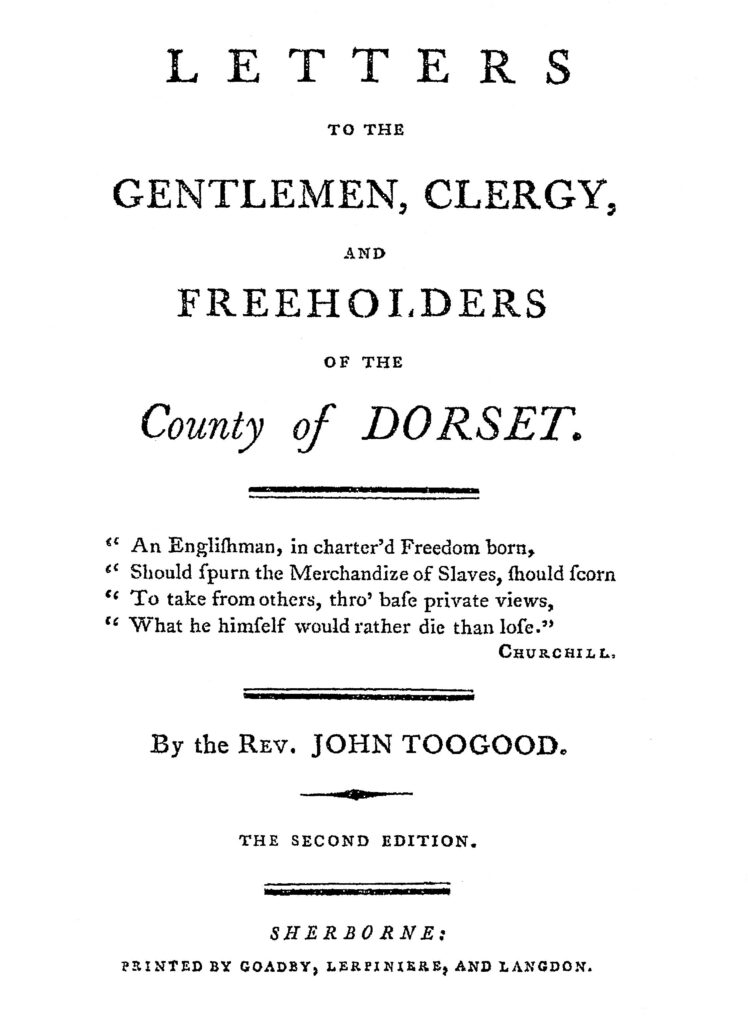
‘ An Englishman, in charter’d Freedom born,
Should spurn the Merchandize of Slaves, should scorn
To take from others, thro’ base private views,
What he himself would rather die than lose.’
These lines from Charles Churchill’s poem Gotham (1764) are quoted on the title page of Letters to the Gentlemen, Clergy, and Freeholders of the County of Dorset on the African Slave Trade, an anti-slavery pamphlet written by the Rev. John Toogood, rector of Kington Magna, Dorset, and first published in c.1800.
The founding in 1787 of the Society for the Abolition of the Slave Trade had provided a focus for the British anti-slavery movement. The Society developed a network of supporters around the country who distributed anti-slavery pamphlets, such as the one written by the Rev. Toogood, and organised petitions to Parliament. Their 1792 petition campaign resulted in 519 petitions presented to Parliament, the largest number ever submitted on a single subject. One of these petitions, presented to the House of Commons on 12 March 1792, was from the vicar and inhabitants of Sherborne in Dorset.
A meeting had been held at Sherborne on 29 February 1792 ‘for the purpose of petitioning Parliament for the Abolition of that disgraceful commerce, the African Slave Trade‘. The resultant petition stated that the traffic in slaves had now arrived at ‘a dreadful pre-eminence of wickedness.’

The following month, on 22 March 1792, the Rev. John Toogood organised a meeting of the clergy of Dorset at the King’s Arms in Dorchester, the purpose being to discuss and hopefully sign a petition for the abolition of the slave trade. The result of the meeting was that the following petition to Parliament was agreed to by 111 clergymen of Dorset, with only one opposing:
‘To the Honourable the House of Commons, in Parliament assembled. The Petition of the Clergy of the County of Dorset.
We, your petitioners, are fully convinced that the Slave Trade, considered in a moral, and more especially in a religious point of view, is a traffic most pernicious in its consequences, and disgraceful to that country in which it is tolerated. We are also persuaded that no degree of expediency, no temporary advantages, can warrant a breach of the lamentable laws of morality and justice; and that the practice of other countries in permitting the Slave Trade cannot in any degree justify the continuance of it in this. We consider it as the indispensable duty of all ministers of that religion, which proclaims “Peace on earth, good will towards men,” to promote, as far as in them lies, that universal charity, which is therein proposed as an invariable rule of conduct to mankind. Strongly impressed with these sentiments, as citizens anxious for the honour of their country, as men feeling for the miseries of their fellow creatures, and above all, as ministers of the Gospel, zealous in behalf of their religion, and sincerely wishing to diffuse as widely as possible the inestimable benefits derived from it, we think it incumbent upon us to express our earnest hopes that such measures will be adopted by the wisdom and justice of the legislature as may ultimately tend to put a final period to that trade, the cruelty and injustice of which every enlightened man cannot but acknowledge, and every good man cannot but abhor.’
The one clergyman to oppose the petition was the Rev. William England (1757-1836), curate and later rector of West Stafford, and Archdeacon of Dorset 1815-1835. The Rev. England was married to Mary Estridge (d.1782), the daughter and co-heir of John Estridge (1732-1778) of Brislington, Somerset, who owned slave plantations on St Kitts in the West Indies. In his Letters to the Gentlemen, Clergy, and Freeholders of the County of Dorset on the African Slave Trade (first published c.1800), the Rev. Toogood included the text of a speech he made on 22 March 1792 in response to the Rev. England’s arguments against the abolition of slavery. The Rev. Toogood’s speech reveals his skills as an orator and his passion as an abolitionist:
‘A considerable number of Clergy of the county of Dorset met, in the year 1792 [22 March 1792], at Dorchester, to consider of a petition to Parliament for the Abolition of the Slave Trade. The measure was opposed, in a long harangue, by the Rev. Mr. E. [Rev. William England (1757-1836)]. When he had concluded, the Rev. J. Toogood said; that, having been desired by 34 Clergymen (whose names he read) to signify their approbation of a petition for the Abolition of the Slave Trade; and considering himself as the representative of so respectable a number of Gentlemen, he hoped he should not be deemed impertinent, if he made a few observations on some extraordinary assertions of the Gentleman who opposed a petition: who had averred that the Africans were happier in European servitude than in their native country. May I not ask, in the language of Warburton [In 1766, the Rev. William Warburton (1698-1779), Bishop of Gloucester 1759-1779, delivered the anniversary sermon before the Society for Propagation of the Gospel in Foreign Parts in which he condemned the ownership of enslaved Africans]. Who are you that pretend to judge of another man’s happiness? Be so gracious as to permit your slaves to determine wherein their happiness consists, and see whether they do not place it in a return to their own country. The late Archbishop Secker [Thomas Secker 1693-1768), Archbishop of Canterbury] observed, “that slaves are treated, even by the better sort of masters, like cattle; that their servitude is most laborious; their punishments most severe.” But the Archbishop must, if we are to believe the fanciful representations of Mr E. [Rev. William England] have been totally mistaken; and the life of an African slave is to be considered as a scene of more than Elysian happiness; his labour only the “sweet garden toil that makes delight most easy.” Whence, then, comes it to pass that one Jamaica Gazette advertises 94 runaway slaves, branded in the shoulders, neck, and face; another 87; and another 77? Why, if thus happy, do they fly from happiness? Why are not some of them sent back to their native country, to publish the glad tidings, and, like decoy ducks, to bring over shoals of their countrymen ‘To share their triumph, and partake their bliss?’
It has been said also, for the genius of interest is inventive, that slaves are happier than English peasant.
The English peasant lives in his native country, from which no power on earth, but that of laws, made by his representative, can tear him; nor even those laws ‘till guilt has been proved, after a trial by his Peers. He is free, and his children will be free. He cannot be sold like a beast; he cannot be struck, or even greatly menaced, with impunity; being, equally with the highest of his superiors, under the protection of mild and merciful laws.
The hapless, helpless African is torn from this country by every marauder; he, and his posterity are for ever slaves; the reward of their labours chains, and stripes, and misery; and, which is the consummation of wretchedness, he is deprived of all effectual legal protection; the evidence of a slave against his oppresser being inadmissible.
But, supposing, for a moment, that the yoke of West Indian servitude were easy, and its burthen light; still, disguised it as you will, still slavery thou art a bitter potion, and thy advocates are the enemies of the human race.
For a man to be torn, without offence, from the bosom of his native country; dragged pinioned, like the vilest malefactor, from all the bleeding ties of nature; all the charities of father, son, and brother; plunged into the pestilential horrors of a slave ship’s hold, and emerge from thence only to meet the scourge and the manacle in the land of perpetual slavery, is a most soul harrowing consideration. But this, perhaps, is the least of the much injured negroe’s sufferings.
“Chains gall his limbs, but heavier chains his mind.”
And who can minister to that mind diseased? Who eradicate from the wretched captive’s breast the love of his lost country, his liberty, and friends? Let us not add the most poignant insult to unexampled injuries, by language which contradicts experience, and affronts common sense.
The Gentleman also tells us that slavery is allowed by the Gospel. It is true that the Gospel does no where expressly say, Thou shalt not have slaves: but men stealers are classed, by an Apostle, with the most scandalous and enormous sinners; and the mild genius and temper of the Gospel holds forth a cheerful hope that slavery will, gradually, be expelled from every Christian country. We have seen the Greek and the Roman servitude, and, since those days, the feudal tyranny decline before it; and may its blessed and benign influence be widely and rapidly extended, ‘till not a vestige of slavery, that odious institution, so replete with human misery, can be found on earth.
‘If there exiled existed a religion which authorised, which tolerated, even by its silence, such enormity; if it did not eternally denounce vengeance against the authors or instruments of this tyranny, its minister ought to be massacred beneath their altars.’ Abbé Raynal.
A petition was agreed to by one hundred and eleven of the Clergy, Mr E. alone opposing it.’
The Rev. Toogood’s sympathy for the anti-slavery movement no doubt explains an advertisement that appeared under his name in the Bristol Times and Mirror on 3 September 1803. The advertisement reads: ‘A BLACK WOMAN, aged 30, who came lately to England from the island of St. Vincent’s, as an Attendant on some children, is desirous of returning, and will be glad to attend any Lady or Family that is going thither. N.B. Apply to the Rev John Toogood, Gillingham, near Shaston, Dorset.’ Sadly, we will probably never know who this woman was and whether she was able to return to the island of St Vincent in the Caribbean.

Who was the Rev. John Toogood?
John Toogood was born at Sherborne in 1742, where he was baptised on 23 June 1742. His parents were John Toogood senior (1712/3-1795), a mercer, and Jane Toogood (née Perfect) (c.1711-1795). John Toogood senior had attended Sherborne School as a boy and from 1746 served on the School’s governing body, of which he was warden/chair in 1752, 1764 and 1776. John and Jane’s other children included Jane Toogood (b.1743), Charles Toogood (1745-1825), Elizabeth Toogood (b.1746), Sarah Toogood (b.1750), James Toogood (1752-1816) who in February 1799 purchased Sherborne House from the Portman family, and Hester Hannah Toogood (1756-1790).
John Toogood junior attended Sherborne School in the 1750s under headmaster the Rev. Joseph Hill (c.1712-1776), who John’s father described as ‘a good Grammarian, had a perfect knowledge of the Classics, and grounded his scholars in a regular good method of learning. He diligently applied himself to a faithful discharge of his office. He was of an amiable, good natured disposition, and in his moral and religious character very respectable.’ (DHC ref. S.235 HM1)
On 26 January 1760, aged 17, John matriculated at Oriel College, Oxford, from where in 1763 he was awarded a BA and in 1766 an MA.
John was ordained a deacon at St Paul’s Cathedral on 23 December 1764 and the following day he was appointed curate of the parish of Kington Magna in Dorset. John’s father was patron of the living of Kington Magna where, in 1761, he had appointed as rector his son’s former headmaster, the Rev. Joseph Hill. On 21 September 1766, John was ordained priest at the Bishop’s Palace in Wells, Somerset. That same year he married Ann Fox (c.1747-1846), daughter of Giles Fox (1721- 1760) of Sherborne, a mercer, and granddaughter of Baruch Fox (1685-1735). The children of John and Ann’s marriage included John James Toogood (1770-1834), Jonathan Toogood (1784-1870), and Martha Toogood (1787-1858).
On the resignation of the Rev. Joseph Hill as rector of Kington Magna on 5 April 1768, John’s father appointed John to the living. The rectory was then worth £250 p.a.

John also ran a private school from his home at Sherborne. On 30 June 1783 and again on 2 January 1786 advertisements appeared in the Sherborne Mercury in which he offered ‘Private Tuition in Classical Learning’, later that year on 6 September 1786 he was licensed by the Bishop of Salisbury to teach school and instruct youth within the parish of Sherborne.

By 1792 John had become actively involved in the campaign to abolish the slave trade.
On 21 October 1799 an advertisement appeared in the Sherborne Mercury for the sale of house John’s house at Sherborne. The advertisement described the property as follows:
‘TO be SOLD, A HOUSE, in Sherborne, lately in the occupation of the Rev. John Toogood. Part of this house, consisting of an entrance hall, two parlours, six bedchambers, convenient offices, and a small walled garden, is now occupied by Mrs Hawker; another part; consisting of two rooms on the ground floor, and two chambers is occupied by _ Darke. The adjoining house, in the occupation of Isaac Buckler, may be purchased with it. Apply personally, or by letter post paid, to the Rev. J. Toogood, Kington, near Sherborne.’
The Rev. John Toogood died on 2 December 1824 and was buried at All Saints church, Kington Magna on 9 December 1824, aged 82 years. He had served as rector of Kington Magna for 56 years.

A marble tablet was erected to John’s memory on the south side of the chancel in Kington Magna church. The tablet no longer exists and was probably removed during the restoration of the church in 1862, but according to Hutchins’ History and Antiquities of the County of Dorset (3rd ed., 1870) it read:
‘Near this place lie the remains of the Rev. JOHN TOOGOOD, A.M. fifty-six years Rector of this parish, who died December 2nd, 1824, aged 82 years; also five of his children; also ANN his wife, who died October 18, 1846, aged 99 years and 3 months; also MARTHA their daughter, who died January 27, 1858, aged 72 years.’
The efforts of the Society for the Abolition of the Slave Trade, with the help of individuals such as the Rev. John Toogood, led in 1807 to Parliament passing An Act for the Abolition of the Slave Trade, which ended the buying and selling of enslaved people within the British Empire. However, it was not until 1838, fourteen years after John’s death, that slaves in the British West Indies (excluding those ruled by the British East India Company) were freed and the slave owners, but not those enslaved, were compensated for their loss.
 During his lifetime the Rev. John Toogood published a number of writings and sermons, including:
- Three Letters to the Gentlemen, Clergy and Freeholders of Dorset (c.1788)
- The Country Clergyman’s Shrovetide Gift to his Parishioners (2nd, 1788, 3rd ed. 1792)
- The Book of Nature; a Discourse on some of those instances of the Power, Wisdom, and Goodness of God which fall within the reach of common observation (2nd enlarge ed., 1792)
- A Dictionary for the Book of Common Prayer (1794)
- A Discourse on the wisdom of God and the goodness of God in the formation of Man (1796)
- A sermon, preached at Kington Magna, Dorset, on Shrove Sunday, 1800 (1800)
- Letters to the Gentlemen, Clergy, and Freeholders of the County of Dorset on the African Slave Trade (c.1800, 2nd edition 1801)
- A Discourse on some of the instances of the power, wisdom and goodness of God, which are in the reach of common observation.
- Sermons on the Seasons (c.1794, 3rd 1803)
- The Causes of the Contempt of the Clergy (c.1803)
Further reading:
- John Toogood, Letters to the Gentlemen, Clergy, and Freeholders of the County of Dorset on the African Slave Trade (Sherborne: Goadby, Lerpiniere, & Langdon, 2nd ed., c.1801) (pdf)
- Centre for the Study of the Legacies of British Slavery (UCL)
- How did the slave trade end in Britain? (Royal Museums Greenwich)
- Kington Magna, British History Online
Rachel Hassall
Archivist, Sherborne School
For further information about the Sherborne School Archives please contact the School Archivist
Return to the School Archives homepage