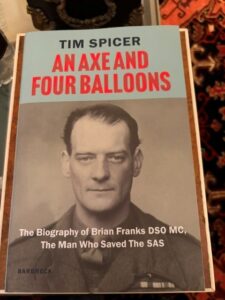
 AN AXE AND FOUR BALLOONS – The biography of Lieutenant Colonel Brian Franks DSO MC – the man who saved the SAS, with a foreword by General Sir Michael Rose KCB, CBE, DSO, QGM
Brian Franks, loved by officers and soldiers alike, tough, capable, charismatic and charming. Like Biffy Dunderdale (A Suspicion of Spies) and David Birkin (A Dangerous Enterprise) he is largely unknown outside the Special Operations world. David Stirling credited him as being one of the five founding fathers of the SAS.
Educated at Eton, he chose not to go into the army like his father, a professional soldier, killed leading his regiment in a cavalry charge six weeks before the end of the First World War when Brian was eight. Unusually for an Old Etonian he joined the hotel business, starting as a ‘pan diver’ at the Dorchester in 1932. His skills, style and ambition were soon noticed. By 1936 he had been promoted to Manager of the Mayfair Hotel and subsequently head hunted to run the Hyde Park Hotel in its exclusive and stylish heyday in the 1930’s.
In 1939 he was commissioned into the Middlesex Yeomanry. Soon he gravitated to the world of more esoteric military operations, which suited his unconventional temperament, moving first to the GHQ Reconnaissance Regiment or ‘Phantom’, then to the Commandos. He became the Brigade Major of the Special Service Brigade in 1943 and took part in the invasion of Sicily, and the operation at Termoli in Italy where he won the MC.
He was posted to 2 SAS in early 1944 taking over command from Bill Stirling in June 1944, when Bill resigned over a dispute as to how the SAS would be used after D Day. He commanded the Regiment on operations in France, Italy, Germany and Norway. During Operation LOYTON in the Vosges mountains in September 1944 he parachuted in to lead operations behind enemy lines. 31 of his soldiers were captured, tortured and executed by the Germans. Brian was determined to avenge them and set up an “off the books” war crimes hunting team to bring the perpetrators to justice. For Operation LOYTON he was awarded the DSO, Croix de Guerre and Legion d’Honneur.
After the war he returned to the Hyde Park Hotel where he was general manager throughout the 50’s and 60’s. The Hyde Park became a favourite of the Royal Family and was the hub of the London social scene.
He also kept a foot in the secret world – working for SIS making preparations just in case the Cold War turned hot. He thought the disbandment of the SAS in 1945 very short sighted, and fought hard to have it reinstated. By 1947 he had succeeded, with the establishment of 21 SAS of which he was the first Commanding Officer. He also used the Hyde Park as an unofficial headquarters of the SAS, and welcomed its operational use by the Intelligence Services. He became involved with running another ‘off the books’ venture in the 1960’s, Britain’s secret war in Yemen, together with David Stirling and Julian Amery.
In 1977 he became the Colonel Commandant of the SAS, and helped manage their image and profile, defending them in public against malicious propaganda from their enemies, quite often against the wishes of the MOD. In this he was very forthright and robust. He died on 6th May 1982 six weeks after the Argentinians invaded the Falklands and sadly was unable to welcome the SAS home after a very successful war.
In his private life he was a dashing bon viveur, a gastronome and a terrific sportsman – cricket, shooting, racing, stalking and fishing. He was great company, loved by all, from the Royal Family, to the most junior soldier. He was close friends with a wide range of characters. David Niven, Ian Fleming, Evelyn Waugh, and Winston Churchill as well as his military comrades – the Stirling Brothers, Paddy Mayne, Roy Farran and Bob Laycock.
Publisher: Barbreck
- ISBN-10 : 1999589173