Suffragette & founding member of the Sherborne branch of the NUWSS.
Evelina Scarlett was born on 9 August 1867 at Inverlochy Castle, Fort William, Inverness, to William Frederick Scarlett, 3rd Baron Abinger, and Helen Magruder.
Following her marriage in 1887 to Major Henry Wykeham Brook Tunstall Haverfield RA (1846-1895), Evelina lived firstly at West Hall in Longburton, Dorset, and from 1894 at Marsh Court, Caundle Marsh, Dorset. Major Haverfield died in 1899 from symptoms associated with syphilis, leaving Evelina with two young sons. In 1899, she married an old army friend of her husband, Major John Henry Balguy RA (1859-1933), but retained by deed poll the surname of her first husband.
In 1909, Evelina was a founder member of the Sherborne branch of the National Union of Women’s Suffrage Societies (NUWSS) and later joined the militant WSPU. On 29 June 1909, during what was known as the Bill of Rights March, Evelina was arrested with Emmeline Pankhurst after they attempted to enter the House of Commons to present Prime Minister Herbert Asquith with a petition. Their arrest was reported in the Western Gazette under the title ‘SUFFRAGIST FURIES’ and ‘MARTYRDOM OF TWO WEST COUNTRY AMAZONS’.
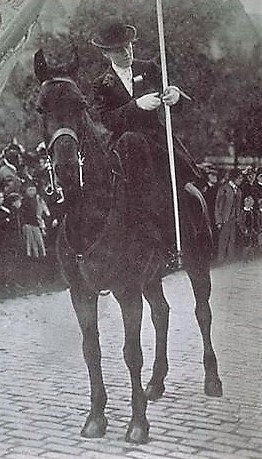
Evelina was also a member of the Blackmore Vale Hunt and a keen horsewoman, a skill that would come in useful during her militant days with the WSPU. On 18 June 1910, she took part as a mounted marshal in The Great March, when 10,000 women marched to the Albert Hall carrying banners designed by Sturminster Newton stained glass artist and suffragist, Mary Lowndes (1856-1929), and on another occasion she was arrested for leading police horses out of their ranks.
Following the notorious ‘Black Friday’ riots on 18 November 1910, when the home secretary Winston Churchill authorised the police to use extreme physical violence against the protesters, Evelina was charged with hitting a policeman in the mouth. When charged she said, ‘It was not hard enough. Next time I will bring a revolver.’
With the outbreak of war in 1914, the women’s suffrage societies encouraged their members to abandon their campaign and support the war effort. Evelina’s own war efforts were particularly significant. She was pivotal in forming the Women’s Emergency Corps, the Women’s Volunteer Reserve (WVR), and was Commandant in Chief of the Women’s Reserve Ambulance (Green Cross Society). In May 1915, she joined the Scottish Women’s Hospitals with whom she worked in Serbia, making frequent visits back to England to raise funds for the Serbian Red Cross in Great Britain and the Fund for Disabled Serbian Soldiers. On 8 February 1918, she gave a fundraising lecture at Sherborne School, after which one attendee wrote in his diary, ‘Heard Mrs Haverfield lecture on Serbia in Schoolroom. We in England know nothing of suffering compared with this heroic nation wh. has been deliberately murdered.’
Evelina Haverfield returned to Serbia where the government asked her to help the orphans of the war. She founded the ‘Hon. Evelina Haverfield’s Fund for Serbian Children’ and set up orphanages at Uzitza and Bajina Bašta. In March 1920, she contracted pneumonia and died on 21 March 1920, aged 52. She was buried at Bajina Bašta and a memorial service was held for her at Southwark Cathedral on 1 May 1920. In 1923, a memorial tablet was installed in her memory at Bishop’s Caundle church beneath the memorial window Evelina had erected for her first husband.
Further reading:
Wendy Moore, Jack and Eve. Two Women in Love and at War (London: Atlantic Books, 2024)
Pamela Vass, Breaking the Mould. The Suffragette Story in North Devon (Bideford: Boundstone Books, 2017)
See also:
- Sherborne & the fight for women’s suffrage
- Evelina Haverfield’s recipe book
- Evelina Haverfield (wikipedia entry)
Find more Strong Women of Sherborne