
Between 1947 and 1950, twenty-two Dorset boys attended Sherborne School on state bursaries. The bursary scheme grew out of a report completed in June 1944 by the Fleming committee which, as part of the post-Second World War desire for social reform, considered the relationship between Britain’s leading public (private) schools and the state. The committee recommended that ultimately 25% of pupils (boys and girls) at public schools should be state-supported under a national bursary scheme for children who might benefit from boarding. The committee defined a public school as a member of the Governing Bodies Association (GBA) or of the Headmasters’ Conference (HMC).
1944 also saw the passing of the Education Act, which promised ‘secondary education for all’ through the provision of universal free schooling at grammar, secondary modern, and technical schools.
On 18 September 1944, the Governors of Sherborne School called a special meeting to discuss the potential implications of the Fleming Report and the Education Act. The Headmaster, Alexander Ross Wallace, who was invited to speak to the meeting, told the Governors he did not think that the question of a number of boys coming to Sherborne from poorer homes need cause anxiety, as a modification of the existing form of Common Entrance Examination could be made to avoid these boys being at a disadvantage compared with those who would have spent their earlier years at a higher grade school. He felt that what was most important was not whether a boy came from a rich or a poor home, but the home itself – if it was the right kind, then in most cases they could turn out the right stamp of boy.
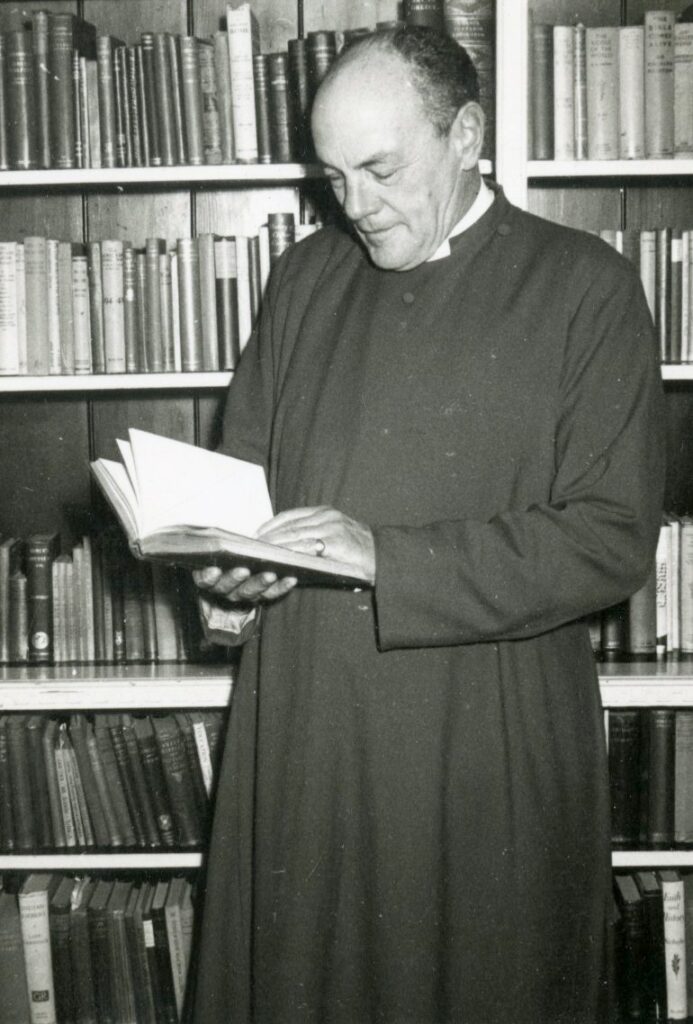
Having read a letter received on the subject from the Bishop of Salisbury [Neville Lovett] and a circular from the Bishop of London [Geoffrey Fisher], the following points were made by the Governors during the meeting:
- That the advantages of public schools were obvious and what they had to do was to ensure that those advantages were retained.
- That what was now before them was a report only. Even if it were adopted changes would almost certainly be made and a decision need only be taken later on.
- That while the general attitude was that the existing atmosphere must at all costs be preserved, the fundamental effect was to destroy that atmosphere.
- That boys from poor homes would not be able to compete successfully with those from preparatory or private schools, but this was not thought to be necessarily the case.
- That if, as was proposed, a boy who entered at eleven years of age had spent two years at a preparatory school, it would not be possible to refuse him entrance subsequently to the public school, as this period of preliminary training would be sufficient.
- That “Direct Grant” Schools would certainly suffer.
- That a public school education should be made much more widely possible than in the past, and that the report as presented did not carry out the terms of reference.
The Governors concluded the meeting passing unanimously a resolution that, ‘The Governing Body of Sherborne School sympathises warmly with the aim stated in the terms of reference of the Fleming Committee, viz: the development of the association of the Public Schools with the general educational system of the Country, but does not consider that the schemes propounded provide sufficiently for the freedom, flexibility and variety which are essential for the maintenance of those benefits which it is now desired to extend more widely.’
In February 1945, the Headmaster explained in the Old Shirburnian Society Newsletter the impact he believed the 1944 Education Act and the Fleming Report would have on the School:
‘There is the new Education Act coming into force and the Fleming Report to be implemented and it is quite clear that this involves certain changes. Personally, I do not agree to having the 25% quota of ‘Bursars’ sent to Sherborne especially if these are not to include the best boys from the Primary Schools. My own view is that we should make the entrance examination competitive for all comers irrespective of any other quality except ability, and I am happy to say that I have the Governors and the Staff behind me in this and we are beginning to make converts outside, including the Director of Education for this county. I have fortified myself with expert opinion from the Institute of Education in London University on the subject of selective machinery and I have no doubt that if we stick to our guns we shall in the end win through but there is a vast “vis inertiae” of ignorance and prejudice to overcome before we do it. Still the great thing is not to be rushed in these matters and if there are to be changes, as I expect there will be, it is my belief that they will come quietly and gradually in this place and not in any dramatic or revolutionary manner. As you know well, Sherborne is too old to be stampeded into rushing about suddenly in this or that direction and while we are determined not to stagnate, we are equally determined to feel our way prudently and cautiously forward.’
The author John le Carré (David Cornwell, Westcott 1945-48), however, remembered the Headmaster’s reaction slightly differently when he recalled a speech he made to the School in 1945 in which ‘he spoke as if the world was about to end. We boys should gird ourselves and wait bravely for the worse. We were the last of the Romans. The barbarians were at our gates.’ (John le Carré, Afterword to A Murder of Quality, Penguin Modern Classics, 2011).
Dorset’s Director of Education from 1942 to 1949 was Jack Longland (1905-1993). A mountain climber who took part in the 1933 British Mount Everest expedition, Longland was also a broadcaster, appearing on BBC Radio’s Round Britain Quiz and Any Questions? After lecturing in English at Durham University, Longland joined Durham’s Community Service Council, and for thirty years from 1940 until his retirement in 1970 was involved in educational management in Hertfordshire, Dorset, and finally Derbyshire. He was also member of eighteen national commissions, committees and advisory bodies. On his retirement in 1970 he was knighted for public services.
As Director of Education for Dorset, Longland, who had attended King’s School in Worcester, was keen to promote the opportunities offered by the state bursary scheme for the county’s children, initially just boys, to attended four of Dorset’s independent public schools (Bryanston, Canford, Clayesmore, Sherborne) and Eton College.
In February 1947, Alexander Ross Wallace received a letter from Longland asking him formally to confirm whether Sherborne School was prepared to take part in the provisional scheme, and, if so, how soon they would be able to admit county bursars and how many places could be offered. After discussing the matter with the Housemasters, who agreed that one place should be offered in each house, the Headmaster agreed that the School would take part in the provisional scheme and offered seven places a year commencing in September 1947.
In June 1947, 81 boys from state schools in Dorset sat for the bursary scheme examination and, after interviews with the headmasters of the public schools involved in the scheme, twenty-two bursaries were awarded. Two boys from Weymouth Grammar School were awarded places at Eton College; five boys from grammar schools in Poole, Lyme Regis and Beaminster were awarded places at Bryanston School; four boys from Swanage, Poole, and Wimborne grammar schools were awarded places at Canford School; four boys from Sherborne, Dorchester, Weymouth, and Wimborne grammar schools were awarded places at Clayesmore School; and seven boys from Beaminster, Weymouth, Poole, Dorchester and Wimborne grammar schools and Poole’s Henry Harbin Modern School, were awarded places at Sherborne School.
In February 1948, Sherborne School received a letter from Longland pointing out that the county was only prepared to pay a certain sum towards school books, over and above the inclusive fee. As an entrance fee of £5.5s.0d was payable this would mean that for the first year the cost of the books would either have to be recovered from the parents or provided by the School. It was felt by the School that the county should be charged for books, not the parents. However, when Dorset County Council told the Headmaster that the other Dorset schools and Eton College charged the parents, it was agreed to follow suit.
In April 1948, 130 boys at Dorset schools sat the examination and 44 boys were selected for interview. Twenty-two bursaries were awarded and in September 1948 seven boys from Poole and Weymouth grammar schools came to Sherborne School. At the end of the year the Headmaster was pleased to report to the Governors that ‘the success of the experiment of admitting State Bursars to Sherborne last year has resulted in the repetition of the same scheme in September, when seven more have been elected, one to each house.’
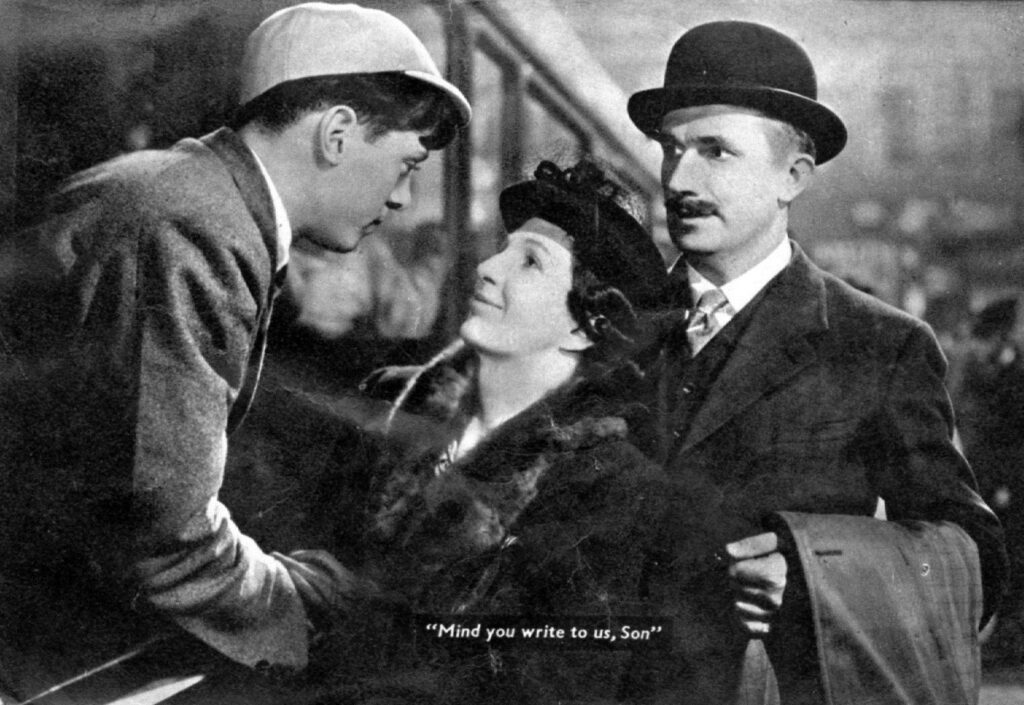
In May 1948, The Guinea Pig, starring Richard Attenborough, was filmed at Sherborne School. Based on a play written by Old Shirburnian Warren Chetham-Strode (Abbey 1910-13) the film told the story of Jack Read who had been ‘pitchforked from the local elementary school into the strange world of one of the great public schools… As the “guinea pig” hero of an educational experiment.’ It is interesting to note that this film was seen by Richard Hill Brown (School 1950-1955), one of Sherborne’s last ‘bursary boys’, just before he came to Sherborne in September 1950.
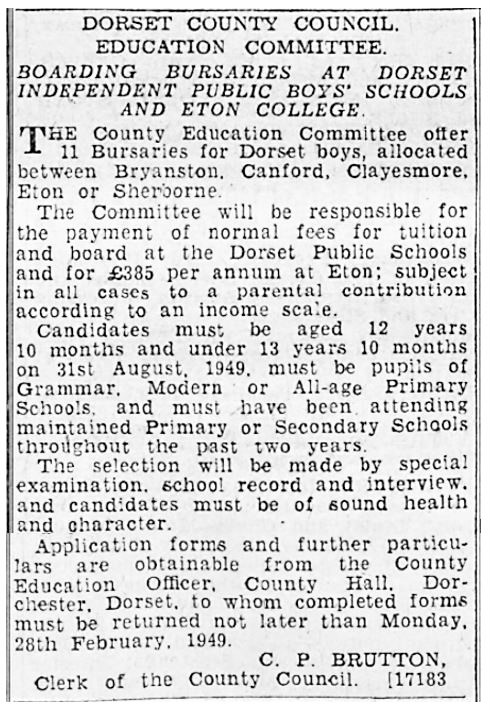
In November 1948, the Headmaster informed Longland that the School fees had increased. The following year the number of bursaries offered in Dorset was reduced to just eleven, with four boys from Parkstone, Dorchester and Weymouth grammar schools coming to Sherborne in September 1949.
The question of whether public school bursaries should also be open to girls at state schools in Dorset was raised in 1947, but it was not until 1950 that the Dorset County Education Committee awarded two places for girls at Sherborne Girls’ School and Cranborne Chase School for Girls. That year nine boys were awarded bursaries, with four boys from Parkstone, Dorchester, and Swanage grammar schools coming to Sherborne. This was the last year that Sherborne School received any ‘bursary boys’ under the scheme.
Jack Longland left Dorset in March 1949 and the county’s bursary scheme lost its chief advocate. In November 1950 the DCC County Education Department decided to limit from 1951 the number of boarding scholarship they awarded to four, with two for boys (one place each at Eton College and Winchester College) and two for girls (one place each at Cranborne Chase School and Sherborne Girls’ School). They also decided that candidates for the award should in future be confined to pupils at grammar schools.
In 1951, just one boy and two girls were awarded boarding scholarships, with a boy from Lyme Regis grammar school awarded a place at Eton College, and one girl from the same school awarded a place at Sherborne Girls’ School, and another girl from Dorchester County School awarded a place at Cranborne Chase School. The decline of the bursary scheme has been blamed on a number of factors, including a general lack of political will and a shortage of public finance.
In his History of Sherborne School (1971), A.B. Gourlay summed up Sherborne’s experience of the bursary scheme and its unfortunate early demise:
‘The introduction in 1947 on a small scale of state bursars was an innovation with considerable possibilities and worked very successfully; its phasing out after only some half a dozen years was due solely to the cost of the places which fell too heavily on the county authority.’
Whether the bursary scheme achieved the aims set out by the 1944 Fleming Report, is contentious. Looking back in 2014, one of Sherborne’s last ‘bursary boys’, Richard Hill Brown (School 1950-1955), described the impact the state bursary scheme had had on him:
‘I am conscious that I entered for five years into a way of life still connected to pre-1914 upper class Britain. The photos on the tuckshop walls of Edwardian-era teams and the OTC were a constant reminder that we were heirs to traditions which developed when some notable headmasters and the railway turned a shrinking local grammar school into a Victorian public school. A few of those around me were ruthless, ambitious and materialist cynics, but in general Sherborne upheld the concept of good citizenship – with a hint of noblesse oblige that was not patronising. I remember fondly some fine, talented contemporaries, my housemaster [A.B. Gourlay] and the other masters who taught me so well. I am sad when I read the obituaries of those staff and (increasingly) of those contemporaries.
Over the last four decades I have taken a few groups of staff and adults for guided tours of the school, and the nostalgia always returns on those visits. There is a sentimental attachment to the sandstone buildings, yellowy warm around the magnificent abbey. The print of Dennis Flanders’ 1956 sketch of the Courts, hangs on our living room wall, if I need a reminder. However, there is also the shadow with me that, despite my state paid opportunity, I never fulfilled either my parents’ hopes or the county’s and school’s trust in my abilities. In fact, none of us four bursary boys of 1950 made much of a mark at school. Was that the fault of our characters, or of the process which selected us rather than others? For myself, I can only write that I doubt if I would have got to Oxford (or Cambridge) from Swanage Grammar School. But beyond that brief success, which was thanks to the superb teaching I received, the rest was down to me, and I fell short. I never developed that extra determination and confidence which was the hallmark of so many Shirburnians of my generation. I have been the “compleat” historian: I have collected some wonderful experiences as a detached observer, and have done nothing with them.’
Rachel Hassall
School Archivist
See also:
- Filming The Guinea Pig at Sherborne School in May 1948
- Scholarships and Bursaries at Sherborne School
For further information please contact the School Archivist.
Return to the School Archives homepage.