Robert Glen, who arrived in Sherborne in 1960 – and many of whose early pupils will already have retired – died in May of this year. He was 81. He will be vividly remembered, for so wide was his range of talents and accomplishments that he singularly enriched the life of the whole community for a quarter of a century and more.
He was primarily appointed to teach classics and it was clear from the outset that he was a master of his brief. More than that, however, he was an enthusiast of rare warmth, a vigorous champion of the language and literature of the Ancient World. This intellectual delight was spontaneously caught by his pupils who, like their master, never doubted the relevance of their studies to their own 20th century lives.

Devan Haye, a bizarre, colonial-style house built partly of corrugated iron, he acquired when he arrived, bringing with him his aunt and his mother. Charming, competent and capable, they and Robert set a pattern of generous hospitality which was already starting elsewhere to fade. Afternoon tea meant bread and butter, scones, at least two home-made cakes and biscuits, and woe betide you if you appeared fainthearted. Devan Haye was their home until they, one by one, came to the end of their lives. Even without Mrs Glen and Miss Sawers, Robert was not alone. He was unusually tender-hearted and kept birds in aviaries. These he had bought from pet shops if he felt their cages were too confining. Dogs, too, he was particularly fond of. But latterly he chose rescue dogs from animal sanctuaries, dogs of uncertain temperaments, given to nervous barking, given too, to biting his car upholstery to shreds. They were never chastised and rarely rebuked.
Robert’s arrival at Sherborne filled an awkward gap. The two members of staff who had most usually directed the plays, John Buchanan and John Melvin, had both left to become headmasters. Robert, already an accomplished and experienced director, offered his services and a succession of memorable plays and spectacles followed. Latterly in the 70s and 80s, with Patrick Shelley and Augusta Miller, he directed fifteen productions for Dorset Opera, which again enriched the experience of present and old pupils of Sherborne School and of Sherborne Girls singing in the chorus. Since he had worked as a répétiteur at Glyndebourne he knew what he was about, and the professional singers and orchestra naturally recognised his authority. In the rehearsal period he would delicately pick his way between the squalls and tantrums, both real and artificial, reducing the tensions and spreading harmony and light. Sharp confrontations were alien and distasteful to him, and he instinctively chose the path of moderation.
When his housemastership at Abbeylands came to a close, he resolved to take holy orders and after the requisite period of study and preparation he emerged as a priest. He was assistant chaplain at Sherborne School, he worked particularly in Yetminster and served four years as Rural Dean of Sherborne. This new career, new vocation, was, as might be expected, the old career, the old vocation with an additional and significant spiritual quality. Robert was the same person, but his talents were used anew. He preached perceptively, often humorously. He brought comfort to the distressed, saw families through christenings, marriages and bereavement. Robert’s life of service up until this point, had always been expressive of and informed by his faith. Now, beyond his life as a schoolmaster he continued to live a life of service.
This wise and compassionate man, with his admirable intellect and perception, his kindness and generosity, his charm and good humour, has left us, but our grateful memory of him endures.
Simon Wilkinson.
Vale Robert Glen by D. Phil Jones, Landmark (Abbeylands magazine), 1983
As Tutor to the retiring Housemaster, J.H.P. Gibb, in Abbeylands in 1973, I was one of the first to know of R.S.G..’s appointment to succeed him as Housemaster later that year. Typically, R.S.G. took on the job at very short notice and J.H.P.G. whispered conspiratorially that R.S.G. was “Just the man for the job. His gentle touch will cope beautifully with the House’s eccentricities.” As a very ‘green’ house tutor some of those eccentricities were already apparent to me, but I was less sure of what to do about the changeover. “Hand in your resignation,” advised J.H.P.G., “And he will ask you to say if he wants you.”
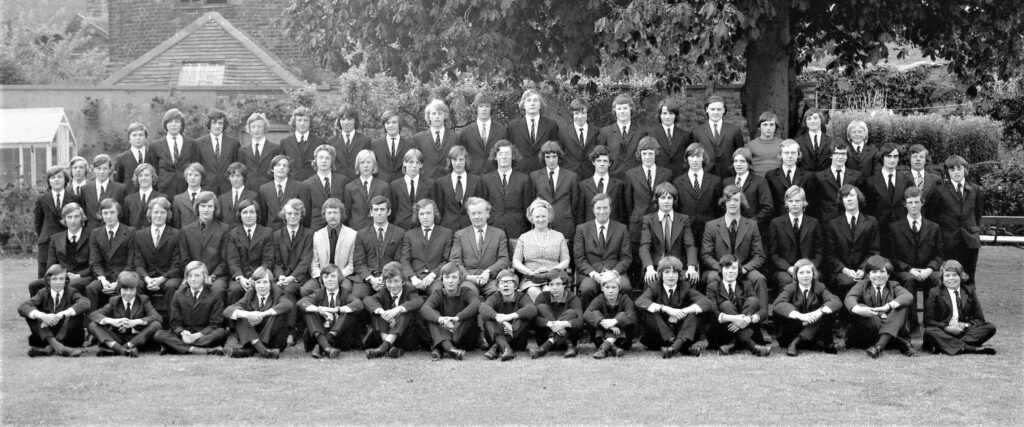
Up to then R.S.G. had seemed, to me a rather distant figure. Silver haired, always begowned, usually talking earnestly to boys and carrying learned-looking volumes whose titles I always felt I should have read. Though his courteousness was unfailing he still emanated a definite alarmingly learned and academic air. I resigned.
A reply came promptly, within hours, a delightfully phrased request that I continue as the House Tutor in order, and amongst other things it is remembered well, “to cover areas where my ignorance is profound.” It was not long before the green tiro became well aware that there were very, very few areas where R.S.G. was out of his depth; rather that he was in total command of both word and deed. Equally swiftly came the realisation that here was a warm and understanding personality; a wit, quick, subtle and sharp, but never unkind; a huge humility and charity of thought and deed to colleague and pupil alike. It would be a close thing whether members of the House or the Tutor learnt most from the new man.
With straight face and tongue tucked well into cheek R.S.G. would claim that his influence was immediate. Abbeylands won the Senior House Rugby Competition. A hasty dash back to the House to fill the gleaming trophy with sparkling wine; (“Champagne would be a little excessive, don’t you think?”) precluded an equally mad rush off to the dress rehearsal of some play or other. Subsequent “Blues” won by Abbeylanders at Oxbridge in a variety of sports (have other Houses won any?) would says R.S.G., testify to his detailed coaching – of the Corinthian ethic of course, and anyway, the Greeks had a saying for that sort of thing.
There we have some of it. A modest, disclaiming of anything successful while always a readiness to admit responsibility for anything that had gone wrong. Even when picking up someone else’s pieces there was never any “I told you so”, even though he usually had, and always an immediate “Can I help?” or, “Let me do it for you”. Whilst others sweated and heaved and panicked and intrigued and raged, often over trivia, R.S.G. pursued altogether higher goals. So what if the Junior Leagues ‘B’ XV were sometimes five minutes late on the wrong pitch wearing the wrong colour tracksuits. Far more important was the need to stress self-discipline, tolerance, understanding and thought for others. Nonetheless, well-regimented teams from other Houses were often surprised by the fervour, elan and unorthodoxy of the Abbeylands approach. Admittedly, we did lose sometimes!
So, what has R.S.G. contributed to Abbeylands and the School during his term of duty? The fact that the two things are mentioned together speaks volumes for R.S.G.’s determination that Abbeylands be an open house rather than an ivory tower and it is a strong argument that his interests outside Abbeylands made him more understanding within it. For a long time he remained Head of Classics (“Silly really. The others would do a far better job than me.”) Not for him the intricate and esoteric convolutions of curriculum development; instead, and by example, the rigorous pursuit of literary precision and unquenchable enthusiasm for Greek and Roman cultures. As one old Abbeylander wrote recently, “In his first term he taught us that Art was not short for Arthur.” Ironically, he took a great delight in his role as travel agent-cum-adviser to those seeking to justify their travel grants by visiting the Mediterranean and Greece in particular.
Each year there was at least one mammoth Drama production, and always the Commem showpiece in which most of the School seemed to take part and from which one would never guess the rehearsals squeezed uncomplainingly into odd and often antisocial hours. The players, often the most unlikely people, blossomed on the stage and as a result, off it as well.
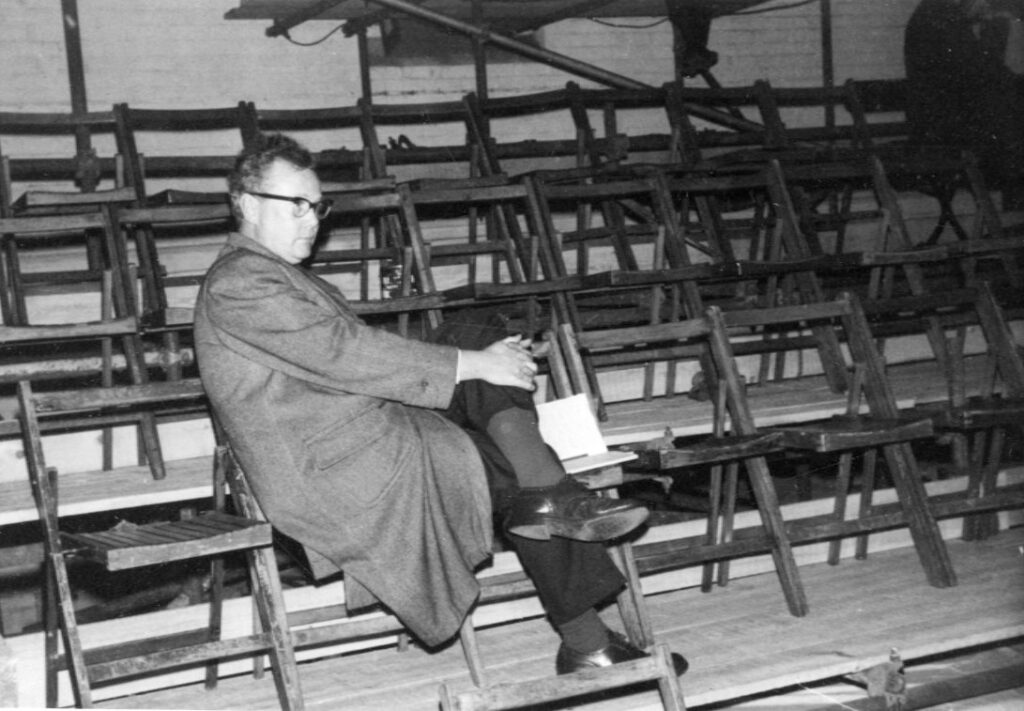
Despite having gone a little greyer – this would be admitted grudgingly – R.S.G.’s stamina has been immense. “Two days holiday at the end of the year are enough for anyone,” and so it was off to Glyndebourne or Stratford, usually with several boys as his guests, perhaps to gain ideas for the forthcoming Dorset Opera. A founder and committee member of the latter R.S.G. was, and is, its producer. The Bartered Bride, Carmen, Turandot, Edgar, even the mighty Aida were brilliantly produced in difficult surroundings (“Now if only they would listen to me we could have a Globe theatre to sit 1800 people”). The leading singers of the land as well as the combined Schools and Staff chorus eat from his calm hand. (“I only ever lost my temper once in each production: usually at 4.37 pm on the fourth day”), and in the middle of all this would be the Oxbridge Reading Party, of which he had charge, with its walks to Trent for lunch and cream teas at Devan Haye.
Many have trod the path along Newland and North Road to R.S.G.’s home. Guarding his house, Ben, biter of more Abbeylanders than all the Tutors put together, but relegated to the nether regions when company arrived. At Devan Haye, whether for Society meetings (beloved Interpretes), parties for the numerous casts of numerous plays, committee meetings, or simply the famous summer birthday parties there was ever a warm welcome and instant and generous Scottish hospitality. The committee meetings might have been to coordinate Boys and Girls’ School joint activities, to organise the 6th form dances for which he was responsible for many years (“We must have them in the Dining Hall – after all I helped choose the curtains.”) Perhaps they were on behalf of the town’s drama committee, or to bring a sense of proportion to the dealings of the Senior Common Room of which he was President.
There is more, of course, much more. Images invade. R.S.G. sitting on two huge and well-worn volumes of ‘A Greek Lexicon’ in order to play the piano more comfortably at a House concert. (“I knew I’d find a use for them one day.”) R.S.G., clad only in thin shirt and blazer emerging from the frozen wastes of Carey’s after umpiring a cricket match in Sherborne’s bleak spring. (“It was much worse than this in Edinburgh you know. Lovely day. Yes, lovely day.”) R.S.G. found practising his ‘cello prior to being collected to sing in the Glee Club. (“I thought my arpeggios were getting a bit rusty.”) R.S.G. at his most urbane during his final House Supper (“This is not a sentimental occasion and will that filthy boy stop taking photographs!”) R.S.G. who could announce suddenly to a large unsuspecting community, “I am being ordained next week,” and add shyly, “Perhaps if you aren’t doing anything you might like to come.” R.S.G. with whom it was and is, to me at least, impossible to win an argument. (“Hm. Well, yes I suppose you could say that, but what about…”) and whose contribution to the intellectual life of the School goes way beyond Classics and Abbeylands. Who else would you choose to be your entry for Mastermind? (“Oh dear me no. I wouldn’t be any good at that sort of thing.”)
In the context of schoolmastering, however, it is with the “difficult” pupils that R.S.G. excels. The examples are numerous: the pupil so disturbed that he stabs himself on entering the House at the start of a new term. (“Oh dear. What on earth did you do that for. Let me make you a cup of tea.”) who goes on to win a Scholarship to Cambridge; the semi-literate entrant, virtually unintelligible and so belligerent as to be almost unteachable, who left the House polite, fluently self-possessed and with a Scholarship to Oxford; the boys who found school life elsewhere impossible, yet who, in Abbeylands with R.S.G., gained confidence and self-respect.
No doubt there is more that could and should be written, but already I feel the urge to be somewhere distant when R.S.G. reads this. I can imagine his response. “Good heavens. What utter rubbish. I don’t think we want any of that sort of thing. Better get rid of it – quick. And you have missed an apostrophe in the second paragraph. Now, how about you and Jane having my tickets to go to the Old Vic next week.” Robert – from Abbeylands. Thank you.
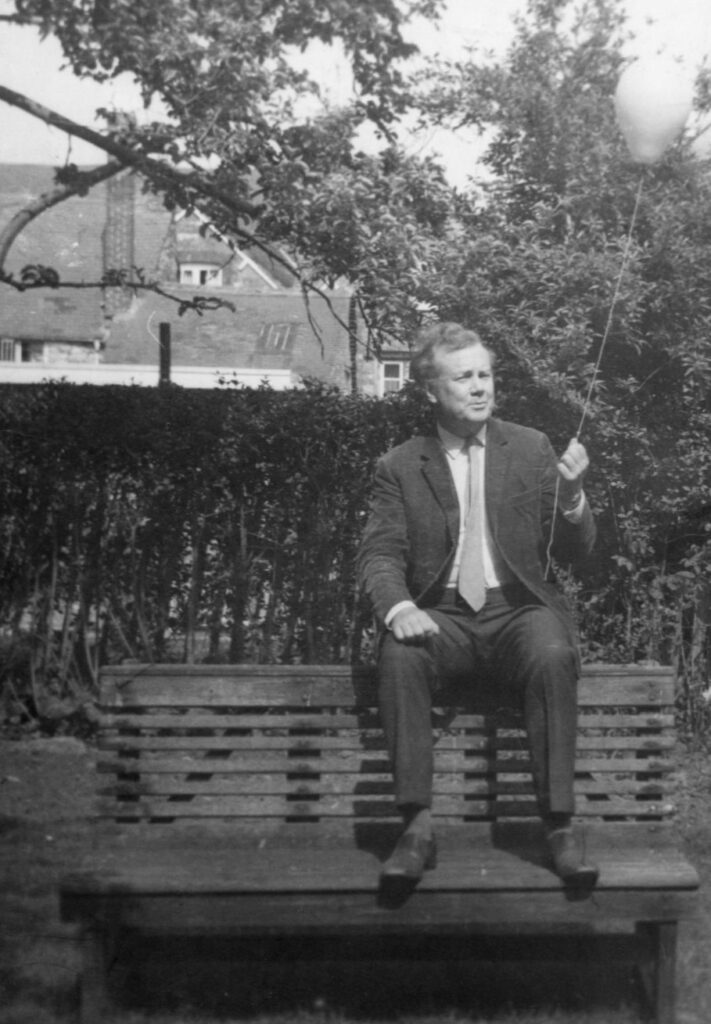 Robert Sawers Glen (1926-2008)
Born on 23 June 1926.
MA, Scholar of Queens’ College, Cambridge.
WW2, 2nd Lieutenant, Royal Artillery, May 1945. Served in Burma after the Mandalay campaign was over. After Independence was declared, left India and returned to Cambridge.
Assistant master at Sherborne School 1960-1988, 1989-1991.
Housemaster, Abbeylands 1973-1983.
Ordained a Deacon in Salisbury Cathedral on 26 September 1981.
Assistant Chaplain, Sherborne School, 1981-1986.
Assistant curate of Yetminster with Ryme Intrinseca and High Stoy 1986-1995.
Rural Dean of Sherborne, 1992-1995.
Directed fifteen productions for Dorset Opera.
Died at Sherborne on 23 February 2008.