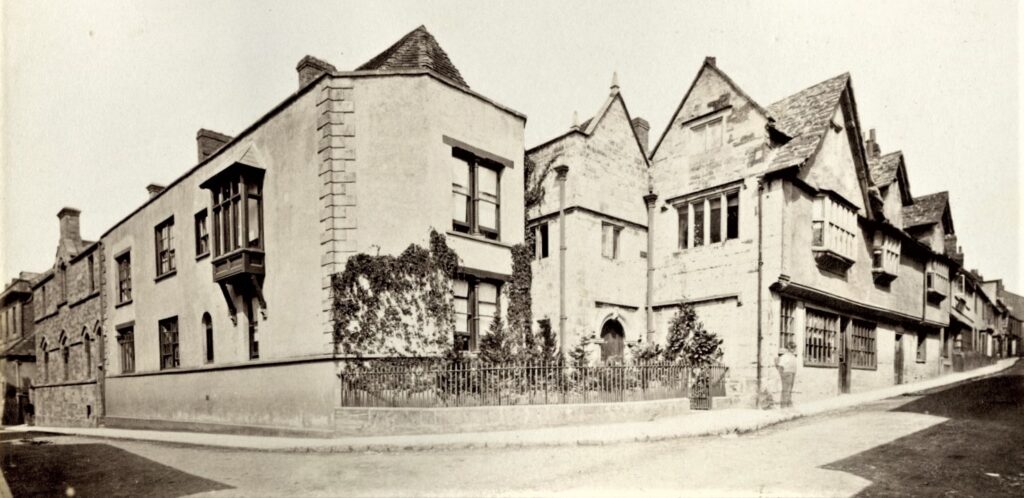
Abbeylands has been in continuous use as a school boarding house since 1872.
This area lay within the Precinct of Sherborne Abbey, which had been founded as a Benedictine institution in 998, hence the house’s modern name.
Abbeylands is the combination of two separate properties. The main part running east and west and fronting Abbey Road has been used as a boarding house since 25 January 1872. In the early part of the 19th century the house was occupied by John Melliar (1757-1840) (Old Shirburnian and School Governor). John Melliar bequeathed the property to the Reverend Richard Cutler (1795-1873) (Old Shirburnian), son of Headmaster John Cutler (1756-1833), from whose descendants the School first rented and in 1921 purchased the property for £4,187.
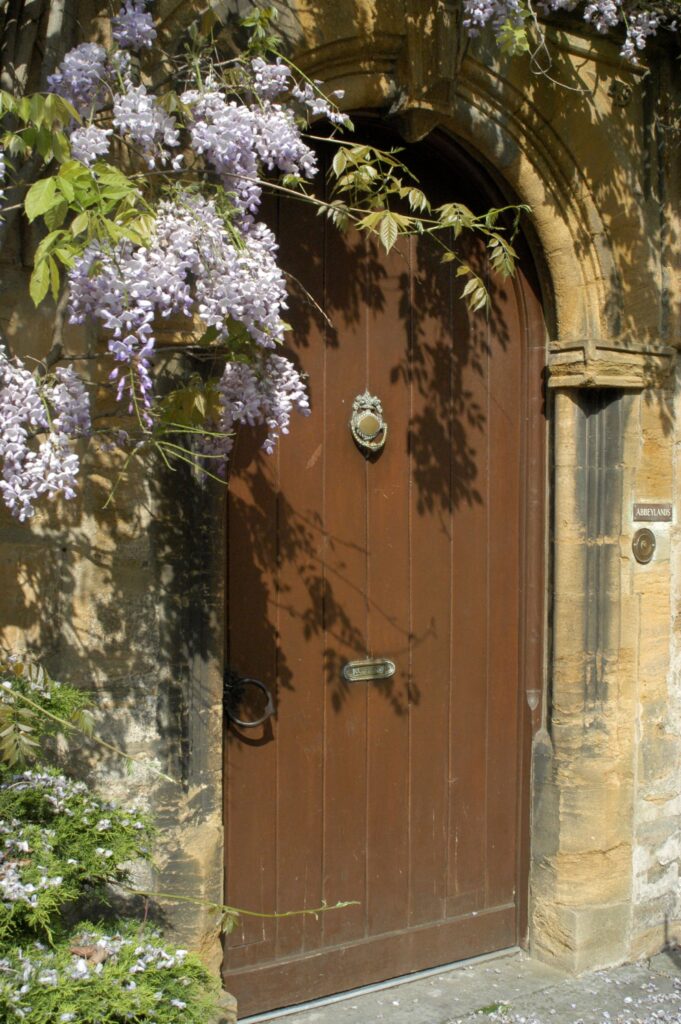
In 1924-1925, the neighbouring premises fronting Cheap Street was incorporated into Abbeylands and the old timber frontage exposed and restored. This section of the building dates from the late 16th century and the carpenter’s marks used to aid the construction of the timber-framework can still be seen on the joints. The front door is said to be constructed from ancient beams found on the premises and bears above it the date 1649. The premises were at one time occupied by a firm known as the Sherborne Coal, Timber, Corn and Cake Co. Ltd. (the company was liquidated in 1921). Legend has it that an underground passage runs from the Abbeylands cellars to Sherborne Abbey, though this has never been substantiated and most likely refers to the Cheap Street sewer which, in the 1850 Report to the Board of Health, was described as being 4ft high and egg-shaped.
Abbeylands is a Grade II* Listed Building.
Former Abbeylands boys include Robert ‘Bungalow’ Briggs (architect and designer of the Upper’s pavilion clock turret), Herbert Buckmaster (founder of Buck’s Club & namesake of the Buck’s Fizz), Godfrey Mohun Carey (England Rugby International), Sir Cecil Cochrane (major benefactor to Newcastle University, including Cochrane Park Sports Ground and the Students’ Union building), Arnold Cortesi (journalist, New York Times foreign correspondent & Pulitzer Prize winner), Francis William Galpin (antiquarian musicologist), Robert Harris (actor), Tobias Jones (journalist & author), Colin Lucas (historian, Vice-Chancellor of Oxford University), Colin Payne (England Rugby International), Jon Pertwee (actor best known for The Navy Lark, Dr Who and Worzel Gummidge), Steuart Pringle (Royal Marines Commando, Chairman & Chief Executive of the Chatham Historic Dockyard Trust), James Whitham (athlete, soldier).
House letter: f.
House colours: red and black.
House magazines: Landmark.
House cricket team (played local villages): The Academicals, The Centurions.
Dormitory names (after former housemasters): Hetherington, Rhoades, Hodgson, King, Elderton, Randolph, Watkins, Gibb, Glen, Elliott, Weston, Bool.
Housemasters:
1872 William Lonsdale Hetherington (1845-1912)
1880 James Rhoades (1841-1923)
1893 Charles Herbert Hodgson (1857-1922)
1900 Henry Robinson King (1855-1935)
1919 Merrick Elderton (1884-1939)
1940 John Randolph (1898-1975)
1955 Geoffrey Watkins (1907-1992)
1966 James Gibb (1919-2005)
1973 Robert Glen (1926-2008)
1983 Ian Elliott
1995 Michael Weston
2003 Richard Bool
2008 Steven & Victoria Clayton
2019 Rhidian McGuire
2025 Ryan Buckley
Online Resources:
- Abbeylands house photographs
- Abbeylands roll of honour
- The founding of Abbeylands, 1872
- Abbeylands house rules, 1876
- Abbeylands boys’ accounts of the bombing of Sherborne on 30 September 1940
- Evelyn Waugh’s six-month stationing in Sherborne during the Second World War
- Lieutenant J.P. Whitham: casualty of the SS Lisbon Maru
- Herbert Buckmaster: the man who put the ‘Buck’ into Buck’s Fizz
- The Hodgsons of Sherborne by Michael Hanson
- Henry Robinson King (1855-1935)
- Memories of Abbeylands 1919-1966 by Mary Watkins (née Elderton)
- History of Sherborne School’s boarding houses
For further information about the Sherborne School Archives please contact the School Archivist
Return to the School Archives homepage