 Alan Turing attended Sherborne School from 1926 to 1931, during which time he boarded at Westcott House in Horsecastles, which stands on the opposite side of the road from the School’s main playing field, The Upper. Alan was not a great team game player, preferring at Sherborne to take part in individual sports such as golf and long-distance running, although he did play rugby for his house. It was while he was at Sherborne School that Alan became interested in long-distance running, taking part in the inter-house steeplechase race, an interest that nearly culminated in his being selected for the men’s marathon at the 1948 London Olympic Games.
ATHLETICS
Alan Turing took part in inter-house athletic sports at Sherborne School and in 1931 he was part of Westcott House’s senior relay team, which came third in the 440 yards (400m) race. The Westcott House sports book for 1931 reports that ‘An experiment was made this year, in which the 100 yards, 220 yards & 440 yards were run as house relays. It was more or less of a success, although the house relay teams were not over successful. The senior team was third in the 440 yards, gaining three points; in the other two it did not reach the finals.’ The four members of the Westcott House senior relay team in 1931 were G.M. Addison, J.D.H. Iles, L. Knoop, and A.M. Turing.
CRICKET
In May 1926, Alan wrote to his parents from Westcott House telling them that because the trains were prevented from running during the General Strike his luggage had not been delivered to Sherborne. Without his cricket whites (white flannel trousers) Alan was not allowed to play cricket, instead his housemaster gave him permission to play golf.
CYCLING
In May 1926, aged 13, Alan cycled 63-miles (104 km) from Southampton docks to Sherborne for his first day at school. Alan had to undertake this journey on his own and through unknown territory because the General Strike had prevented trains from running. Before leaving Southampton Alan had some repairs carried out to his bicycle, but when he reached Burley in the New Forest his pedal went ‘a bit wrong’ and he had to have it repaired. Alan’s journey from Southampton to Sherborne was later reported in the Western Gazette newspaper (14 May 1926), which briefly made him a local celebrity.
Alan remained a keen cyclist and in 1934, after receiving his degree from Cambridge University, he went with a friend on a cycling holiday in Germany, and in 1948 he returned to Europe for a cycling holiday in Switzerland.
At Bletchley Park during the Second World War, Alan would cycle to work from his digs. During the summer, to prevent him from breathing in pollen which caused him to suffer from hay fever, he would cycle to work wearing a gas mask, which caused people who saw him to think that enemy aircraft must be in the area.
GOLF

In the summer term of 1926, Alan’s housemaster Geoffrey O’Hanlon allowed him to play golf instead of cricket.
Alan probably played at Sherborne Golf Club at Higher Clatcombe, which had been founded in February 1894 and was then a nine-hole course.
Alan was obviously keen on golf and a photograph taken of him in Guildford in the spring of 1928 shows him holding a golf club.
Alan’s father was a member of Guildford Golf Club and Alan is known to have played a round of golf there with his mother during a summer vacation from Cambridge University.
GYM & PHYSICAL TRAINING (PT)
Alan is known not to have enjoyed the compulsory gym classes held in the School’s gymnasium (now the dining hall). The School gymnasium, designed by Reginald Blomfield, was built in 1922. The new gymnasium incorporated part of the original gymnasium built in 1885 and would have been considered state-of-the-art when Alan arrived at Sherborne in May 1926.
The new gymnasium building included a dressing room and 460 lockers which had to be kept in perfect order, with each boy responsible for keeping his clothes spotlessly clean and neatly folded.

In 1923, Max Westlake was appointed as the School’s first Physical Training Master. Max had attended Sherborne School (Abbey House 1910-14) as a boy and in 1914, when he was captain of the 1st XI cricket team, he had awarded Alec Waugh his colours. Max not only oversaw the gymnasium but also the compulsory PT drills that were held every day in The Courts.
The ‘Swedish Drill’ system of physical training had been adopted by Sherborne School in 1910 and was believed to promote health through the performance of a series of prescribed movement patterns and regimented drills. The system was credited with having improved ‘the health and carriage of the School.’
At Christmas 1928, Geoffrey O’Hanlon wrote to Alan’s parents telling them that Alan had taken more trouble that term with his physical training.
Every year on Commemoration Day (Commem), all the boys at the School performed (rain or shine) a mass PT demonstration in the Courts for the benefit of the visiting parents and guests. Arranged by house, Alan took part in this annual display with the other members of Westcott House.
HOCKEY

Alan had played (or not played!) hockey at Hazelhurst Preparatory School in Sussex, which he attended from 1922 to 1926. He later claimed that he learnt to run fast attempting to avoid the ball.
In 1923, Alan’s mother presented to Miss Dunwell, the matron at Hazelhurst, a sketch of Alan entitled ‘Hockey or Watching the Daisies Grow’. Alan’s mother described the background to the sketch in Alan M. Turing. A Biography (1959):
‘In games of hockey he was to be seen half-seated on the end of his hockey stick, and the fact that he took his games shorts to Matron for repair of the seat tells its own tale. Yet another song at the end of term poked fun at his “watching the daisies grow” during hockey. This drew from me a pen-and-ink caricature of Alan, leaning on his stick with his back to what was going on near the goal and bent double examining a daisy in the grass. This caused much amusement at his school, not least to Alan himself. What was my surprise when Matron, Miss Dunwell, returned it to me in 1955, saying she had kept it all those years in the belief that one day a biography would be written of Alan. Encouraged, however, by accidently hitting a goal he was soon playing quite well.’
In Lent term 1927, Alan’s third term at Sherborne, hockey was made a School game and was played throughout the School during the second half of the Lent term.
LONG DISTANCE RUNNING
In his thirties, Alan Turing became a keen marathon runner and, it is said, he would have been selected for the men’s marathon at the 1948 London Olympic Games had he not contracted fibrositis the previous January.
Alan’s interest in long-distance running began at Sherborne School where, in March 1930 and 1931, he took part in inter-house steeplechase races.
Steeplechase is a long-distance cross-country race which took its name from the horse races that were originally run from one town’s church steeple to the next. The School steeplechase course at Sherborne started at Westbridge, near Hyle Farm, running south towards Thornford, crossing the River Yeo in two places, coming back between Silverlake and Lenthay Wood, and home across Lenthay Common with the finish near the old pavilion on Carey’s playing field.
On 11 March 1930, Peter Hogg, John Iles and Alan Turing represented Westcott House in the senior inter-house steeplechase race. The Westcott House games book reported that: ‘Turing finished 10th and was our first arrival. Our method of training may not have been quite thorough enough, but even so I do not think any of our team were up to the standard of the winners.’ The senior race that year was won by George Laws of The Green.

In Michaelmas term 1930, Alan become friends with fellow Westcott House boy, Victor Beuttell, and they began running together. On 10 March 1931, Alan again represented Westcott House in the senior inter-house steeplechase race, with the Westcott House games book reporting that ‘Turing ran a good race in the steeplechase finishing 6th. He was very keen & his place does him credit.’
Alan continued running after he left Sherborne and on a return visit to Westcott House c.1933-1936, he immediately went out on a long run, much to his former housemaster’s surprise!
While working at Bletchley Park during the Second World War, Alan took part in and won a cross-country race, coming in three minutes before anyone else. His colleagues at Bletchley Park, many of whom were military men, were said to have been surprised that they had been beaten by ‘The Prof’.
In 1945, Alan joined Walton Athletic Club, one of Surrey’s oldest and most successful athletics clubs, and began marathon running. Another famous Old Shirburnian, Sir Christopher Chataway (Harper 1944-49), who ran in the men’s 5,000m at the 1952 and 1956 Olympic Games, was also a member of Walton Athletic Club. While living at Teddington, Alan would often run to his parents’ home in Guildford, roughly the distance of a marathon, sending a change of clothes in a parcel before him.
In August 1947, Alan took part in the Amateur Athletics Association Championships held at Loughborough College Stadium in Leicestershire, where he came 5th in the men’s marathon championship with a time of 2:46:3. Alan’s prowess as a marathon runner very nearly culminated in his being selected for the men’s marathon at the 1948 London Olympic Games, at which his Sherborne contemporary, Torsten Ullman (School 1925-1927), won a bronze medal for Sweden in the men’s 50m free pistol. Having contracted fibrositis the previous January, Alan was prevented from taking part in the Olympic Games, although he did take two of his nieces to watch them. The men’s marathon that year was won by Delfo Cabrera of Argentina with a time of 2:34:51.6.
Alan’s brother John later wrote of Alan’s success at marathon running: ‘I cannot forebear to remark that the whole business was yet another unpredictable eccentricity for he had never shown the slightest interest in athletics before, yet he was, at the age of 35, in the front rank of marathon runners and seriously considered for the Wembley Olympics.’
In Summer 1950, Alan bought ‘Hollymeade’ in Dean Row, Wilmslow, Cheshire. From 1951 to 1952, his running partner there was the teenage Alan Garner (author of The Owl Service) who said that Alan Turing used running to think.
RAMBLING

Alan went on many walking holidays with family and friends to, amongst other places, the Lake District, Scotland, North Wales, Sark, Cornwall, Norfolk, and Ireland.
During the winter term of 1930 the Headmaster granted the School an extra half holiday. Alan’s housemaster, Geoffrey O’Hanlon, used the opportunity to take Alan Turing and Peter Hogg on a walk to the Dorsetshire Gap on the Wessex Ridgeway. In a talk he gave to the Sherborne Wesleyan Guild on 10 February 1931, Geoffrey O’Hanlon described the walk as ‘One of the best walks I have done’ and outlined the route they took that day:
‘To Okeford Fitzpaine and then on to Okeford Hill. At the top turn as usual westwards… After a mile and a half or so, you join the track from Belchalwell to Bulbarrow… From Bulbarrow go on to Rawlsbury Camp… From Rawlsbury drop down to the stream this side of Ansty, and cut across some fields, a sort of common and a copse, which is very wet indeed, and up the hill again. Presently you arrive at Dorsetshire Gap, a network of small paths cut deeply in the chalk, most forbidding when I passed it with two boys who shared with me the adventures of the day… I feel sure that it was a meeting place, and a very safe one far from anywhere, for the smugglers who might land their freight at Lulworth Cove or Worbarrow Bay. They might get rid of part of their loads at Tolpuddle. But for distribution farther north the Gap was an admirable meeting place.’
View a map of the route of Alan Turing’s walk to the Dorsetshire Gap.
In March 1931, Alan went on a walking holiday in Norfolk with his school friends Peter Hogg and George Maclure, and in September 1931 Alan joined Geoffrey O’Hanlon and Peter Hogg on Sark.
ROWING
Not having a large river nearby, Sherborne School has never been a rowing school.
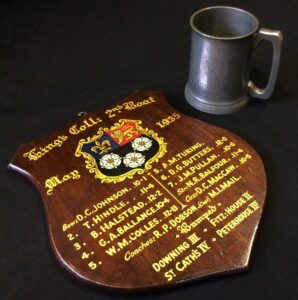
In 1931, Alan won an Open Scholarship in Mathematics to King’s College Cambridge, where in his first term he joined the King’s College Boat Club. Alan won several tankards for his performance in trial eights and included in the Turing Archive held at Sherborne School is the pewter tankard he was awarded in 1933. The tankard is engraved ‘K.C.B.C. TRIAL EIGHTS 1933’ along with the signatures of the team: C.F. Earp, A.F. Eliott, T.S. Elliott, J.P.D. Mounsey, M.F. Mounsey, Eugene Rostow, S. Skewes, A.M. Turing, J. Turner Patterson, D.G.M. Williams.
Alan also took part in the May bumps at Cambridge in 1934 and 1935. Despite having passed his final exams in 1934 and retired from rowing, Alan was still at King’s in May 1935, when he replaced W.M. Colles on the third day after was injured in a brawl. Their boat did well and bumped Downing III, Fitzwilliam House II, St Catherine’s IV, and Peterhouse III, for which they were awarded a set of ornamental oars (one of which is now on display at Bletchley Park) and a shield (which is in the Turing Archive at Sherborne School). The King’s College team in the 2nd Boat that year were D.C. Johnson (bow), T. Hindle, B. Halstead, G.A. Ballance, W.M. Colles, A.M. Turing, D.G. Butters, J.M. Pullan, N.R. Balfour, and D.C. MacCaw (cox). The coaches were R.P. Dobson and M.I. Mail.
In 1933 and 1934, Alan’s school friend Peter Hogg rowed for Oxford University in the Boat Race which was won in both years by Cambridge.
RUGBY FOOTBALL
From 1922 to 1926, Alan Turing attended Hazelhurst Preparatory School in Sussex, where his Headmaster, Willoughby Darlington, wrote a rhyming couplet about him which suggested that any interest Alan showed in rugby football had more to do with mathematics than in the game itself:
‘Little Turing’s fond of the football field
For geometric problems the touch lines yield.’
Alan continued to play rugby football at Sherborne School, appearing for his House in inter-house matches.
In February 1927, Alan played for Westcott House in the Thirds Challenge Round against Harper House. Unfortunately, due to a reduced side, Westcott House lost the game 22-0. The following account of the game appeared in the Westcott House games book: ‘There were only six of the original side and only thirteen left in the house under thirds age. They defended fairly well in the first half at the end of which they were all over Fox’s [Harper House] for five minutes. Score at half time was 8-nil. During the rest of the game the play, especially the collaring, was very poor.’ The Westcott House team were L.L.W. Bamber, M.H. Blamey, V.D. Carse [later famous as an explorer and the radio voice of Dick Barton], W.G. Cockcraft, A.W. Dawson-Grove, J.D. Henderson, G.R. Maclure, P.H.D. Panton (captain), J.R. Phillips, P.R. Read, J.W. Setten, A.M. Turing.
On 13th November 1930, Alan again appeared for Westcott House in the first round of the inter-house Junior XV. They played Elderton’s house (Abbeylands) and lost 18-0. The Shirburnian reported that ‘the game was fairly even till the end of the first half, when Elderton’s scored twice, once through a forward rush and once through a break-through by Russell. In the second half O’Hanlon’s [Westcott House] defence broke down and Elderton’s [Abbeylands] scored two quick tries resulting from forward rushes. The play was again fairly even till towards the end the winners went over for two more tries.’ The Westcott House games book singled out for mention Alan’s unique contribution to the game: ‘In the loose everyone in time was conspicuous and elsewhere in tackling & general common-sense. Turing was the only star, in no danger whatever of being eclipsed by a rival. Unfortunately Turing has a violent dislike to running with the ball, or even holding it, which detracts from his value as a forward.’
In February 1931, Alan was a member of the Westcott House senior XV that played in the first round against Harper House, and this time they won the game 6-0. The Westcott House team were G.M. Addison, J.K. Baker, G.G. Best, W.S. Bevan, G.G. Briggs, I.D.W. Cramer, W.H. Dowdeswell, R.S. Elwell-Sutton, J.D. Henderson, H.V. Hoey, P. Hogg, J.D.H. Iles, L. Knoop, J.F. Oats, A.M. Turing. In Alan’s end of term report, Geoffrey O’Hanlon wrote that Alan had ‘played footer really well.’
SKIIING
Alan learnt to ski on a family holiday at St Moritz in December 1921, and in 1936, while studying at Princeton University, he went on a skiing trip to New Hampshire.
SWIMMING

The outdoor swimming pool at Sherborne School was opened in 1873 and remained in use until the 1970s when it was replaced by an indoor pool in the new Sports Centre.
Although Alan Turing’s name does not appear in any swimming teams, he was known to enjoy ‘wild swimming’. During one cold January at Sherborne, for a bet Alan swam the river Yeo which runs to the south of Sherborne, and in January 1948 he dived into a cold lake which, it is believed, caused him to contract fibrositis which prevented him from taking part in the men’s marathon at the 1948 London Olympic Games.
Alan also enjoyed swimming on holidays spent in Sark and Cornwall with his housemaster Geoffrey O’Hanlon and other boys from Westcott House.
Rachel Hassall
Archivist, Sherborne School.
See also:
For further information about the Sherborne School Archives please contact the School Archivist
Return to the School Archives homepage