
Cecil Day-Lewis CBE (1904-1972) (Harper House 1917-23), Poet Laureate 1968-1972.
Cecil Day-Lewis was born on 27 April 1904 at Ballintubber, County Mayo, Ireland, to Frank Cecil Day-Lewis, a Church of Ireland curate, and his wife Kathleen Blake Squires.
He attended Wilkie’s Preparatory School in London, and in September 1917, aged 13, he arrived at Sherborne School, boarding at Harper House in Hound Street where he eventually became Head of House.
Cecil’s talent for writing was already evident at Sherborne where in 1922 and 1923 he won the School’s English Verse prize for his poems ‘St Ambrose’ and ‘The Power of Music’. He was also awarded the Barnes Elocution prize (1922), the Carrington Exhibition (1923), the English Essay prize (1923), Greek Prose prize (1923), Latin Verse prize (1923), Latin Prose prize (1923), and was editor of The Shirburnian.
A keen sportsman, he was a member of the 2nd XV rugby team (1923) and also played rugby, fives and cricket for his house. His entry in the Harper House games book describes him as ‘A good fly or scrum half, with a good turn of speed. Saves his side much by very good kicking but at present is rather fond of trying to get over the line on his own. A good collar and generally manages to stop a forward rush. 1921 House Cap.’
He also enjoyed singing and was a member of the School Choir. In December 1921 he was solo chorister at the School’s first joint Festival of Five Lessons and Carols held with the Sherborne Girls’ School choir in Sherborne Abbey. The following extract from The Shirburnian (December 1921) describes the service:
‘The Abbey was full of boys and girls, or young men and maidens. The choir stood in the centre under the tower. Mr Tester conducted and Mr Wearden was at the organ. The service began with a quivering voluntary, but if this was meant to illustrate the supposed apprehensions of the young singers it was thrown away. The singing throughout seemed to us assured and finished, the choir well-balanced and in good tune, and this with the quaint beautiful old music sung in such a place produced an effect of rare harmony such as might belong to the music of the spheres. One felt that however distracted the world was ‘Such harmony alone could hold all heaven and earth in happier union.’ So none of the carols are to be picked out for special praise, lest we should mar this harmony by any disagreement. Between the carols there were sung three Christmas hymns, and five short lessons on the Christmas theme were read by Canon Goodden, the Headmaster, Mr Bensly, the Head of the School, and one chorister, Day-Lewis.‘
In the Sixth form Cecil was invited to join The Duffers, a literary society founded at the School by the Rev. Henry Robinson King (1855-1935) with the aim ‘To keep its members alive to all that is best in English Literature, and to do so in as happy and congenial surroundings as possible.’ Many years later, to celebrate the 50th anniversary of the founding of the society, Cecil gave a paper to the Duffers on the 6 June 1948 in which he paid tribute to the society and to its founder, and by then his father-in-law, the Rev. H.R. King.
On leaving Sherborne in 1923, Cecil was awarded a Classics Exhibition at Wadham College, Oxford, and in 1925, with a £25 legacy, he privately published his first volume of verse Beechen Vigil and Other Poems – a collection of 24 poems dedicated to ‘the Lady Dream-Maker’.
On the 28 December 1928 Cecil was married at Sherborne Abbey to Mary King (1902-1975), the daughter of his former schoolmaster the Rev. Henry Robinson King. The service was conducted jointly by Cecil and Mary’s fathers, with Rex Warner as best man. Cecil’s second volume of verse Country Comets, published in 1928, was dedicated to Mary, and his next collection Transitional Poem, published in 1929, was dedicated to Rex Warner.
During the 1930s Cecil was associated with a group of left-wing poets known as the Auden Group, a collective that included W.H. Auden, Stephen Spender, Christopher Isherwood and Louis MacNeice. Louis MacNeice CBE (1907-1963) had attended Sherborne Prep School from 1917 to 1921 before going on to Marlborough and later wrote with great affection about his time at Sherborne in his poems ‘Carrickfergus’ (1937) and ‘Autumn Sequel’ (1953).
Needing a steady income, Cecil took up a series of teaching jobs at Summer Fields Prep School in Oxford (1927), Larchfield School near Glasgow (c.1928-30), and at Cheltenham College (1930-35). He continued writing and in 1935, under the pen-name Nicholas Blake, published a detective novel A Question of Proof which was, perhaps unwisely, set at a public school. He went on to write twenty more novels under the pen-name Nicholas Blake and even joined the Detection Club whose members included Agatha Christie, Dorothy L. Sayers, Hugh Walpole, Baroness Emma Orczy, and G.K. Chesterton (the club’s first president).
In 1933, largely due to the efforts of Cecil and his friend Victor Clinton-Baddeley (Harper House 1913-18), the author Alec Waugh and his publisher father Arthur Waugh were reinstated into the Old Shirburnian Society, having been asked to resign from it in 1917 following the publication of The Loom of Youth, Alec Waugh’s semi-autobiographical novel about his time at Sherborne School.
The Second World War saw Cecil working for the Ministry of Information, and in 1946 he was appointed Clark Lecturer at Cambridge University.
On 19 September 1947, Cecil and Mary Day-Lewis took their son Nicholas to Sherborne School where like his father before him he boarded at Harper House. In September 1948 Cecil’s second (and last) adventure story for children was published. Possibly inspired by Nicholas’s time at the School, The Otterbury Incident is loosely set in Sherborne (which he renamed Otterbury) and at the King’s School (the old name for Sherborne School).
Cecil remained a proud Old Shirburnian and his re-engagement with Sherborne School put him in a nostalgic mood, the result of which was a collection of poems published in 1948 under the title Poems 1943-1947. In ‘Sketches for a Self-Portrait’ Cecil wrote of ‘the mellow South West town/That spoke to him words unheeded but unforgotten…’, and the almost maternal role that Sherborne played in filling a void left following the death of his mother:
‘So I returned to school, a kaleidoscope
Of shaken images, arguments jangling like glass.
And the wise grey South West town claimed me, calmed me
With the sedatives of routine, the balm of multitude.’
And in ‘The Chrysanthemum Show’ he recalled the feelings evoked in November 1917 when as a boy he visited the town’s annual chrysanthemum show in the Wesleyan School Room (now the Powell Theatre):
‘Here’s Abbey Way: here are the rooms
Where they held the chrysanthemum show –
Leaves like talons of greenfire, blooms
Of a barbarous frenzy, red, flame, bronze –
And a schoolboy walked in the furnace once,
Thirty years ago.’
In 1950, Cecil was commissioned to write A Commemoration Ode to celebrate the 400th anniversary of the founding of Sherborne School by Edward VI. In the poem Cecil describes the centuries of learning and the thread that connects all those who have attended the School:
‘Summers of leaf falling from the skyline trees on the Slopes,
Generations of youth sinking through court and cloisters…
We walk on a buried forest, work on a deep, rich seam
Laid down by their lives and hopes
Whom Sherborne shaped, who saddened or rejoiced her.
The hidden treasure they left here is ours. We inherit the dream
That she spins from living and dead. False starts,
Frayed ends she has known; but still unbroken the thread of her spinning,
The colours fast – blue for a royal beginning,
Old gold of these mellowing walls, young gold in blossoming hearts.’
Today, lines from A Commemoration Ode adorn the glass panels leading from School House to the Old Schoolroom (OSR).
Following Cecil and Mary’s divorce, Cecil was married on 27 April 1951 to the actress Jill Balcon (1925-2009). Cecil’s friend Victor Clinton-Baddeley described Jill in a letter to a master at Sherborne School as ‘an attractive creature & the best woman reader of poetry I ever heard’, adding that she ‘is a charming, kind, friendly creature, far more suited to Cecil than the ravening Rosamund [Lehmann] or the quiet Mary.’
That same year Cecil was appointed Professor of Poetry at Oxford University, a post he held until 1956. He also served as Vice-President to the Royal Society of Literature, was a member of the Arts Council of GB, and in 1964-65 held the Charles Eliot Norton Professorship of Poetry at Harvard University. In 1965 he was made a companion of literature, and in 1968 he succeeded John Masefield as Poet Laureate, the first Irish-born holder of that office since Nahum Tate. He also received honorary degrees from Exeter University (1965), Trinity College Dublin (1968), and Hull University (1970), and in 1968 was made an honorary fellow of Wadham College, Oxford, and was elected to the Irish Academy of Letters. He also has the rare distinction of being the only Old Shirburnian to have been castaway twice (in 1960 & 1968) on long-running BBC Radio programme Desert Island Discs.
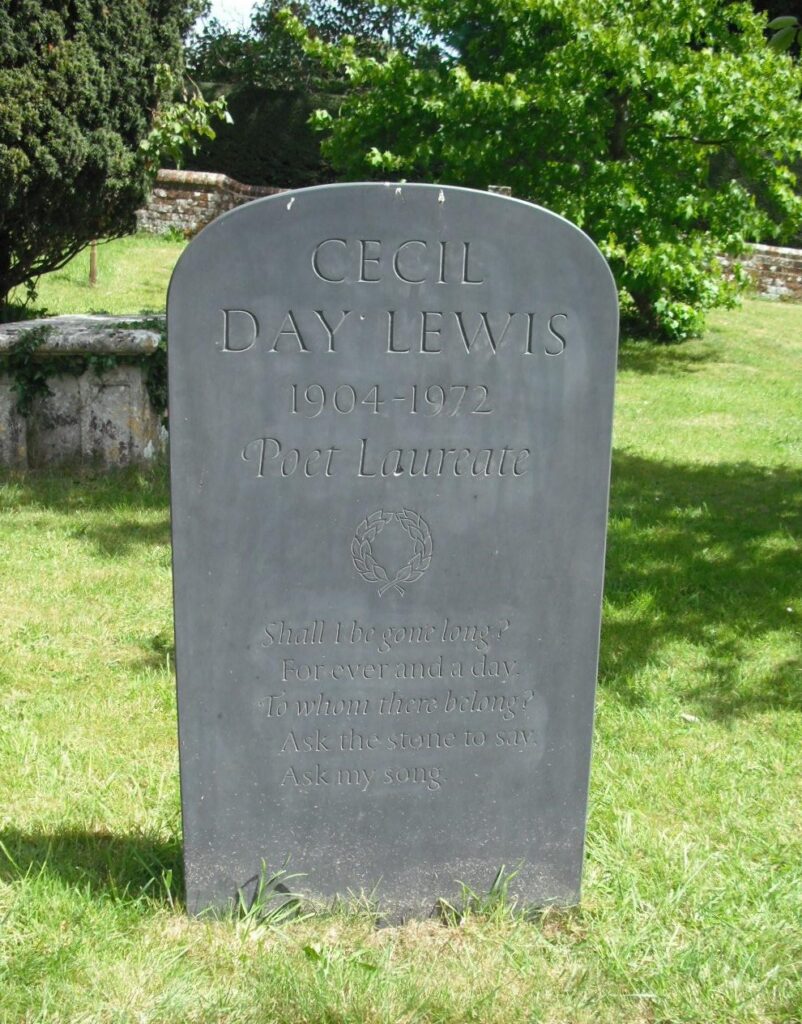
Cecil Day Lewis CBE died on 22 May 1972. He was a great admirer of Thomas Hardy and Vice-President of the Hardy Society and asked to be buried at Stinsford in Dorset near the grave of Thomas Hardy.
Rachel Hassall
School Archivist
See also:
- St Ambrose by Cecil Day-Lewis, 1922 winning English Verse prize (pdf)
- The Torch of Liberty, In Remembrance of July 5th, 1922, by Cecil Day-Lewis, 1922 (pdf)
- The Power of Music by Cecil Day-Lewis, 1923 winning English Verse prize (pdf)
- Wreck near Ballinacarig by Cecil Day-Lewis (first published in The Mosaic, June 1927) (pdf)
- The White Mountain by Cecil Day-Lewis (The Mosaic, June 1927) (pdf)
- The Christmas Tree (The Shirburnian, December 1944)
- The Chrysanthemum Show by Cecil Day-Lewis (Poems 1943-1947)
- The Otterbury Incident by Cecil Day-Lewis (1948)
- Paper given by Cecil Day-Lewis about H.R. King and the Duffers, 1948 (pdf)
- A Commemoration Ode, written by Cecil Day-Lewis in 1950 to celebrate the 400th anniversary of the founding of Sherborne School by Edward VI (pdf)
- Desert Island Discs castaways
- Editors of The Shirburnian
For further information about the Sherborne School Archives please contact the School Archivist.
Return to the School Archives homepage.