
‘He loved Sherborne and her traditions, which he did so much to maintain, and in return Sherborne loves him.’ These lines were written in tribute to Henry Robinson King on his retirement in 1925 from the teaching staff at Sherborne School after forty-two years’ service.
Henry was born on 6 July 1855 at Kirkby Stephen Vicarage, Westmorland (now Cumbria). His father, the Rev. Henry King (1818-1862), was vicar of Kirkby Stephen and his mother, Anne Mason (1816-1894), was the daughter of a local brewer and magistrate. Henry’s father died at Kirkby Stephen on 1 November 1862, aged 44, and a stained-glass window in Kirkby Stephen church is dedicated to his memory.
Henry had four siblings: Thomas (‘Tom’) (1847-1917), Jane (1849-1943), Mary (1851-1952), and William (‘Calc’) (1858-1895). Tom became Resident Obstetrics Officer and House Surgeon at St Mary’s Hospital, Paddington, and William taught at Rossall School in Lancashire before becoming Headmaster of The Towers Preparatory School in Portinscale, Cumbria.
In 1869, Henry went to Clifton College in Bristol, where he was a member of T.E. Brown’s house, the Manx schoolmaster-poet whose poem ‘Betsy Lee’ Henry enjoyed reciting throughout his life. He did well at Clifton, becoming Head of School and a member of the 1st XV. In 1875, Henry was awarded a scholarship to Exeter College, Oxford, where he met his lifelong friend Reginald Blomfield (1856-1942), the architect later credited ‘as the man responsible above all others for the aspect of modern Sherborne [School].’
On leaving Oxford in 1879, Henry was articled to a firm of solicitors in Kendal but after four years decided that the law was not for him and, following a few months teaching at Clifton College, in September 1883 he was appointed assistant master at Sherborne School where he remained for the next forty-two years, teaching form IVA and imparting to his pupils his passion for English literature and poetry.
In 1894, Henry asked Reginald Blomfield to enhance the interior of the Big Schoolroom (built in 1877), possibly with the aim of creating a space more akin to Exeter College Hall where they had first met. Over the next 32 years, Blomfield designed all the major new buildings at Sherborne School, including the Carrington Building and Westcott Art School (1910), the classrooms in the north range of the Courts (1913), the Devitt Court workshops (1921), the war memorial staircase and ante-chapel (1922), the gate tower to the Courts (1923), the gymnasium (1923), and the Music School (1926). Henry’s affection for the Big Schoolroom was such that in a will he made in September 1899 he left £1,000 to the School Governors for building two new classrooms so that the BSR ‘may never in the future be again used as a common schoolroom or classroom’, however, in a codicil to his will written in March 1919 he revoked the legacy saying he had previously given the School considerably over this sum during his life!
At a meeting held at Commemoration Day on 26 June 1896, Henry founded the Old Shirburnian Society. The aim of the society was ‘to keep Old Shirburnians in touch with the School and with each other.’ Henry held the post of Honorary Secretary from 1896 until 1924 when he was made a vice-president.
On 4 January 1898, Henry married Emily Constance (‘Connie’) Gray (1871-1945), daughter of Alexander Gray and Maria (née Miller) of Edinburgh. They had five children: Henry (1900-1971), Constance Mary (1902-1975), Alexander (1904-1970), Francis William (1907-1981), and Charles Mason (1910-1987). Prior to their marriage Connie had nursed at Nottingham Hospital, and during the First World War she worked as a part-time VAD nurse at Sherborne Castle Auxiliary Hospital. Connie and Henry were supporters of women’s suffrage, attending local meetings, and they voted together for the first time in a general election on 14 December 1918.
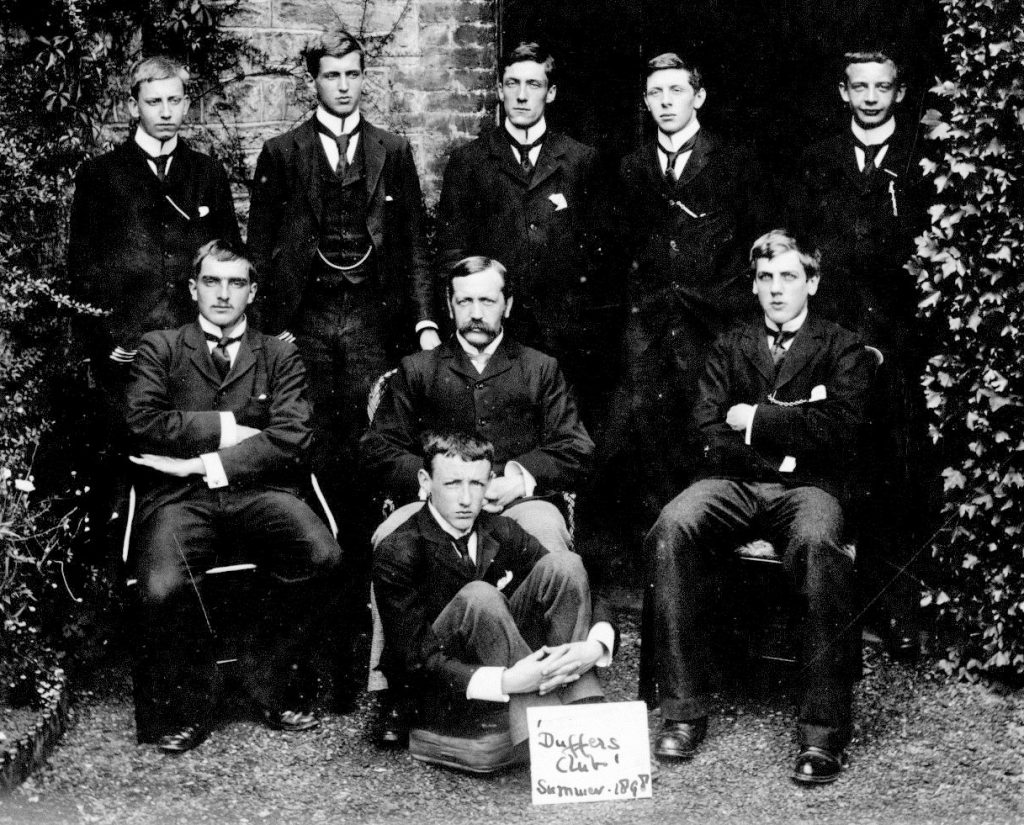
In May 1898, Henry founded the Duffers, a literary society for selected members of the Sixth Form in the model of Winchester College’s ‘stolidi’. Henry defined the purpose of the Duffers, ‘To keep its members alive to all that is best in English Literature, and to do so in as happy and congenial surroundings as possible.’ The Duffers met six times a term to read papers on subjects of their own choice and at the last meeting of each term a Shakespeare play was read by all the members. At the first meeting, which was held on 22 May 1898 at Henry’s home on Greenhill (now Cumnor House), Henry read a paper on ‘Socialism’. On 23 November 1930, Henry attended a meeting of the Duffers at which the 18-year-old Alan Turing read a paper entitled ‘Other Worlds’. Henry resigned from the presidency of the Duffers in 1931.
In 1900, Henry took over the housemastership of Abbeylands from C.H. Hodgson (1857-1922) and remained housemaster until 1919. In 1925, a former Abbeylander wrote of him, ‘all old Abbeylanders will unite in saying that their housemaster taught them, more by example than precept, that a love of music, of poetry, of all beauty can be united with real manliness. Thanks to him, one old boy of the house had as his constant companion throughout the Boer War a ‘Golden Treasury’, another throughout the last war kept in his pack a ‘Browning’ which he was first inspired to read at Abbeylands.’
In 1904, Myths from Pindar, chosen and edited by H.R. King, was published by George Bell & Sons. The aim of this school’s edition was, Henry stated in the Preface, ‘to stimulate the imagination and strengthen the love of literature rather than to train the mind in verbal accuracy or educate it by the mastery of difficulties… But, as Pindar is a difficult author both in language and connexion of thought, I have considered it essential to give much help. With his difficulties smoothed away this poet is well fitted by his heroic theme and splendid vigour to excite the imagination of boys of any literary bent.’
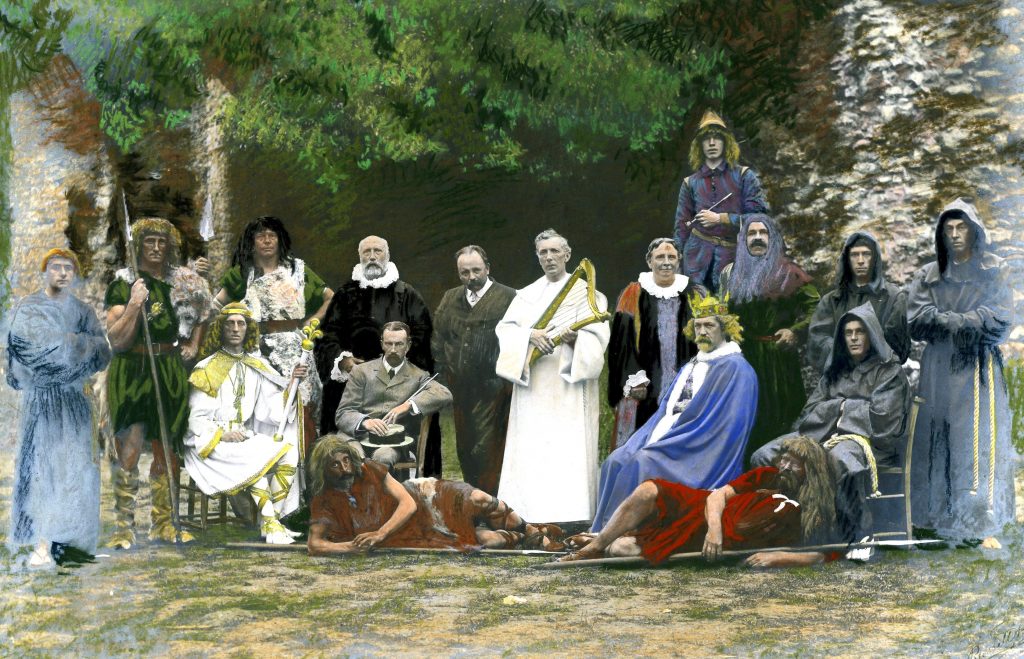
Henry took the role of King Ine of Wessex in episode 1 of the Sherborne Pageant, which was staged at Sherborne Old Castle from 12 to 16 June 1905. His son, five-year-old Henry, also appeared in episode 1 of the Pageant. Over 800 performers took part in the Sherborne Pageant which was estimated to have been attended by 30,000 visitors.
Following the appointment in September 1909 of the School’s first lay Headmaster, Nowell Charles Smith (1871-1961), Henry decided to read for ordination. He was ordained by the Bishop of Salisbury on 24 April 1910 and held the role of School chaplain from 1910 until 1933.
The First World War brought many challenges for Henry and Sherborne School. Thirty-seven Abbeylanders and five members of the School’s teaching staff (A.G.J. Alderson, K.H. Culpin, G.L.B. Lloyd, H.G. May, T.H.H. Wood) died on active service during the war and their names are remembered on the walls of the staircase and ante-chapel designed by Reginald Blomfield (consecrated on 5 July 1922). On the staircase a wall plaque is inscribed with a couplet suggested by Henry from Milton’s Paradise Lost: ‘Nor love thy life nor hate; but what thou liv’st/Live well – how long or short permit to Heaven.’
On 19 July 1917, Grant Richards published a semi-autobiographical novel written by a former Sherborne School pupil, Alec Waugh (1898-1981). Alec had been a member of the Duffers, though Henry had considered him rather precocious. Alec’s novel, The Loom of Youth, caused great controversy at Sherborne School with the result that Alec and his father resigned from the Old Shirburnian Society (they were not reinstated until 1933) and Alec’s brother Evelyn Waugh was sent to Lancing College rather than Sherborne School. Henry was not amused to discover that he appeared in The Loom of Youth as ‘Claremont’ and felt he had been caricatured by Alec Waugh as ‘a feeble ass, lover of poetry, with a cribbing form, anaemic house, etc.’
On 27 December 1928, Henry’s daughter Constance Mary (‘Mary’) King was married in Sherborne Abbey to one of Henry’s former pupils, Cecil Day-Lewis (1904-1972), who in 1968 was made Poet Laureate. They had two sons, one of whom, Nicholas, later attended Sherborne School. The couple divorced in 1951.
In 1926, Henry’s portrait was painted by the artist Gertrude Powys (1877-1952). The portrait was presented to Henry by the Powys brothers who greatly admired their former teacher.

Henry Robinson King died on 28 September 1935, aged 80. His funeral took place in the School chapel on 1 October 1935 and was conducted by his friend the Rev. Arthur Field, who had succeeded him as Secretary of the Old Shirburnian Society. A memorial pew (no.83) in the School chapel, where Henry served for so many years as chaplain, is named in his memory, and the Old Shirburnian Society set up the H.R. King Memorial Fund to found a scholarship for the education of boys who show a proficiency in English studies and to ‘perpetuate the memory of one whose outstanding characteristic was his profound love of English poetry and of the English countryside.’
Connie King died on 31 July 1945, the day before her 74th birthday. Her obituary, which appeared in the Old Shirburnian Society Annual Report (December 1945), remembered the important role she played in the life of the School: ‘Old boys will not forget her gentle, unassuming, considerate and kindly ways, nor will the members of her Duffers, who for more than twenty years enjoyed her hospitality at the terminal reading of a Shakespeare play, nor the many other friends whom her life in Sherborne brought her into contact. She was a good wife, a good mother and a good friend, and her memory will always be cherished by those who knew her.’
Throughout his life, Henry kept a daily diary. Thanks to a generous loan by the King family, fifty-eight of Henry’s diaries, covering the years 1865, 1866, 1868, 1870-1879, 1881-1889, 1892, 1894, 1895, 1897-1900, 1904, 1906-1931, are now held in the School Archives.
Online resources:
H.R. King’s introduction & preface to his Myths from Pindar (1904) (pdf)
‘Influence of Women in Pedagogy’, by H.R. King (1909) (pdf)
VAD nursing card for Connie King, 1914-1916 (pdf)
Letter from H.R. King to Alfred Hardcastle re. The Loom of Youth, 1917 (pdf)
H.R. King’s review of L.N. Parker’s autobiography, Several of My Lives (1928) (pdf)
Obituary for H.R. King by John Cowper Powys, 1935 (pdf)
Obituary for H.R. King by Littleton Charles Powys, 1935 (pdf)
Obituary for H.R. King by Geoffrey O’Hanlon, 1935 (pdf)
Obituary for H.R. King by Nowell Charles Smith, 1935 (pdf)
Paper given by Francis King about his father H.R. King and the Duffers, 1948 (pdf)
Paper given by Cecil Day-Lewis about H.R. King and the Duffers, 1948 (pdf)
Paper given by Francis King about his father H.R. King (c.1967) (pdf)
H.R. King, Sherborne and the fight for Women’s Suffrage
H.R. King, Sir Reginald Blomfield and the buildings of Sherborne School
Article about H.R. King, OS Annual Record, 2014 (pdf)
An insight into the Powys family through the diaries of H.R. King (2020)
The diaries of a schoolmaster
Duffers Jubilee 1898-1948, with a foreword by Alexander Ross Wallace & articles by Reginald Stanley Thompson, Francis William King, Cecil Day-Lewis, & Geoffrey O’Hanlon (Sherborne, 1949)
See also:
Abbeylands
Sherborne Pageant, 1905
Alec Waugh and The Loom of Youth
Former Headmasters and School Staff
For further information about the Sherborne School Archives please contact the School Archivist.
Return to the School Archives homepage.