
Adam Gosney (1844-1921) was born at Sherborne on 16 May 1844, one of eight children of Thomas Gosney (1813-1864) and Maria Gosney (née Dunell) (1810-1885). The Gosney family lived in Long Street, Sherborne, where Adam’s father worked at the brewery.
By 1861, 16-year-old Adam was working at Sherborne School as a house servant in School House, a boarding house run by Headmaster Hugo Daniel Harper. While working at Sherborne School Adam developed an interest in photography and began taking photographs for the pupils.
A new photographic process had been invented in the early 1850s that used a glass plate to create a negative from which a positive picture could be printed. This new process made photography easier and cheaper and more commercially viable. In 1855, Thomas Geake (1822-1870) opened Sherborne’s first photographic studio, originally in Acreman Street he later moved his studio to Long Street, which is probably where Adam’s interest in photography was first sparked.
Adam’s early connection with Sherborne School led to him becoming the unofficial School photographer, taking photographs of the staff, pupils, and School buildings, which he sold from his studio.
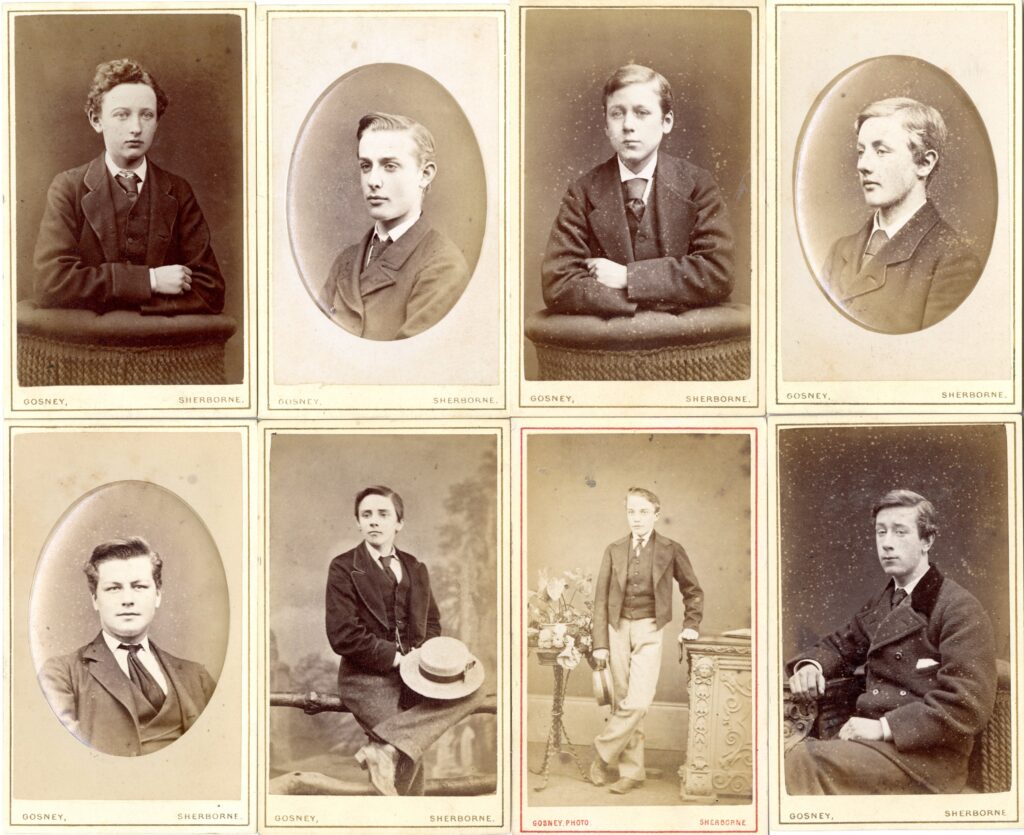
In 1866, Adam established himself in Sherborne as a photographic artist. One of his first commissions was in July 1866, when he took two photographs of the members of the ‘Court Digby’ Sherborne branch of the Ancient Order of Foresters after their annual dinner in a field in Newland, Sherborne.

On 21 April 1867, Adam was married at Bradford Abbas to Harriet Bragg (1832-1899), daughter of George Hooper Bragg (1796-1855), a carpenter, and Ann Green Carman (1807-1882). In the marriage register, Adam gave his occupation as ‘photographer’. Adam and Harriet went on to have three children: Harriet Gosney (born & died 1868), Kate Ellen Gosney (1870-1943) and Edith Gosney (1874-75).
By 1869, Adam had opened a photographic studio in Long Street, Sherborne, which he ran with the assistance of twenty-year old Edwin Targett, who later went on to set up his own photographic business in his hometown of Salisbury, Wiltshire.

In October 1869, the following advertisement appeared in the school magazine, The Shirburnian: ‘An admirer of Photographs wishes to inform the public that some very good new photographs of the School buildings, etc., cabinet size, 1s. 6d. each, can be got in the town, at A. Gosney’s, Long Street.’

In 1873, Adam moved to larger premises in Half Moon Street, Sherborne. He went on to later open photographic studios in Yeovil, Wells, and Crewkerne, as well as running a fleet of mobile photographic studios that travelled around the West Country.
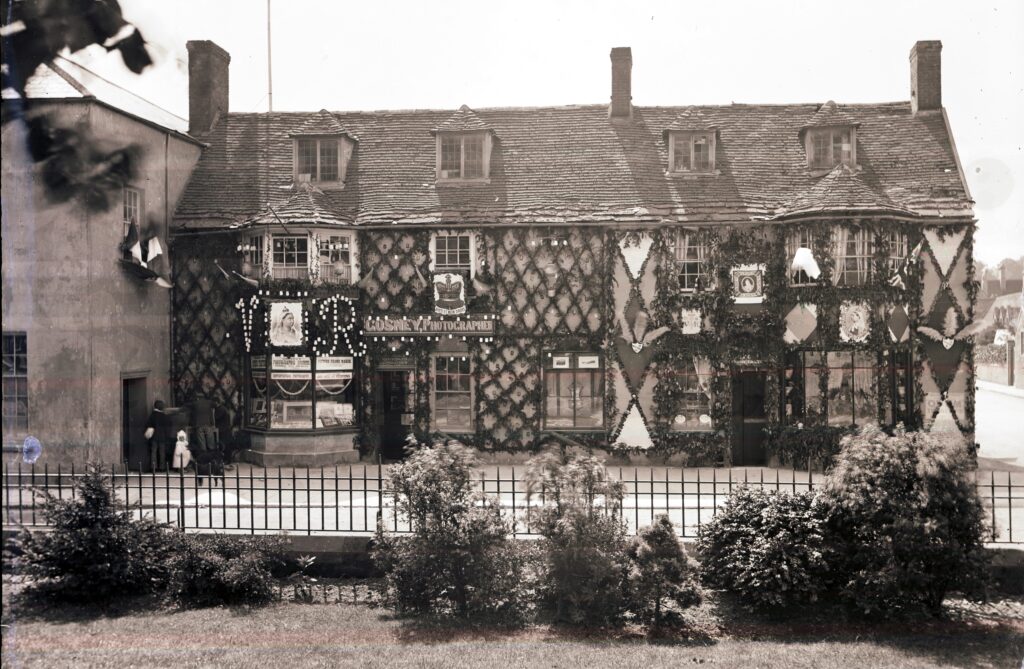
Following the death of his first wife Harriet on 9 October 1899, Adam was married at Yeovil on 14 March 1900 to Jane Martin (1855-1941).
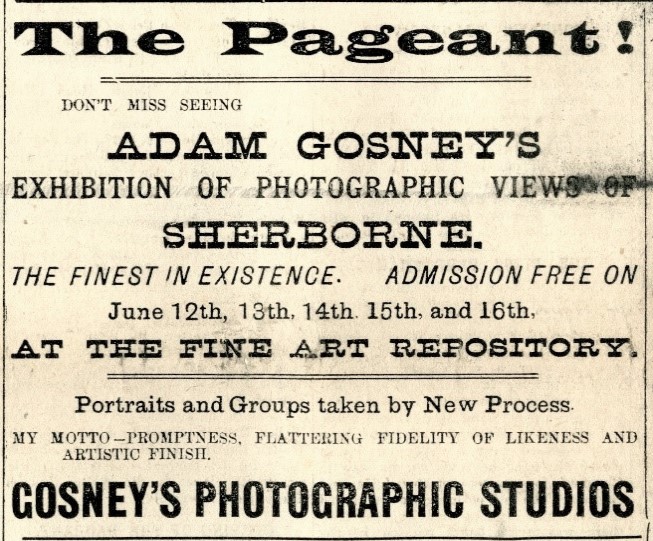
Adam’s business was apparently nearly ruined by the 1905 Sherborne Pageant, for which he had laid in a large stock of photographs in anticipation of the crowds attending the Pageant at Sherborne Old Castle, but because of the trains times, visitors had little time to buy souvenirs and he was left with a huge amount of unsold stock.
Adam suffered a further tragedy on 17 July 1913, when fire gutted his premises in Half Moon Street, destroying the contents of the studio, printing room and several valuable cameras. He was not insured and a subscription list was opened in the town to help with his losses. The following report of the fire appeared in the Western Chronicle on 18 July 1913:

‘In the early hours of Thursday the house and premises of Mr Adam Gosney, Half Moon Street, Sherborne, were discovered to be on fire. The outbreak it seems, originated in one of the outbuildings at the rear of Mr Gosney’s premises, and was discovered some time after midnight. Mr Gosney, from the bedroom in the front, where he and his wife were sleeping, heard the crackling of flames, and, opening the door of the rooms, saw the light of a fire at the back through the window of a room at the end of the passage, and he and his wife quickly raised an alarm. Mr C.A. Ford, of Cheap Street, and Mr E. Pragnell, of the Half Moon Hotel, were amongst the first on the scene. The former, who had just returned from the Police Sports at Dorchester, passed the premises at 1.30 and noticed nothing unusual, but a few minutes later he saw the light of flames from his house and ran quickly to the spot and rung the electric fire alarm, which is fixed, singularly enough, just outside the premises involved, and communicates with Chief Officer J. Newman Taylor’s residence and the house of Fireman Churchill in Wingfield Road. Mr Pragnell, too, saw flames in the yard from his bedroom window, and took the precaution to arouse his guests.
Other neighbours who were early on the scene were Messrs. C.E. Williamson and A. Cooper, who realising the gravity of the situation, went to the railway station and sent a message for the Yeovil Fire Brigade from the signal box. This was it seems, just before the arrival of the Town Brigade, Chief Officer Taylor receiving his call at 12.40, and by the time the old fire bell of the Abbey, which the Verger (Mr G. King) rang, sent forth its alarming notes, was getting away from the Fire Station with the hose cart and some of the men. Unfortunately Fireman Churchill was away from his home at the time, but the firemen who live in Wingfield Road were quickly aroused. When the Fire Brigade arrived on the scene they found the several wooden structures of Mr Gosney burning fiercely, and all the back portion of the dwelling house involved. In a stable nearby were several polo ponies, and these were removed to a place of safety by Mr Noake and others. The efforts of the Brigade were directed to prevent the flames spreading to the front of the premises and to the Plume of Feathers public house on one side, and the premises occupied by Mr Cecil Brett on the other, and in this endeavour they were successful. In the meantime Mr Gosney, assisted by many helpers, succeeded in removing a portion of his furniture out into the street, but little of the contents of the rooms involved could be saved, and Mr Gosney is a very heavy loser. A good deal of furniture was also removed from the threatened portion of the Plume of Feathers and was temporarily stored in the premises of Mr E.J. Tuffin, confectioner in Church Avenue. The Brigade, under Chief Officer Taylor, worked their hardest, and soon had the outbreak well in hand, and by the time the Yeovil Brigade arrived, their services were not required. The fire was got under about 3 am although the firemen were occupied until 7 o’clock. The ringing of the firebell aroused a great many of the townsfolk, and a large crowd witnessed the fire.
As a result of the outbreak the studios (Mr Gosney’s own property) and the outhouse were reduced, with their contents, to a heap of blackened ruins. The whole of the rear part of the dwelling house was gutted, and much damage done to the rest of the premises by fire or water. Some of the bedrooms, &c., in the Plume of Feathers were damaged by water. The property belongs to the Digby Estate, who are insured, but unfortunately Mr Gosney’s very extensive loss is not covered. The contents of the studio and printing room, including several valuable photographic cameras, were entirely destroyed, together with a great number of photographic plates and other material. In the sheds and stalls beneath the studio were several ladders, barrows, and the frames for set pieces of fireworks, and there were reduced to cinders. A huge quantity of negatives, fairy lamps, &c., was also destroyed. Very little of the contents of the rear part of the house was salved. Much sympathy was expressed with Mr Gosney in the misfortune which has overtaken him. Mr Gosney’s furniture, in the saving of which Mr J. Evans, the police, and others materially assisted, was afterwards removed, under the supervision of Messrs. Batchelor and Blanchard, to an empty coach house in Long Street, kindly lent by the Digby Estate, who also provided vans for its conveyance. While helping during the fire, Mr Coleridge, an assistant at Messrs. Dingley & Son, cut his right arm with some glass rather severely, and received surgical attention at the hands of Dr Wilson. The origin of the fire is unknown. It is understood that a subscription list is to be opened in the town with a view to helping Mr Gosney in his serious loss.’
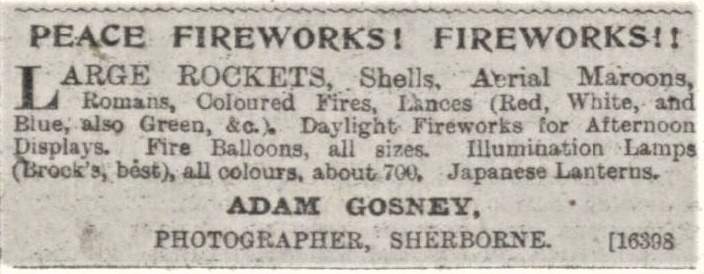
Adam was also a well-known retailer of fireworks in the town. He was a member of the committee of the Sherborne Bonfire Boys, which organised the town’s 5th November celebrations, and he also designed and organised the firework displays at the annual Sherborne Flower Show in the grounds of Sherborne’s Old Castle. It has been suggested that pyrotechnics and photographic fluids were a dangerous combination and that this may have contributed to the ferocity of the fire that destroyed his photographic studio in July 1913.
While attending a meeting of the town’s Carnival Committee in October 1921, Adam was taken ill. He died at his home in Half Moon Street on 11 October 1921, aged 77, and was buried in Sherborne cemetery on 17 October.


Further reading:
- Robin Ansell, Allan Collier and Phil Nichols, Secure the Shadow: Somerset Photographers 1839-1939 (SDFHS, 2018)
- Katherine Barker, Sherborne Camera (The Dovecote Press, 1990)
- Photographers of Yeovil on Yeovil’s Virtual Museum by Bob Osborn
- Susan Penn and Ray Penn, A History of Long Street, Sherborne (SDFHS, 2008)
- Photographs of Sherborne women by Adam Gosney (Strong Women of Sherborne)
- Former Headmasters and School Staff
For further information about the Sherborne School Archives please contact the School Archivist
Return to the School Archives homepage