
Alan Turing attended Sherborne School from May 1926 to July 1931, during which time he boarded at Westcott House in Horsecastles.
Alan was supposed to have arrived at Sherborne by train on Tuesday 4th May 1926 for the start of his first term at Sherborne School[1]. His family were then living at Dinard in France[2], from where 13-year old Alan set off alone for Sherborne, taking the ferry from Saint-Malo to Southampton from where he would travel by train to Sherborne.
However, on arriving at Southampton Alan learnt that the Trade Union Congress had called a general strike in support of the miners and that no trains were running. Alan’s mother had evidently seen this as a possibility and had supplied him with a Plan B, which involved leaving his trunk at Southampton and cycling to Sherborne.
With Plan B now in place, Alan sent a telegram to his housemaster Geoffrey O’Hanlon at Westcott House informing him that he would be a day late arriving at Sherborne. Having brought his bicycle with him from France, Alan purchased a map of the route from Southampton to Sherborne and prepared to set out on a 63 miles (104km) bicycle ride.[3]
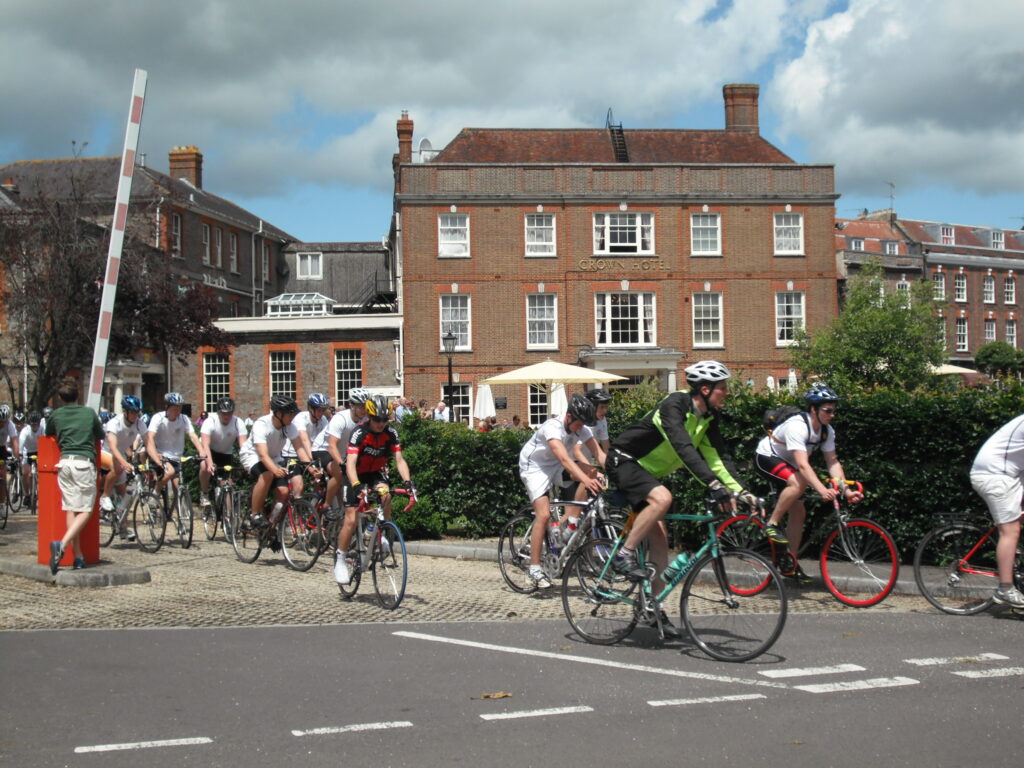
Leaving Southampton Alan headed to the New Forest, passing through Lyndhurst (where he bought an apple for 2 pence), Burley (where he had his bicycle pedal repaired), Ringwood and Wimborne Minster. On reaching Blandford Forum he checked into the Crown Hotel for the night and was amused when the following morning the hotel staff turned out to see him off on the last leg of his journey to Sherborne.[4]
Twenty-eight years after Alan’s arrival at Sherborne on 5th May 1926, Alan’s former housemaster wrote to Mrs Turing recalling that day:
‘… the picture I keep and treasure is of a somewhat untidy boy arriving during the Railway Strike, after making his way on a bicycle from Southampton via the best hotel in Blandford, and reporting, ‘I am Turing.’ It was a good start.’[5]
News of Alan’s epic journey to Sherborne was picked up by the local press. Alan was very amused when Mr Darlington, his former Headmaster at Hazelhurst Prep School in Sussex, sent him a copy of the Western Gazette which included the following report of his cycle ride:
‘On the first day or two of the stoppage the scholars of the King’s School and the Sherborne School for Girls were due to return. Many of them had returned before the railway services were disorganised, but many others only arrived at Sherborne after great inconvenience, and in some cases unforgettable experiences. In one case a boy from France, who was coming to Sherborne School, could not get any further than Southampton, but he cycled from there through what was to him unknown country, and arrived safely at Sherborne.’[6]
With the staff of many national newspapers supporting the strike, copies of the Western Gazette were sold for the first time in the newspaper’s history on the streets of London, becoming for a brief period the largest newspaper on sale in the city. Copies were also distributed in Somerset, Dorset, Wiltshire and Hampshire, where crowds desperate for news eagerly awaited its arrival.[7]


On Wednesday 5th May, having arrived that day at Sherborne, Alan sat down to write to his parents giving details of his journey[8]. That same day a poster was displayed in the town by the Sherborne Urban District Council asking the town’s inhabitants and schools to reduce their use of coal and gas which were needed to power the water supply. The UDC also warned the town’s traders not to increase their prices and announced that ‘to save unfounded rumours’ official telegrams would be exhibited in named shop windows in Half Moon Street and Cheap Street. Volunteers were asked to come forward who were prepared to loan their vehicles or to help out in the community.[9]
The only workers on strike at Sherborne in May 1926 were the railway men and members of the Typographical Association, although the town’s gloving factories were also considering closing. Local food supplies were maintained during the strike with the help of the Food Officer (Mr George Lowman) and the Transport Officer (Brigadier-General T. Bruce). Two hundred and thirty people in the town came forward to volunteer, some working as special constables guarding the petrol depot at the railway station. Boys from Sherborne School helped out by transporting barrels of tar from the railway station to the Council depot.
To ensure that people were kept informed of what was going on, Prime Minister Stanley Baldwin’s government published a short-lived newspaper – the British Gazette. Copies of the British Gazette were posted daily in a shop window in Half Moon Street and the text of a speech made by the PM on the night of the 8th May was issued in Sherborne the following morning.[10]
Despite the Trade Union Congress calling off the strike on 12th May, Alan’s trunk did not arrive at Sherborne until two weeks after he had left it at Southampton. This meant that not only did Alan not have a change of clothes or his school books for two weeks, but also that he wasn’t able to take part in house games because he didn’t have his cricket whites.[11]
When Alan returned home (by train) at the end of his first term at Sherborne he took with him his school report, on which his housemaster attempted to sum up this resourceful and independent boy who was prepared to cycle 63 miles to get to School:
‘Quite a good start. He appears self-contained & is apt to be solitary. This is not due to moroseness: but simply I think to a shy disposition.’’[12]

Rachel Hassall
Archivist, Sherborne School
Revised 5 May 2026
References:
[1] Sherborne School Blue Book, Summer Term 1926, Sherborne School Archives.
[2] Dermot Turing, Reflections of Alan Turing: A Relative Story (The History Press, 2021), p.42.
[3] Letter from Alan Turing, Westcott House, Sherborne, to his parents, 5 May 1926, ref. AMT/K/1/17 King’s College Archives, University of Cambridge.
[4] Sara Turing, Alan M. Turing: Centenary Edition (Cambridge University Press, 2021), p.24.
[5] Sara Turing, Alan M. Turing: Centenary Edition (Cambridge University Press, 2021), p.38.
[6] ‘How Sherborne Carried On’, Western Gazette, 14 May 1926, p.4, The British Newspaper Archive (accessed online 7 January 2022)
[7] ‘The Western Gazette. How Last Week’s Issue was Distributed’, Western Gazette, 14 May 1926, p.8, The British Newspaper Archive (accessed online 7 January 2022)
[8] Letter from Alan Turing, Westcott House, Sherborne, to his parents, 5 May 1926, ref. AMT/K/1/17 King’s College Archives, University of Cambridge.
[9] ‘General Strike’ poster, issued by Sherborne UDC, 5 May 1926, Dorset History Centre, ref. DC-SHU.
[10] ‘How Sherborne Carried On’, Western Gazette, 14 May 1926, p.4, The British Newspaper Archive (accessed online 7 January 2022)
[11] Letter from Alan Turing, Westcott House, Sherborne, to his parents, undated, but written after 14 May 1926, ref. AMT/K/1/18 King’s College Archives, University of Cambridge.
[12] Alan Turing’s School Report, Summer Term 1926, Sherborne School Archives.
See also:
- Alan Turing at Sherborne School
- Letter from Alan Turing to his parents telling them about his journey from Southampton to Sherborne, 5 May 1926 (ref. AMT-K-1-17 King’s College Archives, University of Cambridge)
- Letter from Alan Turing to his parents telling them about his first few days at Sherborne School, May 1926 (ref. AMT-K-1-18 King’s College Archives, University of Cambridge)
For further information about the Sherborne School Archives please contact the School Archivist
Return to the School Archives homepage