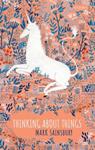
 In the blink of an eye, I can redirect my thought from London to Austin, from apples to unicorns, from former President Obama to the mythical flying horse, Pegasus. How is this possible? How can we think about things that do not exist, given that they are not there to be thought about?
Thinking about, wanting, hoping and similar states are intentional states: they are directed on things or are about things. Taking as its framework a representational theory of mind, this book explains how intentional mental states are attributed, what their “aboutness” consists in, whether or not they are relational, and whether any of them require there to be nonexistent things.
If you want a beer, it’s not that you want a representation of a beer. But your desire does involve representing a beer. Representational theories are sometimes discredited on the grounds that they claim that our thoughts and fears are about representations. My view is that representations are what we think with, and normally not what we think about, just as our eyes are what we see with, and normally not what we see.
The representations to which I appeal are concepts. Concepts are like words in the language of thought; words in public language express concepts. Concepts combine to make thoughts, and thoughts are evaluable for truth or falsehood. The concepts FIDO and BARKS can be brought together to form the thought that Fido barks.
The heart of the book is display theory, a claim about how concepts figure in attributions of intentional states: they are displayed, and the attribution is correct if the concepts displayed match those in the mind of the subject. When we say that Ursula is thinking about unicorns, we do not use the concept UNICORNS in the normal way, the way we would use it if we said there were unicorns in the park. Instead, we put the concept UNICORNS on display, and our attribution is correct if Ursula is exercising that concept in her thinking. Display theory explains the intensionality of our attributions: some of them seem to involve nonexistent things, and they typically have semantic and logical peculiarities, like the fact that there may be no landscape that a representational landscape painting is a painting of. Display theory predicts that a
concept that refers to nothing may be used in a correct attribution of what someone is thinking, explaining how Ursula can think about unicorns; and it allows that an indefinite concept, like A LANDSCAPE, may be displayed in describing what a painting is of, without commitment to there being a corresponding landscape.
The nature of concepts is critical to this story. I describe how they can be learned, originated and given a systematic semantic description, independently of whether there exist things to which they refer. There being no things we are thinking about does not mean we are not thinking about things.
- Hardcover: 224 pages
- Publisher: OUP Oxford (24 May 2018)
- Language: English
- ISBN-10: 0198803346
- ISBN-13: 978-0198803348