Taken from With the Flag to Pretoria:
‘The announcement of the relief of Mafeking was made somewhat unconventionally by an excited footman at the Mansion House at 9.35 pm on May 18th 1900. In an instant the news was all over the crowded space in front of the building, and as if by magic, scores of Union Jacks made their appearance, whilst the crowed sang “God Save the Queen” and cheered for Baden-Powell, Roberts, and all the generals they could think of. The scenes in the West End were equally exciting; not even on Ladysmith day had the sombre metropolis witnessed such rejoicings.’

Western Gazette, Friday, 25 May 1900:
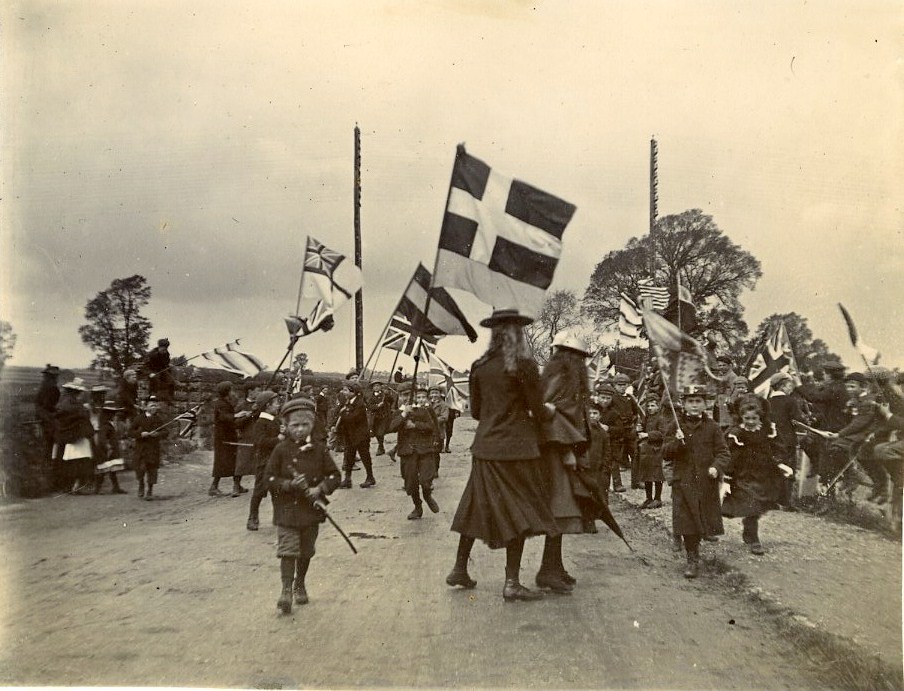
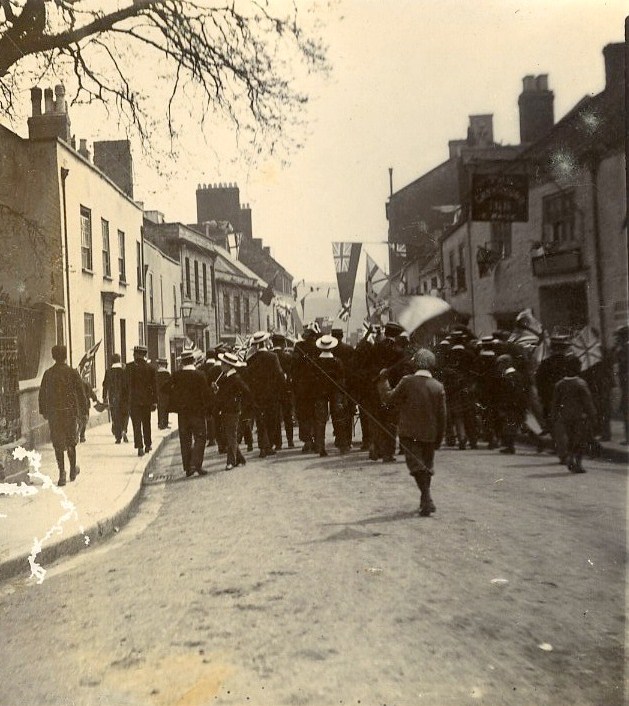
‘The news was received with much joy in Sherborne on Saturday [19 May 1900]. The town was already liberally adorned with bunting in connection with the Yeomanry encampment, but additional streamers were suspended over the principal thoroughfares. Union Jacks in profusion were displayed, the Abbey bells pealed forth the good tidings, and everywhere the utmost enthusiasm prevailed. A streamer which was particularly noticeable was suspended across Cheap Street, near the Post Office, having on one side “Hurrah for Baden-Powell” and on the other “Bravo, Mafeking.” About half-past twelve a procession was formed, hundreds taking part, and the boys of Sherborne School turned out en masse, leading the way with Union Jacks, &c. The Band of the G Company of Volunteers, led by Bandmaster Hodges, played national airs, and with the processionists made a circuit of the town, the demonstration ending up at the Parade, where cheers were given for the Queen, Colonel Baden-Powell, and others. In the forenoon a short service was held in the chapel at Sherborne School, after which “God Save the Queen” was sung.
The scene at the Yeomanry camp was of the liveliest description. The Sherborne Troop, led by Sergt. Major Pye, formed up and marched to the officers’ tent, where cheers were given for the Queen, Colonel Baden-Powell, and the officers. “God Save the Queen” was sung, and cheers were given again and again for the heroic defender of Mafeking. Streamers of flags and banners were run up near the officers’ mess, and most of the tents were decorated in honour of the event. In one of the larger tents an improvised band was formed in the absence of the Regimental Band, and popular pieces were played. In the afternoon a feu de joie was fired from two pieces of cannon (lent by Mr Abel Adams), near the site of the camp, by Mr R. Adams.
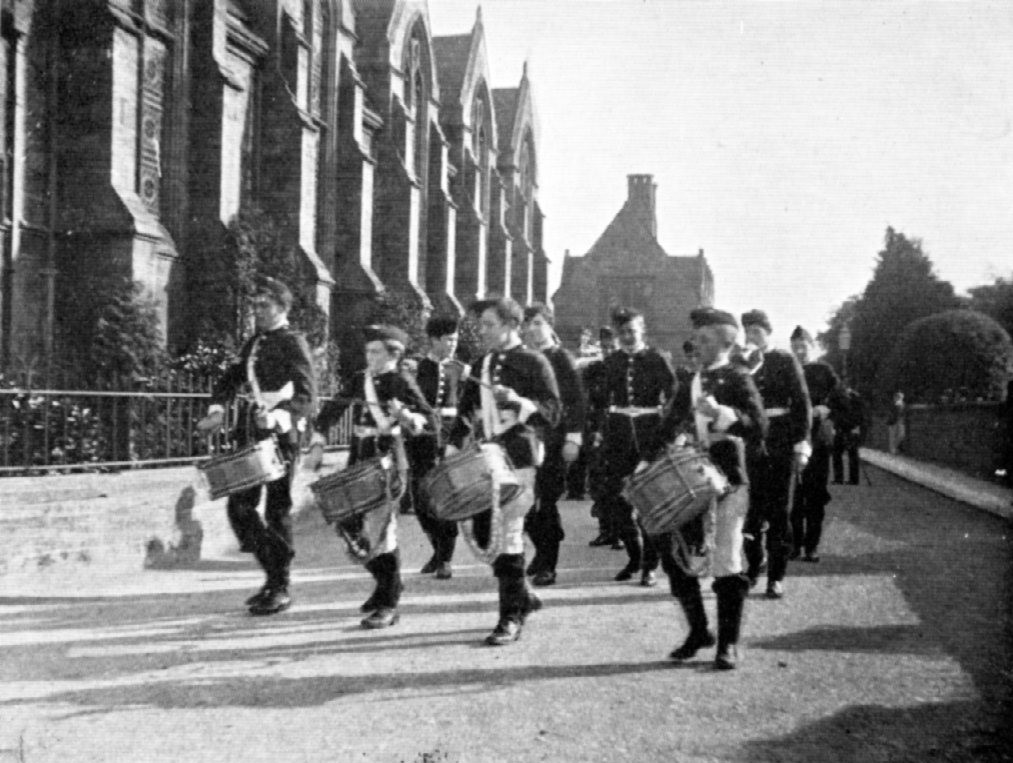
Although there was not much display in the way of firing at the Yeomanry camp this was compensated by the performance of the Sherborne School Cadets, who, after a very smart parade, fired “three rounds of blank” as a feu de joie in the School Quadrangle on Saturday evening [19 May 1900]. Mustering 103, the Cadets started from head-quarters at 7.20. Captain Wildman was in command, and there was also in attendance Lieutenant Dunkin, Lieutenant Carey, and Sergeant-Major Folkes. Headed by the band the Cadets marched up Cheap Street, along Newland, Long Street, and Lower Cheap Street, to the School Quadrangle. After firing the feu de joie they gave three cheers for the Queen and Colonel Baden-Powell, and were subsequently dismissed.
At the Abbey on Sunday morning “God Save the Queen” was sung at the commencement of the service, and the Rev. A. Daunt preaching from i. Samuel, vii., 12, “Hitherto hath the Lord helped us,” touched briefly upon the relief of Mafeking, remarking that the nation was rejoicing with one heart and voice for the deliverance of the gallant little band who had so nobly and bravely upheld the honour of Queen and country. They must remember, however, that whilst they rejoiced and offered their congratulations and honoured those who were serving so faithfully, it was their duty to recognise the hand of God in every deliverance.
References were also made at the various churches and chapels in the town, either in the prayers or sermons, and merry peals were rung on the Abbey bells.
At a meeting held in SS. John’s Hall on Monday evening, Mr W. Seymour (chairman of the District Council) presiding it was resolved, on the motion of Mr F. Bennett, seconded by Mr G.F. Stokes, that Wednesday, the 23rd, be observed as a general holiday, the shops and other businesses closing at 11 am for the rest of the day. It was stated that the Yeomanry would march through the town, and probably the Volunteers and Cadets, followed by the townspeople, and a committee was appointed to carry out the details. Cheers were given for the Queen and Colonel Baden-Powell, and “God Save the Queen” was sung.
Sherborne kept high holiday on Wednesday [23 May 1900] in honour of the gallant defence and relief of Mafeking. The shops and other places of business closed at 11 o’clock, the schools were closed in the afternoon and the remainder of the day was given up to holiday-making. Joyous peals were rung on the bells of the Abbey, decorations were general throughout the town, and the utmost enthusiasm prevailed. About a quarter to two the Volunteers and Cadets assembled on West Bridge, there being about 40 Volunteers and 197 Cadets, the Cadets being under the command of Captain Wildman, and the Volunteers commanded by Captain Baxter. Headed by the Volunteer Band, under the leadership of Bandmaster Hodges they proceeded up Cheap Street, immediately after the Cadets coming the Rev. A. Daunt, Messrs. J.A. Ffooks, G.F. Stokes, J. Douglas, T.W.R. White, I.O. Trevett, F. Clark, M. Parson, P.D. Roberts, W.J. Ingram, J. Pooley, &c. Following came a large muster of the scholars attending the National and British Schools, carrying flags and cheering lustily. The scene in Cheap Street was one that will not soon be forgotten, the crowds of townspeople being largely augmented by visitors who had come in to see the pageant. Conspicuous were three cyclists attired becomingly in red, white, and blue. Proceeding along Newland a halt was made in the Square, where the combined Companies were ordered to present arms. This done, “God Save the Queen” was sung, and cheers were given, the band swelling the grand acclaim. The Companies then changed ranks, and proceeded to their respective head-quarters, everything having been carried out satisfactorily. In the afternoon the sports were witnessed near the Yeomanry Camp, and these are noticed under the camp news.

DORSET YEOMANRY CAMP SERVICE AND SERMON
[Sunday, 20 May 1900] The Regiment paraded in most favourable weather at nine o’clock for Divine Service, which was held in the open air on the space at the foot of the camp set apart for drill. The Rev. Preb. Westcott officiated. There was a considerable attendance of the general public, who took up the responses fervently. The hymns sung were “O God, our help in ages past” and “Stand up, stand up for Jesus”, the band of the G Company, 1st Volunteer Battalion Dorset Regiment, under the conductorship of Bandmaster Hodges, accompanying. Colonel Brymer, who was in excellent voice and distinctly heard read the Lesson, Deut. vi. to verse 16, being an exhortation to obedience, and in one of the prayers special reference was made to the latest success of the British arms.
Preb. Westcott based his sermon on the text “Hold fast that which is good.” They all knew, he said, that for weeks the country had been anxious to know if the long vigil at Mafeking was passed, and if the heroic garrison had been relieved. Thank God, yesterday the heart of England was full of exultation to hear that Mafeking was relieved. This war had taught them many things, amongst others that a great nation did not live by commerce alone. It has also taught them the wonderful power of kinship and the great power of monarchy when they had a Sovereign on the throne like their own peerless Queen. Further, it had taught them that he people of England, the manhood of England, could still hold fast to that which was good. As under Wellington at the Battle of Waterloo, so at Ladysmith, Kimberley and Wepener, and last and best of all it was given at Mafeking. If the time came when any of the Yeomanry present that afternoon were called to go out to defence of Queen and country no one would be afraid that they or their comrades, who shared in the training last year and were now fighting bravely in South Africa, would not do their duty for Dorset and for England. Someone had said that England’s manhood was sapped, that her soldiers were not what they were, that they were stunted in body, demoralised in spirit, and that they were not as their fathers were; that her officers were mere votaries of pleasure and mere carpet baggers; and that her people had lost their patriotism. Thank God, that had all been proved to be false, and that England had proved her ability to hold fast that which was good. Preb. Westcott then dwelt upon the power and force of goodness. To be good a man must be brave and serious minded. Those comrades who had gone out to the war would come back seriously minded. The man who had heard the bullets whistling over his head and faced death at every turn was serious for the rest of his days. Happy were they who were serious without learning the need of it in a school like that. A desirable trait also was gentleness. Two British Life Guardsmen were walking down the streets of Bloemfontein recently, when a little child ran up to the, and one of them picked the child up and held it lovingly in his arms. A foreign officer was standing by, and said “My friend, I tell you what I think of your Tommies. They’re the finest fellows in the world, brave and gentle.” Then a good man must be loyal and true, and a man of his word, and finally, he must know the Lord Jesus Christ, without which he could not be truly happy. Moreover, the preacher exhorted his bearer to hold fast to that knowledge as the pearl of great price.
At the conclusion of the service the National Anthem was sung, and the troops were dismissed.’
See also:
For further information about the Sherborne School Archives please contact the School Archivist.
Return to the School Archives homepage