Patrick Francis, a former history master at Sherborne School and author of Vivat Shirburnia and Old Yet Ever Young, delves into the history of the BBC’s Sport Personality of the Year and its first winner, Shirburnian Sir Christopher Chataway (1931-2014) (Harper House 1944-49):
Christopher Chataway (1931-2014) – athlete, TV presenter, politician, businessman and humanitarian
When Keely Hodgkinson was crowned as Sports Personality of the Year in December 2024 it was the 19th time that an athlete had won the award in its 70-year history. She follows in the footsteps of such household names as Mo Farah (2017), Kelly Holmes (2004), Paula Radcliffe (2002), Daley Thompson (1982), Sebastian Coe (1979), Mary Peters (1972) and Mary Rand (1964). However, even panellists on a Question of Sport might have struggled to name the very first winner of SPOTY in 1954. The answer is Chris Chataway.
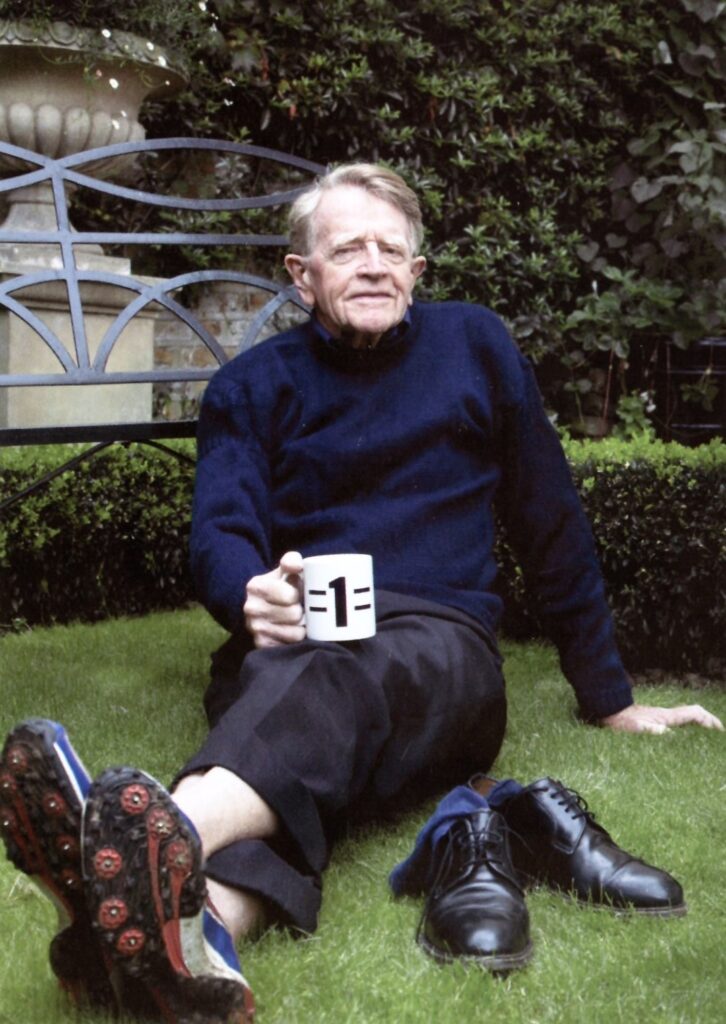
It may seem surprising that it was Chataway who won the award and not his close friend, Roger Bannister, who was the runner-up. After all it was barely six months since Bannister had become the first person to run a mile race in under four minutes, with Chataway acting as one of the pacemakers. But in sport, as in life, timing is everything. Although both Bannister (in an epic race against the Australian, John Landy, dubbed The Miracle Mile, when both athletes again produced sub-four minute performances) and Chataway (in the three mile event) won gold medals in the British Empire and Commonwealth Games at Vancouver that summer, it was Chataway’s subsequent triumph against the Soviet champion, Vladimir Kuts, at White City in a 5000m race, when he set a world record of 13 minutes 51.6 seconds, that enabled him to clinch the inaugural Sports Personality of the Year award. In doing so, Chataway turned the tables on Kuts, who had beaten him into second place at the European Championships in Bern a fortnight earlier. Thus, the handsome Chataway’s success in London (he was nicknamed the Red Fox because of his abundant ginger hair) could be presented as a victory in the athletics of the Cold War and the fact that the contest was televised via the Eurovision network helped to turn him into a sporting celebrity.
In his schooldays at Sherborne, Chataway (Harper House, 1944-49) had enjoyed scholastic as well as sporting success. He won the Lister prize for German in 1947 and was captain of both gym and boxing and also a member of the rugby XV in his final year. In the summer of 1948, he had set new school athletic records for the half-mile and the mile, the latter in a time of 4 minutes 42 seconds, and played a major part in enabling Harper, where he became head of house, to win the school Sports Day in both 1948 and 1949. After leaving Sherborne he went up to Magdalen College, Oxford, where he read PPE and became president of the university athletics club.
Just as in other sports, notably cricket and rugby, England’s leading male athletes as late as the 1950s were more often than not products of public schools and the ancient universities. Chataway, like Bannister (City of Bath Boys’ School and later UCS Hampstead before going on to Exeter College, Oxford) and Chris Brasher (Rugby School and St John’s College, Cambridge), the other pacemaker when Bannister ran the first sub-four minute mile, were all keen competitors in a Corinthian sporting tradition that now seems incredibly amateur – unsponsored and part-time. Many years later Chataway reflected: ‘Our group was the last generation who were lucky enough just to be at the top of the sport while having it only as a recreation. A very serious recreation to be sure. We worked hard at it, but we had other work as well.’ Bannister, later a distinguished neurologist and master of Pembroke College, Oxford, was already practising as a junior doctor in London when he ran the race for which he is for ever associated.
Exactly thirty years earlier the British athletes immortalised in Chariots of Fire who had participated in the Paris Olympics of 1924 were mostly from similarly privileged backgrounds. Harold Abrahams (Bedford and later Repton, followed by Gonville and Caius College, Cambridge) was already training as a barrister when he won the 100m, while Eric Liddell (Eltham College and University of Edinburgh) was already preparing for his life-long service as a Christian missionary in China when he won gold in the 400m and bronze in the 200m after withdrawing from his strongest event, the 100m, after learning that the heats would take place on a Sunday. The flamboyant Lord Burghley (Eton and Gonville and Caius College, Cambridge), portrayed as Lord Andrew Lindsay by Nigel Havers in Chariots of Fire, became an MP (and later governor of Bermuda) after having won gold medals in the 400m and 400 yard hurdles at the 1928 Amsterdam Olympics and 1930 British Empire Games in Canada. At Paris in 1924 he had been eliminated in the first round of the 100m hurdles and the plot line in the film that he interceded on behalf of Eric Liddell and swapped events with him because of Liddell’s Sabbatarian convictions is entirely fictional. One other prominent British athlete at the Paris Olympics deserves mention. Hyla (always known as Henry) Stallard had been educated at Sherborne (Lyon House, 1914-19) before going up to Gonville and Caius College, Cambridge, to read medicine. He went to have a distinguished career as an eye surgeon at Bart’s and Moorfields. He had been the favourite to win the 800m in Paris but suffered a leg injury and finished fourth, though he did go on to win bronze in the 1500m. It may be of interest to Shirburnians to be informed that Stallard presented a relay cup to the school in 1922 and that Chris Chataway was a member of the team which won the cup for Harper House in 1948 and 1949.
What then of Chataway’s many and varied achievements after he called time on his career as an international athlete following the 1956 Olympics in Melbourne? By then he had already spent two years working for Guinness, during which he had persuaded the board of the company to publish a book of records, edited by his friends, Norris and Ross McWhirter. After Marlborough College, the McWhirter twins had both gone on to Trinity College, Oxford. Norris, by then working for the BBC as a sports commentator, had been the official announcer at the Iffley Road track in May 1954 when he announced that Bannister had established ‘a new English Native, British National, All-Comers, European, British Empire and World Record’. The McWhirters edited the Guinness Book of Records for many years until Ross was assassinated by the Provisional IRA in 1975.
Shirburnians may also be interested in certain links and parallels in the careers of Chris Chataway and Alan Lennox-Boyd (Lyon House, 1918-23). It is possible that Lennox-Boyd was one of those who supported Chataway’s involvement in initiating the Guinness Book of Records. A Conservative MP since 1931, when he was only 26, he had married Lady Patricia Guinness, daughter of the 2nd Earl of Iveagh, who was an energetic chairman of the family brewing business for more than thirty years after 1927. Lennox-Boyd was on the Guinness board for many years and was managing director from 1959 to 1967. After his own stint working for Guinness, Chataway moved into television and enjoyed a brief career as a newsreader with ITN followed by four years as a reporter on BBC’s Panorama. By now he had also embarked on a political career, first as a Conservative councillor for North Lewisham on the London County Council and thereafter as MP for that constituency from 1959 until the Labour landslide of 1966. After losing his seat he served on the Inner London Education Authority and became its leader. Chataway returned to parliament at a by-election in 1969 and the following year he was appointed by Edward Heath as minister of posts and telecommunication, where he was responsible for introducing commercial radio. If the Tories had stayed in power for longer, Chataway might well have been promoted to the cabinet. As it is, however, the only Shirburnian so far to have served in a cabinet post is Alan Lennox-Boyd, who was Colonial Secretary from 1954 to 1959 and was subsequently awarded a hereditary peerage as Lord Boyd of Merton. He became a governor of Sherborne School in 1962 and served as chairman from 1968 to 1972. Interestingly, Roger Bannister, who had no previous connection with the school, was a governor for five years from 1988, whereas any later involvement that Chataway had with his old school was purely informal.
In his maiden speech to parliament in 1959 Chataway took an unusual and unpopular stance for a Tory of that era by opposing sporting links between the UK and South Africa and criticising the apartheid regime. This was two years before the publication in The Times of a letter opposing the policy of apartheid in international sport which was signed by a number of prominent sportsmen, including footballers Stanley Matthews and Danny Blanchflower and cricketers MJK Smith and David Sheppard. Sheppard (Lyon House, 1942-47) had been two years senior to Chataway at Sherborne and both men developed a strong belief in practising social justice, though this is better known in the case of Sheppard, who as well as playing 22 Tests for England, several as captain, also became one of the leading churchmen of his era, especially during his 22 years as Bishop of Liverpool from 1975. Chataway’s political career and Sheppard’s ecclesiastical career almost overlapped in a geographic sense in so far as the former was MP for North Lewisham until very shortly before Sheppard was made Bishop of Woolwich in 1969.
After leaving parliament for good in 1974 Chataway pursued a business career combined with some further public service and also work on behalf of the charitable sector. He first enjoyed success in the City as managing director and then vice-chairman of Orion merchant bank. Then in 1991 he became chairman of the Civil Aviation Authority and four years later he was knighted for services to aviation. Meanwhile, his humanitarian work included serving as chairman of Groundwork, an environmental charity, and as treasurer and later chairman of ActionAid, which began as a child sponsorship charity to support a number of poor children in India and Kenya. It has since developed into an international NGO seeking to combat poverty and injustice worldwide.
Chris Chataway never lost his desire to compete and to challenge himself. At the age of 79, preparing to take part in the Great North Run to raise money for a project to bring water to villages in Ethiopia and aiming to beat 80% of the field, he confessed to a journalist: ‘I sometimes think that running, which was a sort of tormentor in my youth, has returned to be a friendly codger in my old age’.
It seems unlikely that any future winner of SPOTY will have been educated at Sherborne. After all, the past four winners are all female.
Patrick Francis
31st December 2024
Find out more about Sir Christopher Chataway in the School Archives