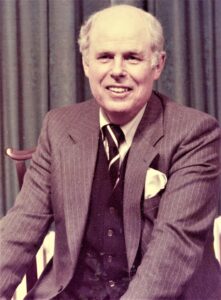
William Alwin Cooper(1923-2011)
William Cooper: A Valediction by Roger Ketley (staff 69-93), OS Annual Record, 2012:
An invitation to write a valedction for ‘Bill’ Cooper is a generous gift and, for me, a privilege. I sit surrounded by letters of appreciation from OS, former colleagues, housemasters, headmasters and Governors of the School. Their words enrich the memories of Bill, his enthusiasm for life, his sense of humour, his generous encouragement of pupils and friends, and his quiet and discerning advice, so often proving to be the correct solution to situations that he we found difficult. He had a breath of knowledge that was enlightened, way beyond the School and town.
He was of the generation whose schooling and early career were disrupted by the Second World War, at one time being evacuated for a while from Westminster School in London to Hereford, then returning to finish with a flourish in the school cricket XI and winning the art prize. Thence to Cambridge to read engineering, with architecture in mind as a career, gathering the captaincy of the college XI and a share in an art exhibition at the same time. But the needs of the war were unrelenting. Conscription from Cambridge to a commission in the Royal Engineers saw him sent to India to train for possible action in Burma. He was soon to be hospitalised and demobilised for rehabilitation, not injury by enemy action but disabled by polio, a disease prevalent at that time and still endemic in parts of that subcontinent. Returning to Cambridge his active cricket playing days were over, gone were plans for architecture, and engineering was replaced with Geography as a Tripos subject, leading to a career in teaching. His first appointment was at Cheltenham College Junior School before he came to teach at Sherborne in 1952. In over 40 years, Bill’s contribution to the well-being of Sherborne was not only considerable but significant in his consecutive roles as Head of Geography, Housemaster of Westcott and, uniquely, as the elected staff respective on the governing boy.
His chance to run the Geography Department came later than it should, but in the few years before he took over Westcott he worked to find the subject more space on the sixth form curriculum and, in a period when logn distance air travel was undertaken of necessity rather than for the annual holiday indulgence of today, he brought in speakers to open up the world and also to hint at the transformation in the discipline of geography that was underway at Cambridge.
Westcott House called in 1966. The House was large with 70+ boys but it was also physically large to maintain and to get about in. As in all that he did Bill must have had to design individual strategies to cope with steps and staircase or distance. He never made anything of this, but we did admire his courage.
Housemastering then was competitive and a partnership with a caring wife was all important because she was to run the domestic side which included catering for the boys. As the neighbouring Housemaster at Lyon, I can say that we had huge respect for Westcott under Bill’s command, and parents clearly wished to send thehir sons to him. Westcott were formidable opponents too, on the games field.
The 1970s were not easy times and brought many challenges, but Bill had a restrained and sensible approach to identifying and implementing change. Other staff used him as a mentor and had confidence in his advice, so it was no surprise that, when his time in the House came to an end, soon to be followed by his retirement, he was elected the staff representative on the governing body where he served for ten years, always readily available and making sure that staff views were heard at Governors’ meetings. ‘One items of significance’ said one governor, ‘when he was talking, we all took pains to listen’.
Whenever School commitments and holidays allowed, he developed a parallel career as an artist. Self-taught he developed expertise in collage and had a following that much admired his work. There were influences of J.S. Lowry and the St Ives School, and his work appeared in a dozen local and national exhibitions, mostly in the 1970s. There was an industrial series, a harbour series and hot Spanish hill-top villages. He was elected a member of the Royal West of England Academy in 1973, later still becoming a member of their Council and finally Artists’ Chairman, guiding the selection of works for their exhibitions.
Cricket was an integral part of his life, coaching, umpiring, enthusing even the no-hopers, and he travelled to watch at all levels the 1st XI, the Pilgrims, Dorset, and England at Lord’s. His School side was the 3rd XI: they played enthusiastically but, as it was Bill’s side, with Test Match discipline. He beamed when they won. Judging an appeal he offered it deliberate consideration before raising his finger, ‘that’s out’: sheer theatre. Later in life he still had an encyclopaedic knowledge of all the emergent test players on the county sides. Skey Sports was his companion with remote control to hand.
A fellow governor said ‘We watched the last day of a Test match at Lord’s, England versus the West Indies. The Windies required 344 to win. They won by 9 wickets, the wicket lost being a run out. This was greatly disappointing, but Bill’s view was more visionary; he was fulsome in praise of the wonderful batting. The game of cricket was the winner. I had to agree.
Obituary for William Cooper by Derek Balmer, RWA Magazine, Spring 2012:
William Cooper MA, RWA, 1926-2011.
I first met Bill Cooper when I joined Council during Leonard Manasseh’s Presidency. Bill had just taken over the demanding responsibility of Academicians’ Chairman from Jean Reese and so, in a way, we were both starting new jobs. However, the Chairman’s role was crucial to the well-being of the Academy, pivotal in providing a link between Council and the wider readership.
Bill carried out his duties with a natural authority and self-confidence born, perhaps, of his background as a former schoolmaster at Sherborne School. He was firm without being dismissive and had the ability to address difficult decisions with good humour. And indeed, there were time when diplomacy and tact were necessary when occasionally dealing with temperamental and forceful characters but Bill, in country tweeds and with solid countenance, handled these situations with ease.
Bill and I got on well from the start and he even had the prescience to tell me, not many months after we first met, that I would be President one day. However, before such predictions became reality the eventual question of Bill’s successor had to be considered, and he was most insistent that I should follow him and I did eventually succeed him.
In the years that followed, Bill and I kept regularly in touch and thus continued our friendship even when his increasing lack of mobility kept him away from Bristol. Early in his life and not long after he went up to Cambridge to read architecture, Bill contracted poliomyelitis and although determined and single-minded, he was undoubtedly hindered by such a devastating setback and was forced to adjust and pace his life accordingly. He returned to Cambridge where he took a degree in Geography in which the physical demands were fewer and which became the subject he taught at Sherborne, where he was also a housemaster. To this end he was lovingly supported by his wonderful wife, Dorothy.
Bill Cooper was a self-taught artist and none the worse for that. At one time his preference was for collage, and many examples of his mastery in this field can be seen in the publication by Sansome and Co in 2005 entitled ‘Why Collage?’ Later, Bill’s small, colourful oil paintings of jaunty fishing boats sailing on choppy seas, or quiet harbours enlivened many a gallery at the RWA’s Autumn Exhibition, and the many greetings and postcards that were published of his work reach a new, wide and appreciative audience. His own taste in art could be seen on every wall of his elegant Sherborne home where his predilection for Mary Fedden and Bryan Peace, and his fondness for Cornish primitive paints could be seen.
William Cooper, ‘Bill’ to his many friends, was a strong and honest man with a wide range of interests. He was proud of his membership of the RWA and through his integrity and dedicated service on Council, enhanced the duties entrusted to him, and we who were fortunate to work alongside him and counted him our friend are the better for having known him.
Blackmore Vale magazine, 24 February 2012:
William Cooper (known as Bill) died on 29th December 2011, aged 88. Walking with a stick as the result of a war injury, he was a familiar and much respected member of Sherborne’s community for many years, and also well-known as an artist. Bill Cooper’s career at Sherborne School spanned 40 years during which time he was assistant master, head of department, housemaster and, latterly, staff representative on the governing body. He was also active in the local community – he served as a town councillor, lay reader to the Abbey, enthusiastic supporter and contributor to Sherborne Art Club and chairman of Dorset Opera. In his retirement from the School he concentrated on his art. He will be remembered especially for his collages and exhibited in London and Bristol as well as Sherborne and was artist’s chairman of the Royal West of England Academy in Bristol. He leaves his much-loved family – wife Dorothy, children Clare, Ben and Rachel., daughter in law Debbie and grandchildren Charlotte and Oliver. There will be a Memorial Service in Sherborne Abbey on Saturday 3rd March at 3pm to celebrate his life. Everyone is welcome.
William Alwin Cooper (1923-2011)
Born 2 June 1923.
Westminster School.
Corpus Christi, Cambridge, 1941-1942, 1946-1948.
Cheltenham College Junior School, 1948-1952.
Assistant master (Geography), Sherborne School, September 1952-July 1983.
Housemaster of Westcott House, 1966-1981.
1967 elected Associate Royal West of England Academy (ARWA).
Died 29 December 2011.