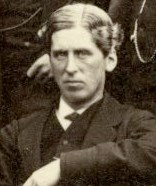
Arthur Mapletoft Curteis (1833-1922).
In Memoriam. A.M. Curteis.
Many of his old friends and pupils will have heard with sorrow of the death of Arthur Mapletoft Curteis, who passed away on September 8th, at the age of 89 years.
He was born at Canterbury on July 2nd, 1833, of a good old Kentish family; G.H. Curteis, Fellow of Exeter College, Oxford, and Canon of Lichfield, was his elder brother. At Harrow he was in the Sixth Form, and also distinguished himself as a bowler for the XI; on his last match against Winchester College he took no less than thirteen wickets.
From Harrow he went to University College, Oxford, but migrated to Trinity on election to an open Classical Scholarship there; and in 1856 he took his degree with a First in Mods and a Second in Greats, being elected immediately afterwards to an open Fellowship at Trinity. He did not remain long in Oxford. For a short time he worked under the Rev. St John Parry at Leamington College, where he had Walter Besant for a colleague, and then he went to Sherborne School as Second Master or ‘Usher’ under Dr H.D. Harper. That distinguished Headmaster was engaged in doing for Sherborne what Tring did for Uppingham, viz., turning a small local school into one of the great Public Schools of England; and Curteis was the leading spirit in a band of devoted colleagues who gave Harper loyal and efficient support of his task. He now became not only ‘Senior Assistant Master,’ taking charge of the Upper Fifth Form, but he was also the first Housemaster under the new scheme; and here he was ably seconded by his wife, Helen, daughter of Thomas Poyntz Wright, Esq., of Tiverton, Devon, who he married in 1859. As a keen cricketer and fives player, Curteis was naturally in touch with all the outdoor life of the school. But it was especially as a teacher of history, both ancient and modern, that he made his influence felt among the senior boys. Hundreds of Old Shirburnians still remember him gratitude and affection as the inspirer of their lives and the perfect type of the cultured English Gentleman.
At Sherborne he remained till 1876, and then moved to Hillside, Godalming, taking over a Preparatory School which had been founded there four years before by the Rev. Francis Dodd, when Charterhouse migrated from London to Surrey hills. For the next twenty years his work lay with the young. He could not fail of success, for he had all the essential gifts – knowledge of, and sympathy with, boy nature, the sunniest of tempers, and a keen sense of humour; and parents instinctively recognised his high-mindedness and trusted his judgment.
In 1888 Mr Gidley Robinson, who had been a master at Charterhouse, joined him as a partner and presently took over entire responsibility for the school. But Curteis still went on with his teaching, especially of history. His method is described in the article on the Teaching of History which he contributed to the Government Bluebook on Preparatory Schools in 1900. His main purpose was to arouse the interest of the boys to the subject, and he was a whole-hearted believer in the ‘spoken word’. Thus at Godalming, as in earlier days at Sherborne, his teaching was oral, supplemented by maps and blackboards; the boys brought a small notebook and pencil into class, took rough notes, and before the next lecture shewed up their own precis of the lesson in a large notebook. A text book, Curteis thought, if used at all, should be consulted after a lesson, never by way of preparation for it. And his method was justified by results; the boys looked forward to the weekly history hour and thoroughly enjoyed it. That such a method calls for special gifts needs no emphasizing; Curteis was a first-rate teacher. An excellent little book on The Rise of the Macedonian Empire which he contributed to the ‘Epochs of Ancient History’ series (Longmans) tempts one to regret that he did not write more.
The closing years were spent at Hythe in his native Kent. There he did his duty as a citizen, serving as a Councillor and County Magistrate as long as health and strength allowed. Mrs Curteis died in 1912, but a devoted daughter and granddaughter made their home with him; and he kept in touch with his friends, writing to them constantly, in the beautiful script they knew so well, on literature and politics and travel or the glories of his garden, with all the old vigour and charm and naturalness of the ‘spoken word,’ till within a day or two of the end.
G.G.R.
The Shirburnian, December 1922 .
Arthur Mapletoft Curteis (1833-1922).
Born 2 July 1833.
Harrow School.
University College, Oxford,
Fellow of Trinity College, Oxford.
Assistant master, Leamington College, 1859-1860.
Assistant master, Sherborne School, 1860-1876.
Housemaster of Abbey House, 1868-1876.
Headmaster of Hillside Preparatory School, Godalming, 1876.
Alderman of borough of Godalming, 1893.
Died 8 September 1922.