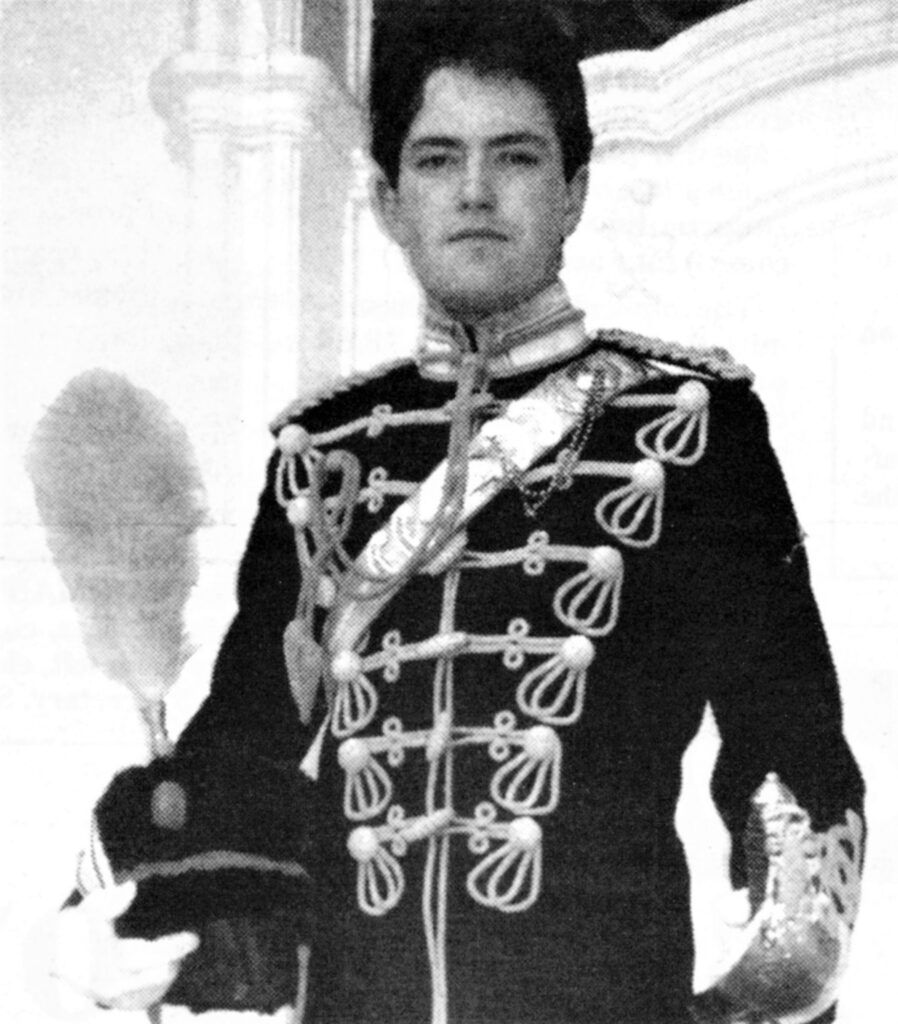
Lieutenant Richard Wyndham Madden (1970-1996) (The Digby 1983-88) was one of three men of the Light Dragoons killed on 28th January 1996 at Drvar (formerly Titov Drvar), 20km west of Mrkonjic Grad, Bosnia, when the detonation of a landmine underneath their Spartan armoured troop carrier sparked a fire which in turn ignited the ammunition stored inside the vehicle. The other men who died in the same incident were Trooper John Robert Kelly (21) and Trooper Andrew Ovingdon (25). Richard Madden was 25 years of age.
The following obituary was published in the OSS Annual Record, 1996:
‘Richard came to Sherborne in 1983. He followed his elder brother David and, indeed, his younger sister Susannah, who had taken her Cambridge entrance from the School. He had a thoroughly successful Sherborne career. In his final year he secured a place to read Russian at Durham and on the way he had been under officer in the CCF, he had sung in the choir for five years, played in the first orchestra, scored for the 1st XI, played in the 2nd XI and had been a house prefect. Without in any way detracting from his achievements at Sherborne it would be fair to say that the most distinctive and lasting impression he made was as a person. He was enthusiastic, lively, completely straightforward in his relationships with his contemporaries and with the staff, engagingly ebullient. He spent a gap year teaching English in Zimbabwe before going to Durham. While there, he was much involved with the Northumbrian Universities OTC and won an Army Scholarship for his final year. After graduation he went to Sandhurst where he was a Junior Under Officer and he opted for the Light Dragoons. He was immediately posted to the Regiment’s HQ at Hohne in Germany. He eventually passed out top of the troop leaders course and won the Royal Armoured Corps prize donated by the Armourers and Braziers. He was gazetted a captain in November. He was killed after serving a fortnight in Bosnia and ten days before he would have taken up his new rank. It is abundantly clear that he was a young man full of promise, widely admired, someone held in deep affection by a great number of people. All who knew him deeply regret his death and express his sympathy to his family.’
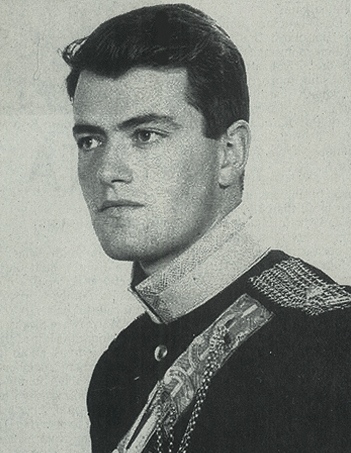 The text of the address given by Richard’s housemaster, Simon Wilkinson, at the funeral service held in Sherborne Abbey on 8th February 1996, was published in The Shirburnian, Lent term 1996:
‘When we first heard of Richard’s death we were shocked, bewildered, angry, incredulous, filled with unfathomable sorrow, with grief and despair. After some time there emerged a mood of at least partial reflection; and as the days pass, and as the sudden immediate wounding of our feelings is to some extent mercifully alleviated, we have in our hearts and minds been taking stock. Am I speaking for us all if I say that we have experienced some sort of a miracle? Richard came for supper on November 2nd, four magic hours of his company, now more precious by far even than then, four hours of his excitable, lively, humours, affectionate conversation. As he left he said, ‘I’ll just walk round the streets a while, for old times’ sake.’ ‘Not for the first time at this hour, I’ll be bound,’ I replied. And he waved, crossed the road and was away.
The miracle is that as I reflect, as I take stock, so those disparate recollections, spanning more than fifteen years, are gradually seen as an integrated whole and no longer as separate loosely-connected memories and impressions. They combine together now as something so much richer, so much more significant, that I wonder whether I suffered from a sort of partial blindness before. Quite unbidden, friends have come to share their memories of him, to recount examples of his till-then unrecorded acts of kindness, of generosity, of strength of character. And I am gradually made aware of something I knew, but formlessly, inchoately, that here was a man of quite exceptional quality. To think of him now is to have one’s thoughts accompanied, as it were, by celebratory fanfares of trumpets.
Richard, while still at Hazelgrove, would accompany his parents to social events at The Digby. His mother would wisely put a tray of eats in his hands and shoo him away – admirable, it stopped the child kicking his parents’ ankles and taught him the virtue of circulating at cocktail parties. But as he made his way from group to group lightening his load I would notice his unusual composure, his friendliness, his natural courtesy. And he never lost it. His dealings with people were quite free of artifice – of even the faintest trace of malice too, I might add. When he came to school at Sherborne no one would have claimed he was particularly talented in any one field – he was not a sporting hero, but a useful and wholehearted player, he was not fiercely academic, but certainly pretty bright, he was a keen musician, played the violin and sang in the choir throughout his time, but fortunately was never asked to sustain a half-hour solo recital. He had indeed, however, a quite special and very rare talent, his capacity for enthusiastic commitment. It flooded out from him somehow quite unchecked by embarrassment, gaucherie or the slightest trace of meanness of spirit. It was his private engine, his powerhouse. A 2:1 at Durham in Russian was a considerable achievement, specially as it cocked a snook at the rest of the family. And in the few days he had in Bosnia his Serbo-Croat was already enabling him to wheedle concessions out of mesmerised natives. I cannot speak of his polo, thought something tells me it might have been a little rough-hewn, but it was clearly played with spirit and delight. I quote from a letter: ‘We loved the polo – even my exam was made fun as he insisted we played polo every night – and I passed.’
What his contemporaries particularly cherished was the quality of his friendship. It is this that come across in the very many letters written to the family. He is called ‘the bright star’, ‘the shining light’. He is extolled for the absolute dependability and trustworthiness of his relationships. A friend wrote, ‘He was the most decent, genuine friend a guy could ask for. He was always there, the most conscientious, generous, forgiving friend, with more courage than anyone I know.’ A contemporary at Sherborne wrote, ‘The example he set was one of honesty, integrity, loyalty and good humour, and it is for those characteristics that I shall remember him.’
This same friend continues, ‘Our time at The Digby was lightened by Richard’s eccentricities and sense of fun. Sometimes he took this to the limit. Reveille on a hunting horn at 7.30 am on a Sunday is not everyone’s favourite alarm call.’ He seems to have found this activity irresistible, as another friend writes of their time together at St James’ School, Zimbabwe, ‘Perhaps his funniest habit was to get up in the morning, or at any other moment that he fancied, and blow his beagle horn across Mutasa South. He became famous as the mad Englishman with the horn – totally incongruous for Zongoro, but totally in character for Richard.’
His parents told me how on his last night at Sherborne he followed time-honoured tradition, slipped out of The Digby and celebrated his departure with friends, somewhere in the surrounding countryside. Returning in the early morning he saw the familiar and unavoidable figure of his Headmaster approaching him. Was Robin Macnaghten, whose last term at Sherborne it also was, slipping home after some equally traditional headmagisterial leave-taking? Never one to cut and run, Richard chose to make use of one of his most celebrated attributes – charm of manner. ‘Good morning, sir!’ Richard beamed. ‘Ah, good morning, Richard!’, came the reply. And the two continued on their way, both preferring to avoid intrusive questioning. Later on that morning, Richard was singing in the choir at the Commemoration service. It was noticed during the sermon that he was taking an opportunist, Churchillian snooze on the floor of the stalls. By the last hymn, however, he was back in action, brighter-eyed than before, and quite refreshed thanks to his finely-judged tactical withdrawal.
Richard had a quality unusual in a schoolboy. He noticed, sometimes embarrassingly, when an adult was not feeling too great and would quite unaffectedly express his concern. ‘Are you all right, sir?’ ‘Thank you, Richard, perhaps just the tiniest wisp of a headache.’ ‘I quite understand, sir,’ And he probably did – too well! In turn, his care for those in his charge was exemplary. No wonder he made so outstanding an officer. Many younger than he have, since his death, attested to the exceptional personal support he gave them. A young man speaks of how, when he was a new boy, and a nervous one at that, it was Richard, as a prefect, who gave him a feeling of steady security till he found his feet. Another told me of visiting Richard’s regiment as a PO and how it was Richard who sought him out and steadied him when the boisterousness suddenly started to disconcert him. These acts of private kindness derived from his unusual imagination and sensitivity. He could detect unease in others, and he had the honesty and warmth to try immediately to relieve it.
Richard was a chapel warden at Sherborne – it goes without saying a conscientious one. Robert Prance, his chaplain, preached a sermon at the beginning of Richard’s last term on the Resurrection, appropriately enough since it was shortly after Easter, using the version from St. Matthew’s gospel. ‘Now late on the sabbath day, as it began to dawn toward the first day of the week, came Mary Magdalene, and the other Mary to see the sepulchre. And behold there was a great earthquake; for an angel of the Lord descended from heaven and came and rolled away the stone, and sat upon it.’ After the service Richard came up to Robert and asked him a question. What he wanted to know was – did the angel laugh while he sat on the stone? Since Robert told me this story my mind has returned to it. Whatever did Richard mean? What a bizarre idea! Do angels indeed laugh? I bet he could tell us now. But two things strike me. Firstly, just because Richard was so open, friendly, warm, so jaunty, stylish and debonair, just because his words tumbled out and even on occasion out and over each other, just because he was, frankly, so accessible, we should not forget his acute and unpredictable perceptions, just because he did exemplify long-cherished virtues – courage, loyalty, honour – we should not forget his capacity to surprise us, to challenge us, to provoke our reflection. I want us to remember he was absolutely not shallow, absolutely never dull. Secondly, Richard might expect the angel to laugh, because that was so often Richard’s own reaction. He was very funny. When you come to think about it, he smiled constantly, he laughed a great deal. And we all did in his company. He enhanced our lives. We are all miles better for knowing him.
When Richard was chapel warden, he cared very much that the pages of the books of remembrance should be regularly turned. It would only be his responsibility when he was on duty, but it was a task which other fellow wardens might from time to time overlook. Discreetly, unobtrusively, Richard would repair the omission. Why did he judge this turning of the pages so important, that each name be read, each photograph be exposed to view? Again, we can only guess. Perhaps, while he accepted that in the hurly-burly of school life such actions would occasionally be forgotten, he determined that during his tenure of office the traditions would be carefully respected, the soldiers, sailors and airmen be regularly remembered. And now it is his own name that will be added to that illustrious list.’
Richard Wyndham Madden (1970-1996)
Born 12 April 1970.
Hazelgrove House Prep School, Sparkford, Yeovil, Somerset.
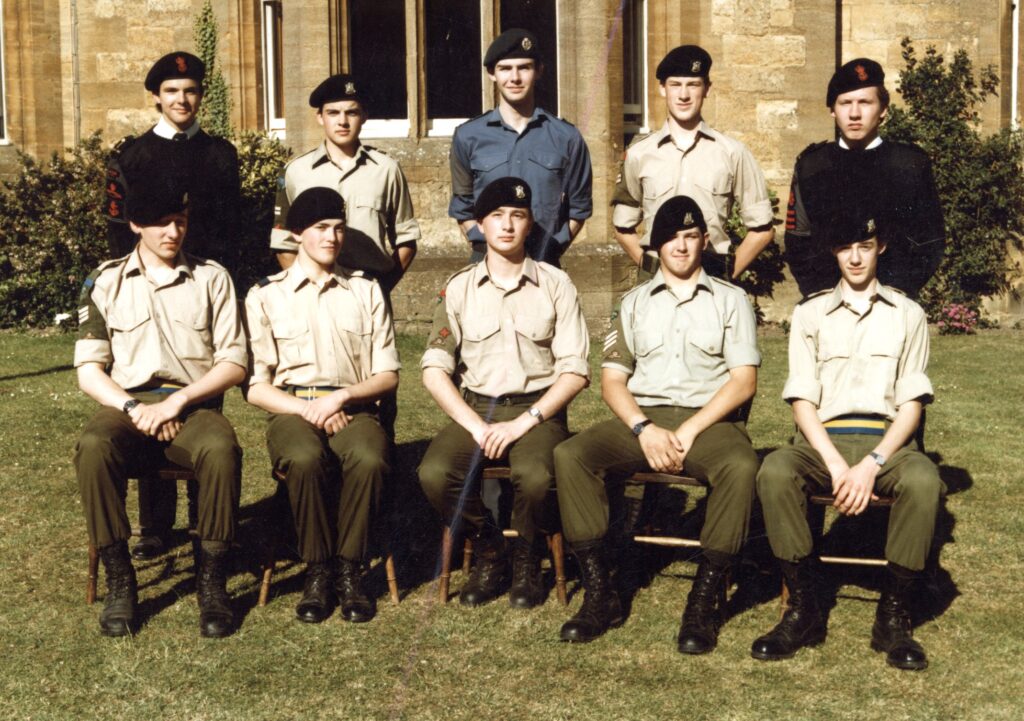
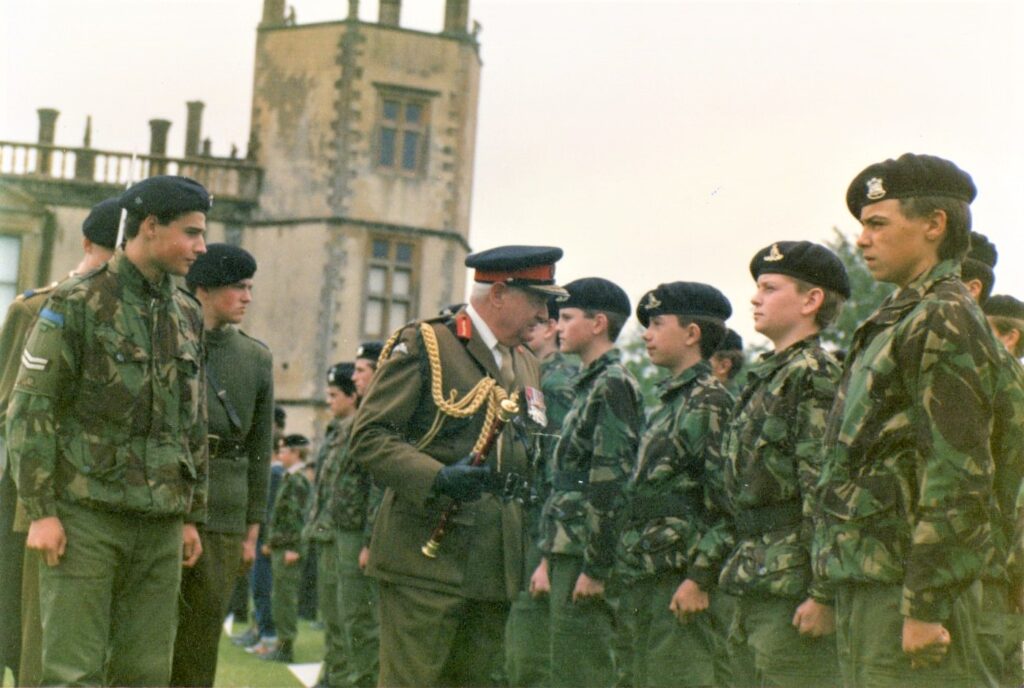
Sherborne School (The Digby) 1983-1988: 6th form, under officer in the CCF (Acting ADC to Field Marshal the Lord Bramall, GCB, OBE, MC, on the occasion of Sherborne School’s CCF Centenary Celebrations at Sherborne Castle on 25 May 1988), sang in choir for five years, played the violin in the School orchestra, mini Colts B (1984), 1st XI scorer (1985), 2nd XI (1988), 5th XV (1988), house prefect (1988), chapel warden.
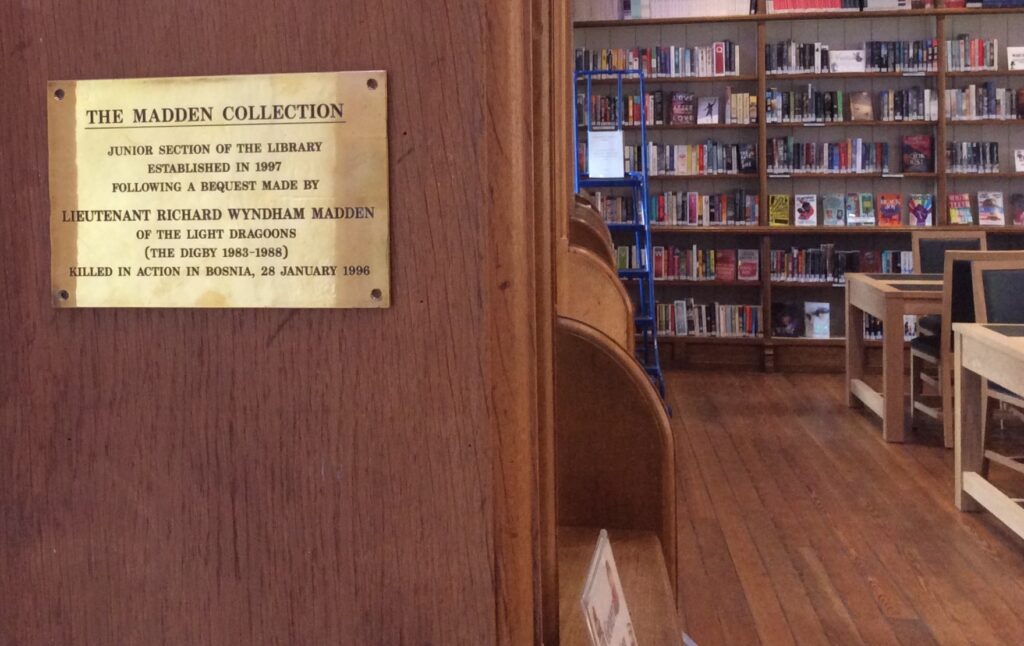
The Madden Collection was founded at Sherborne School in 1997 following a bequest of £5000 by Lieutenant Richard Madden (1970-1996) (The Digby 1983-88). The bequest was used to set up a Junior Library which was formally opened on 15 May 1997 by General Sir John Wilsey, Vice-Chairman of the School Governors and Richard’s Commander in Chief.