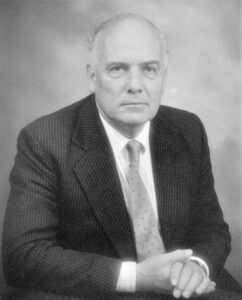
Simon Foulkes Wilkinson (1936-2020) was born in Liverpool on 6 March 1936. He arrived at Sherborne School in 1959 with a Masters degree from Trinity College, Oxford, and joined the Modern Languages Department as a teacher of German. From 1972 to 1987 he was housemaster of The Digby. He retired from teaching in 1996 and served as editor of the OS Record from 1997 to 1999. He died on 13 February 2020.
The following Valete for Simon Wilkinson by Dr Peter Such was published in The Shirburnian, Michaelmas 1996:
To do justice to Simon Wilkinson’s contribution to the life and work of Sherborne School is a task which far exceeds the skills of the author of this brief appreciation, and one which proves particularly difficult since he witnessed nothing of Simon’s achievements during his first twenty years at Sherborne. There will inevitably be very many omissions; at best one can hope to leave the reader with a reflection of the warmth, generosity and intense dedication of the man who has done so much for so many pupils and colleagues and had left an enduring mark on the community in which he has played such a prominent and varied part.
It is ironic that Simon’s qualification at Oxford was in French, for a year in Germany gave him a second language and within the Modern Languages Department it is as a teacher of German that he will be remembered most. Generations of sixth formers benefited from his thoroughness, rigour and attention to detail, and from his enthusiasm for Germany’s people, their culture and their literature. Year after year Oxbridge places have been won and numerous boys have gone on to university superbly equipped for their literary studies; it is common for them to say that the work done with Simon has been of great value in preparing for Finals. To be taught by Simon was a privilege indeed. Moreover, he ran a distinguished and successful department and was responsible for many striking innovations, such as the term abroad for double linguists, which remain an important feature of our work.
Simon will probably be best remembered as Housemaster of The Digby, a position which he held from 1972 to 1987. He showed the deepest care for the development of the young men in his charge, setting and expecting the highest possible standards of behaviour. What distinguished The Digby was the family atmosphere, on which Simon and Juliet placed such great importance. Simon was capable of seeing underneath the surface of the truculent fourth-former to the real person inside and of communicating with him powerfully and directly. He inspired in countless individuals a profound sense of affection and loyalty, which remains in them today.
The warmth shown by Simon was matched by the care and kindness lavished by Juliet. Ever-busy, Juliet for several years was an important member of the School’s Modern Languages Department, until she returned to teach at Sherborne School for Girls. Simon, Juliet, and their family, the most welcoming and generous of hosts, held open-house to all and sundry, at The Digby and, since their move, at Acre House, in term-time and during the holidays. It was logical, then, that Simon should be appointed mentor to new members of staff, giving to them and their families the best and most natural of welcomes, breaking down the formality which can sometimes make it difficult to settle in these surroundings.
There are so many more sides to Simon’s contribution at Sherborne. The important part that he played over the years with Dorset Opera is well known, for example. However, there are other areas in which he has done much and of which he says little. Few now are aware of his role as a pioneer for athletics, struggling against the great cricket monolith and actually digging out the first long jump pit himself. He disdains show and falseness and prefers the quiet gesture. He will probably be embarrassed that I should mention how he would quietly go round picking up litter in the early morning in order to improve the appearance of the School; but these are marks of the man – the readiness to take on the humble task, without fuss, and his great fondness (characteristic, indeed, of such an enthusiastic gardener) for the environment in which he has lived and worked.
Simon is a man of highest principles, to which he has given clear expression in words and actions. He has also had the wisdom to see the true significance of developments accepted without question by many and to anticipate their consequences. He has not been prepared to settle for falseness, superficiality or mediocrity, and when he has disagreed with what has been said or done he has been prepared to speak his mind courageously. If we were to be able to teach our pupils to follow his example, that would be Education indeed!
Simon and Juliet have welcomed so many of us with warmth and love. It is with similar emotions that we wish them the happiest of retirements. We shall continue to benefit from their friendship, but as a part of the school community, they will be irreplaceable.