In 1814, surgeon Nathaniel Highmore MRCS (1789-1866), a former pupil of Sherborne School, conducted an autopsy on a 15-year-old boy he had been treating in Sherborne. What he discovered inside the boy’s abdomen shocked the medical world and made Highmore famous.
Nathaniel Highmore was born on 18 October 1789 in Over Compton, the son of Richard Highmore (1744-1808) and Sarah (née Noake) (1746-1821). In 1806, aged 17, he attended Sherborne School, according to A.B. Gourlay, ‘ to learn Latin to fit him for the medical profession’. Highmore went on to study medicine at the united hospitals of St Thomas’ and Guy’s in London, and in 1812 was made a member of the Royal College of Surgeons of England.
After qualifying, Highmore returned to Sherborne where he set up a medical practice in Newland, and in January 1813 married Elizabeth Andrews (1780-1868) of Cerne Abbas. Although they had no children of their own, their severely-disabled grandnephew William Henry Highmore lived with them until his death at the age of 25.
Highmore became a prominent and respected citizen of the town, serving as a Governor of Sherborne School (1833-1866), a Brethren of Sherborne Almshouse (1831-1866), and a member of the Masonic Lodge. On 18 March 1854 he was awarded the honour of laying the first stone of the chapel at Sherborne School.

On 9 May 1814, Sarah Lane, a poor woman of Sherborne, went to Highmore’s house in Newland to ask him to visit her 15-year-old son who was very ill. Sarah’s son was Thomas Lane (1798-1814), a carter’s boy who was born on 21 December 1798 in Hilfield, Dorset. Sarah told Highmore that Thomas was perfectly healthy until the age of seven when he began to suffer from violent pains in his bowels. She had taken him to Minterne House to see Mrs Eleanor Jauncey, the wife of Admiral Robert Digby, ‘whose benevolence to the poor has ever been uniformly conspicuous’, who attributed his condition to worms and administered vermifuge medicine. But Thomas’s condition did not improve and his body became so swollen that he could not button his clothes. During the next nine years, Thomas’s health continued to fluctuate between periods of good health followed by episodes of violent pains and swelling in his abdomen. While working at Hilfield in March 1814 Thomas told his mother that a quantity of ‘blood and fleshy matter’ was continually evacuated with his motions.
On examining Thomas on 9 May 1814, Highmore found his abdomen was very swollen and over his spleen was ‘a projection visible to the eye’ that appeared to move. On asking Sarah about her son’s condition, she told him that a few days before Highmore’s visit Thomas had shouted out “Mother! Do come to me, I have something ALIVE in my body!” and had then fainted. Highmore was perplexed by the case and, after consulting Dr Woodforde, treated the boy for worms and a diseased spleen. However, Thomas’s condition continued to decline and on the morning of 10 June 1814 he died in extreme pain.
Highmore asked Sarah’s permission to carry out an autopsy on Thomas’ body, which he performed at her house on the afternoon of 10 June 1814. During the autopsy Highmore removed from Thomas’ abdomen what he believed to be a large tumour (weighing 4 ½ lbs), which he took back to his home in Newland intending to examine it the next day. However, when placing the ‘tumour’ into a storage container, he felt what he believed to be the curve of an arm at the end of which he counted five digits! He immediately summoned two medical friends, Mr Eastment and Mr Gray, in front of whom he opened the ‘tumour’ and found inside it a human foetus.
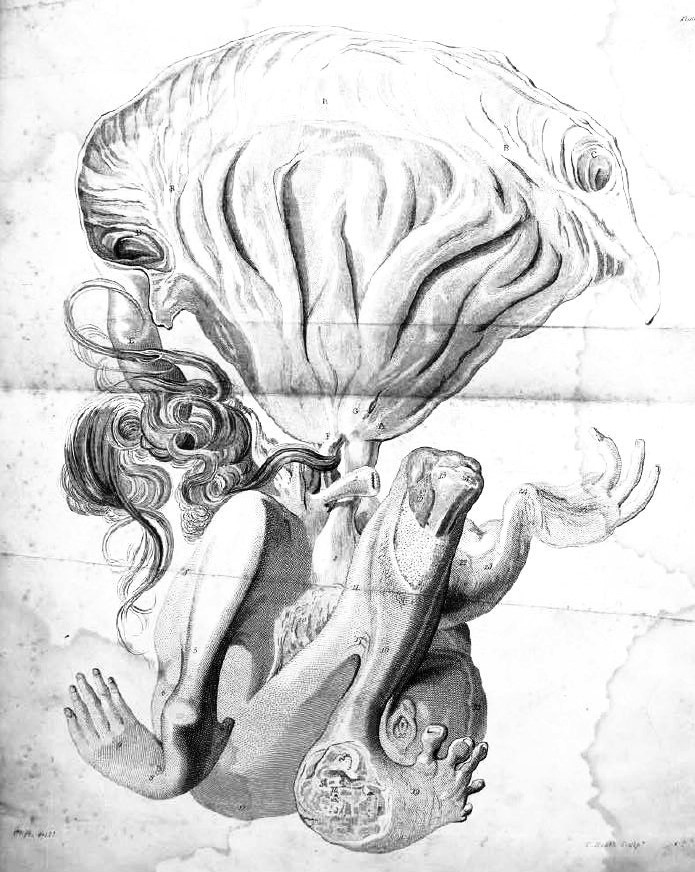
The next day, before an assemblage of the town’s medical practitioners, Highmore carried out a complete examination of the foetus. He discovered that ‘the head and one of the lower extremities appear to have been removed by absorption, which process has commenced in some other parts. From the neck grows a quantity of hair twelve inches in length, and loose portions of it were found in the sac. The umbilical cord was connected with one part of the sac, there being no placenta’, and concluded that the foetus was probably a conjoined twin that had been absorbed while in the womb. To confirm that the foetus has indeed been found inside a male body, the medical attendees visited Sarah Lane’s house to view Thomas’s remains.
News of Highmore’s discovery soon spread and thousands of people flocked to his house in Newland to see the foetus for themselves. As a newly-qualified surgeon Highmore saw his discovery as an opportunity to make his name in the profession and took the foetus to London to deposit it for preservation in the museum of the Royal College of Surgeons (catalogue number RCSPC/03957), where it was examined by leading doctors and also by the future George IV.
In July 1815, Highmore published an account of his discovery entitled Case of a foetus found in the abdomen of a young man, at Sherborne, in Dorsetshire (London: Longman, Hurst, Rees, Orme and Brown; printed by James Cruttwell, Sherborne, 1815). The accompanying list of 339 subscribers to the paper includes the Prince Regent (the future George IV) and Prince William Frederick, Duke of Gloucester; twenty-one members of the Royal College of Surgeons; aristocrats including the Duke of Marlborough, the Duke of Gordon, the Earl of Radnor, Earl Spencer and Earl Digby; members of parliament including the future Prime Minister Viscount Palmerston; the surgeon-dentist Chevalier Bartholomew Ruspini; Dr Műhry, physician to His Majesty at the Court of Hanover; James Grant Raymond the actor-manager of the Drury Lane Theatre; the Rev. Thomas Putt of Trent Rectory and Robert Goodden of Compton House; as well as local surgeons including Mr Trowbridge of Cerne, Mr Inger of Evershot, and Mr Gray, Dr Pew and Mr Turner of Sherborne; and from Sherborne School schoolmaster Thomas James and School Governors James Cruttwell, John Melliar, and Richard Pew MD.

Thomas Lane was buried in the parish churchyard of Sherborne Abbey on 18 June 1814. The churchyard was levelled in 1856 and if he had a headstone it is now lost as is the location of his grave.

Nathaniel Highmore died at his home in Newland on 25 September 1866, a few weeks before his 77th birthday. On the day of his funeral many of the shops in Sherborne closed and the bells sounded a muffled peal. He was buried in the town’s cemetery, next to the mortuary chapel, where his grave is marked by a stone sarcophagus. His obituary, which was published in The Lancet on 13 October 1866, described him as ‘a man without guile; but with a hearty, genuine openness of character, he possessed the no less admirable qualities of energy and perseverance’, and referred to the ‘remarkable case’ of his discovery of a foetus in Thomas Lane’s abdomen.

Further information:
- Read Nathaniel Highmore’s Case of a foetus found in the abdomen of a young man, at Sherborne, in Dorset (1815) (InternetArchive)
- Catalogue entry for the specimen of the foetus held in the pathology collection of the Royal College of Surgeons of England (ref. RCSPC/03957)
- Catalogue entry for Nathaniel Highmore’s Case of a foetus held in the Royal Collection Trust (ref. RCIN 1090258)
Visit Sherborne School Archive News for more stories from the archives.
Posted 14 June 2024 by Sherborne School Archives