Rob Lloyd’s teaching was never constrained by the syllabus, and he was convinced that a good teacher must also practise what he taught. At Sherborne, Rob introduced many A level boys to original project work, and it was his vision as a young biologist that secured Holway Woods for the Dorset Naturalists’ Trust (now the DWT) and the involvement of Sherborne School staff and pupils in managing the area as a nature reserve.
A history of Holway Woods and their management for the last sixty years
In former times, Holway Woods may have been orchards or vineyards, we think because of the terracing of part of it, and Bishop Ramson was said to have had vineyards on a similar west-facing slope at Poyntington. Also, Holway Wood may have extended across to the farm before the First World War took its cut, occupying the recently planted Headlam’s Wood. There are records of the woods being part of the Portman Estates.
Sixty years ago the badgers earned their reserve by making tracks down and up across the steep banks of the sunken lane that divides the woods. In 1962 I was searching for my first home and this led me to drive slowly up the hill in my Morris Minor and see their tracks. My repeated visits to watch the badgers brought me to the attention of Adria Ashwin, the landowner’s wife. She asked me how she could protect her woods from being bought by someone who would probably plant conifers to make a profit from the woods, as has been done on the scarp further south. I suggested she should give her woods to the then Dorset Naturalist Trust. She and Miss Brotherton had meetings at the Farm and the deal was done, with the Trust agreeing to maintain the woods as mixed deciduous woodland. The wood then became the first reserve to be owned by the Trust. I offered to help with boys from Sherborne School. Over the years the team of volunteers has always been of teachers or ex-teachers from the School. Currently this includes Tony Combridge, who is 93! The Trust’s workers have come in at certain times to help out and currently do a clearance of the paths once in the Summer.

The main tasks we have been involved with for the last sixty years
Holway Wood (about 11 acres, donated by Adria Ashwin)
When Holway Wood became the property of the Trust we had to exclude the cattle, which previously browsed through the wood, and I did find the jawbone of a pig when digging out the pond. The Forestry Commission from Evershot advised me and the small group of boys from the School how to install a three-stranded strained barbed wire fence with proper straining posts at intervals and loaned us a strainer (later they showed us how to plant trees).
The Commission also suggested we should plant a shelter belt along the eastern boundary to protect the wood from the damaging Spring easterlies blowing off the top field. In 1966 we planted three rows of shelter belt along that boundary, white beam on the outside and two rows of hornbeam inside them. (approximately 650 trees in all). We followed this by planting beech to form a small wood in the large bracken and bramble dominated space at the southern end of the wood. Scots Pine were recommended as nurse trees but everyone of them were eaten by deer before they could do any nursing. Someone gave me 15 alder trees and I planted them in 1967 just to the north of the pond. We had also dug out the pond exposing the pipe which collected the Spring water and piped it all the way to the farm. The pipe still runs along under the bottom path in the wood. This froze in 1967 causing a crisis in the farm, which we helped with by supplying hose pipes to connect the dairy to the mains. Later we built a breeze block protection wall around the pipe across the pond.
Another crisis arose in the 70s when the elms, which flank the extreme south west end of the wood showed signs of the disease. I was told they were saleable for timber if cut down before the infection killed a certain proportion of the crown. We just managed to sell them and had them felled and extracted across the field.
In the 1980s Roger Gibson and I planted some oaks in the extreme south west of the wood. We also re-fenced the western boundary. In the early 1990s Byron cleared the rhododendrons in that sector, which were there probably to provide pheasant roosts and are known to be highly invasive. At some stage we completed a circular path in this wood and erected a badger-watching hide on four telegraph poles carried by boys across from the lane. Sadly, that was removed after about 20 years in case anyone climbed up it and fell off.
A further event took place threatening Holway Wood, when Sherborne Urban District Council let us know they were considering filling the valley making the south boundary of the wood with refuse! A representative came out to meet me and we measured the boundary from a cattle trough in the top field to the south, which showed that the wood’s boundary reached a third of the way up towards Sherborne and so their refuse would be invading a portion of the wood and I made mutterings of how that would seem as it was an educational nature reserve. The SUDC backed off – triumph!
Holway Ball Copse (to the north of the lane)
This was a relatively small wood of about 4 acres with, beyond this, a scatter of trees to the north. This was acquired by the Trust at very low cost through another deal with the executors for Mrs Ashwin. This brought the wood up to over 10 acres.
In the 1990s we planted up most of this wood with mixed deciduous trees up to the current fence line with about an acre of lime trees just north of where there is still an open space. This was suggested by Professor Grubb of Cambridge, who had consulted with Sir Oliver Rackham, who said small leaved lime was rarely planted.
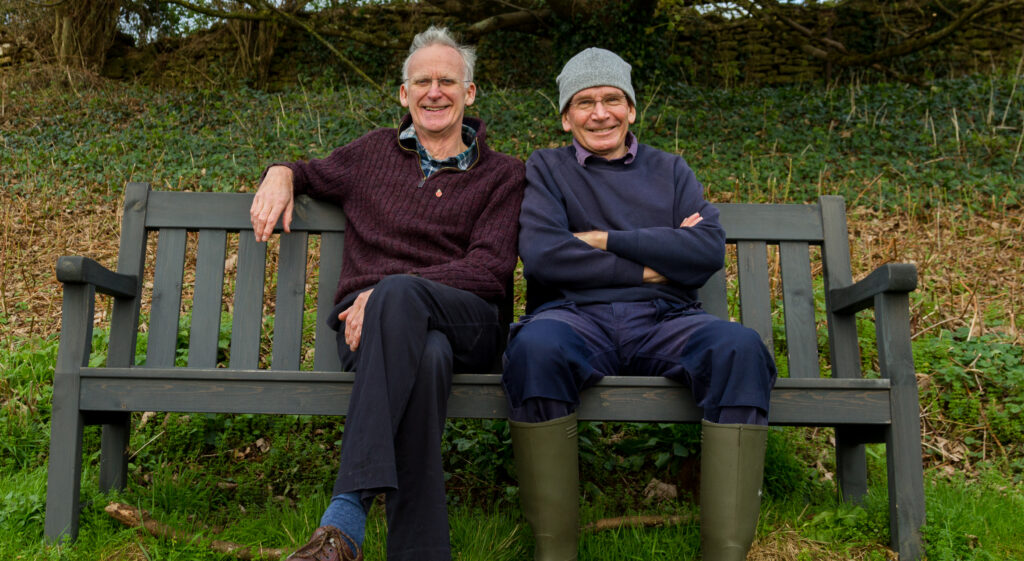
During the last few years Tony Combridge, Byron Henry and Robert Patterson have been keeping the path open round both this and Holway Wood. Tony has planted many young trees, reared in his own garden, particularly a cluster of Spindle, Buckthorn and Hazel just south of the open space. Also he grew three sessile oaks from acorns which are now about thirty feet high, just below the path before it comes to the open space. Tony has also planted wood anemones, snowdrops, and wild daffodils from plants grown in his garden. He also created the conditions for the primroses to thrive near the bottom path. Recently Craig Bryson has helped with the path and fixing a plaque to the bench in the open space donated by my children.
We have all battled with brambles in open spaces and with a large leaved type of bramble, which advances rapidly in parts of the wood. I have cleared one large patch of this just east of the path at the bottom and recently the patch which threatens the top path in the open space, using my hedge trimmer and mattock to dig up the roots. Tony and I have been improving with steps and zig-zags at places around the Holway Ball Copse path over the last three years.
The Headlam Plantation
Mrs Headlam rang me early in the 1990s with a wish to commemorate her husband’s demise, who had been very keen on wildlife. I suggested that she should buy the field between Holway Wood and the lane and we would plant it with trees, which she did. My team, helped by the Trust, did the planting. Initially, the field had to be cleared of gorse, which was widespread. I cut and burnt this one Christmas holidays, spending all Christmas Day 1993/94 doing this. My future wife brought me a picnic lunch. Byron was the hero as he tackled an area of thick bramble at the northern flank of this field. It is now a fine bluebell wood.
The Northern Extension
It has long been my dream to connect the Woods with those at County End. There was a gap between two fences that ran across the top of the scarp to the north, separating Yeoman’s land from Hopkins’ fields to the east. No-one has been able to tell us who owns this strip and, after talking to both farmers, we gained permission from both to plant a loose hedge of hawthorn and hazel to form a corridor connection by adding to various shrub species already there; about 150 trees have survived the extreme exposure along that stretch.
J.R. Lloyd, February 2023
Find out more about the Dorset Wildlife Trust