
On the 5th February 1941 the Air Training Corps (ATC) was officially established in the UK, with King George VI as the Air Commodore-in-Chief, and within the first month of its inception the size of the old Air Defence Cadet Corps (ADCC) had almost doubled to more than 400 squadrons. Their motto ‘Venture Adventure’ was devised by Air Commodore Sir John Chamier, who as secretary of the Air League of the British Empire founded in 1938 the ADCC which became the ATC.
A number of Dorset schools received authority in 1941 to raise flights, these included Bryanston, Blandford, Canford, Weymouth Grammar School, Wimborne, and Sherborne School.
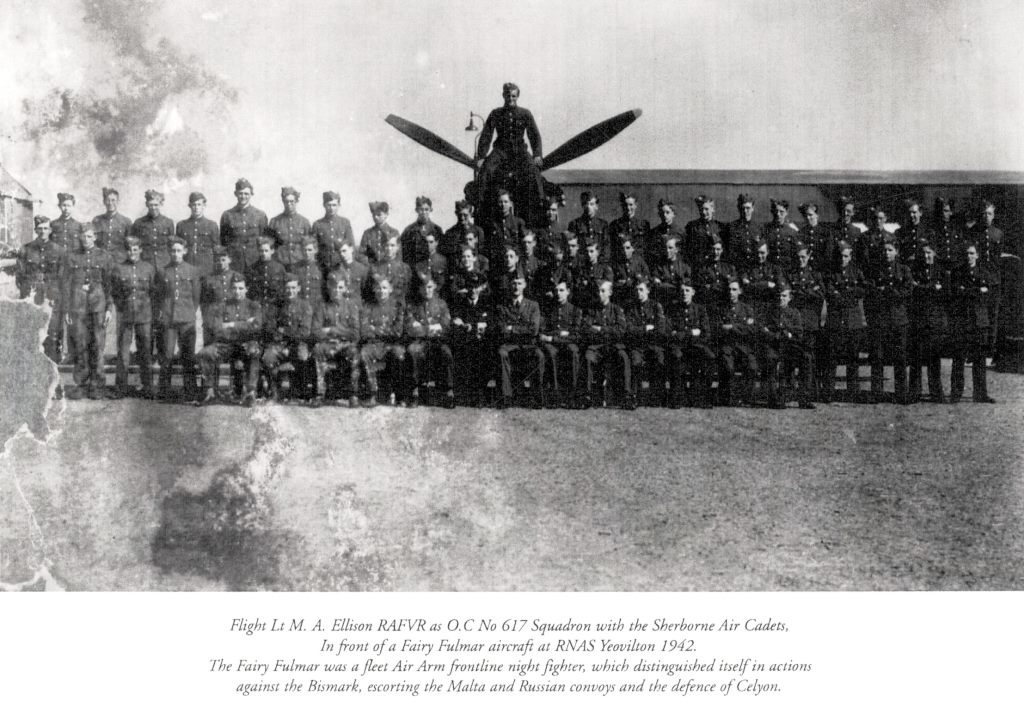
No. 617 Sherborne School Flight was formed by a Royal Warrant on the 5th February 1941, signed by Air Marshal Sir Philip Babington KCB, MC, AFC. Its aim was ‘to provide young men with the means of preparing themselves for air service with the Royal Air Force or the Fleet Air Arm.’
Shortly afterwards a Town Flight was also recruited, with instruction and training being provided on two evenings a week. On the 11th April 1941, an advertisement encouraging cadets to join the new squadron appeared in the Western Gazette:
‘A Squadron of the Air Training Corps has recently been formed in Sherborne under the Air Ministry Scheme. The object of the Air Training Corps is to provide pre-entry training in technical subjects for boys between the ages of 16 and 18 years, who, when called up for military service during the period of present hostilities, wish to join the Royal Air Force, the Fleet Air Arm, or the Royal Navy, intending Cadets should apply for further information to the Council Offices, South Street, Sherborne; or to M.A. Ellison (Provisional Commanding Officer), St Edmund’s, Westbury. Sherborne.’
The Sherborne School Flight was commanded from 1941 to 1944 by Flying Officer Mervyn Ellison FRAS (1908-1963), who was Head of the Army and Navy Class at Sherborne School, with Pilot Officer William G. Hewitt in charge of the Foster’s School contingent. They were assisted by Pilot Officer Frederick Mee who in 1944 succeeded Ellison and remained in charge of the Flight, assisted by Pilot Officer Henry Gervis, until it was disbanded in 1946.
The appeal for recruits met with a positive response from both Sherborne School and Foster’s School and membership of the Squadron was from the outset good, with thirty-four cadets joining in February 1941 (twenty-five from Sherborne School and nine from Foster’s School), eighty-two cadets in October 1941 (fifty-three from Sherborne School and twenty-nine from the town and district), with, at its peak in summer term 1942, 110 cadets.

Cadets were offered a training programme that aimed to prepare them for entry to the RAF. Instruction was given in navigation, aircraft recognition, signalling, mathematics, drill, and shooting. There were also regular opportunities for flying at RNAS Yeovilton, and in 1943 for gliding instruction at No.81 Gliding School. Flying Officer Ellison reported on these first gliding lessons: ‘The first afternoon was somewhat spoiled by heavy showers, but at least one Cadet with some previous flying experience, made a good “slide” across the aerodrome; the remainder seemed to drop one wing about half-way across and could not right themselves. Before the end of term we hope to have acquired sufficient experience of the controls to indulge in short “hops.” It is unfortunate that the time available is so restricted and that Cadets have to return for evening Chapel.’
In 1941, the Sherborne School Flight went on their first camp to RNAS Yeovilton, where they were joined by cadets from schools in Bruton and Crewkerne. During their stay, the cadets were allowed two flights per day, with a rule that anyone who was air-sick had to clean out their own cockpit!
On the 5th July 1942, the Sherborne Flight took part, like all other Squadrons of the ATC, in Air Training Corps Sunday celebrating the eighteen-months’ anniversary of the founding of the Corps. An inspection of the School and Town Flights in the Courts was followed by a service in the School chapel, after which the Squadron marched through the town to the saluting post at the War Memorial, where the salute was taken by Lieut.-Col. J.B.H. Goodden. The Summer Camp that year was held at RNAS Yeovilton where cadets took part in the normal life of the Station and obtained several flights in service aircraft.
In May 1943, Air Vice-Marshal Sir Charles Lambe visited Sherborne to open the town’s Wings for Victory Week and was provided with a Guard of Honour by the ATC for the visit. A significant landmark for the Sherborne School Flight was marked at the end of the summer term that year when the last of the original cadets who had joined the ATC in February 1941, left to join the RAF.
1944 saw the beginning of the end of the ATC. With the RAF no longer able to guarantee entry to every ATC cadet, popularity of the ATC began to decline. At Sherborne, between November 1943 and July 1944, the number of cadets fluctuated between forty-eight at its lowest to sixty (twenty-nine cadets from Sherborne School and thirty-two from the town) at its highest. Activities continued, with sixteen cadets attended Annual Training at RN Air Stations, and twelve more attached to an RAF Station. Ten cadets from the Town Flight also took a course in gliding at No.81 Gliding School, Yeovil. Both the School and Town Flights were inspected that year by visiting Officers who ‘expressed themselves very satisfied with the methods of training in operation and with the smartness of the Flights.’

In July 1944, Flying Officer Ellison left Sherborne on military service to take up the post of Scientific Advisor to the Admiralty Operational Research Group at RNAS Lee-on-Solent, Hampshire. On stepping down from command of No.617 Squadron, Ellison received a personal letter from Air Marshal Ernest Leslie Gossage, Chief Commandant of the Air Training Corps, thanking him for the valuable work he had done, adding ‘it is generally acknowledged that the Corps could not have grown to its present state of efficiency but for the enthusiasm and self-sacrificing efforts of yourself and others, who have placed unreservedly their skill and technical knowledge at the disposal of the cadets.’
Ellison’s position as Officer Commanding the Joint School and Town Flight was difficult to fill and it was decided to split the School and Town Flights, with F/L Frederick Mee, assisted by F/L Laurence May in a civil capacity, taking over the School Flight, and Pilot Officer Maurice Hopkinson, manager of the Midland Bank, assisted by Pilot Officer Stanley Westcott Scott, a laboratory assistant at Sherborne School.
Despite falling numbers, activities continued and in 1945 the cadets made three visits to RNAS Yeovilton where, on two occasions the weather conditions allowed them all to fly. The Field Day was a long-distance lamp signalling exercise near the Corton Beacon, and in August 1945 Pilot Officer Gervis took twelve cadets to a camp at RAF Station Watchfield, near Shrivenham.
Following VE Day in May 1945 and the hoped-for cessation of hostilities, the demobilization of No.617 Squadron ATC began to look increasingly likely. With only twenty cadets remaining in the unit, the Headmaster’s report to the Governors in October 1945 was not optimistic about the Flight’s future:
‘The work carried out by Sherborne School Flight during hostilities has been of very good value as all Inspectors’ reports have shown, but this is a form of organisation which appeals far more to boys in towns and villages than it does to Public School boys; largely because the work is to a great extent duplicated in Schools during the regular Mathematical periods and also because the opportunities of flying are inevitably much restricted in Schools.’
No.617 Sherborne School Flight was disbanded in 1946. In 1948, the Officer Training Corps (OTC) was renamed the Combined Cadet Force (CCF), and in 1955 the Sherborne School RAF section of the CCF was formed. However, it is worth noting that with the addition of the Sea Cadets in September 1942, for a brief period Sherborne shared with one other school the distinction of having all three corps at one time, Junior Training Corps (JTC), Air Training Corps (ATC), and Sea Cadets Corps (SCC).
Unfortunately, I have not been able to find a full list of all the ATC cadets, but the following list has been put together from the Valetes in The Shirburnian:
Flight Sergeant B.R.T. Aitken (School 1940-45)
Sergeant C.J.P. Andrews (Harper 1943-46)
Sergeant D.R. Arnott (School 1941-46)
Leading Cadet D.H. Aylwin (Westcott 1940-44)
Flight Sergeant J.J. Bailey (Lyon 1940-45)
Corporal E.A. Bowhay (The Green 1939-43)
Flight Sergeant R.D. Butterell (The Green 1938-43)
Corporal J.S.W. Chambers (School 1940-44)
Sergeant J. Ching (Abbeylands 1938-43)
Sergeant A.P. Clark (Abbeylands 1939-44)
Corporal T.A.P. Clarke (Lyon 1938-43)
Corporal J.C. Collier (Abbey 1938-42)
Flight Sergeant P.C. Collier (Abbey 1941-47)
Corporal M.N. David (Westcott 1942-46)
Sergeant A.R. Forrest (School 1941-45)
Corporal D.K. Freeth (Abbey 1938-43)
Corporal M.W. Graham (The Green 1942-47)
Sergeant N.W. Heale (Westcott 1936-41)
Corporal P.A. Hearne (School 1941-44)
Corporal P.C. Hepherd (The Green 1939-44)
Sergeant J.A. Hewitt (Westcott 1937-41)
Corporal G.D. James (Lyon 1938-42)
Corporal M.E.A. Manning (The Green 1941-45)
Sergeant D.F. Miller (Abbeylands 1939-44)
D.R. Morgan (School 1937-41)
Sergeant W.T. Rice (Lyon 1937-42)
Corporal E. G. Rogan (The Green 1937-41)
Sergeant Instructor M.E.C. Stedham (Abbeylands 1937-41)
Corporal P.M.R. Walton (School 1937-42)
Flight Sergeant J.B. Wingate (Harper 1938-42)
Sergeant J.T. Wroth (Westcott 1938-43)
Corporal A.H. Young (The Green 1940-44)
Rachel Hassall
School Archivist
See also: Sherborne School and the Second World War
For further information about the Sherborne School Archives please contact the School Archivist.
Return to the School Archives homepage.