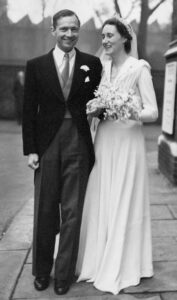
John Turcan Melvin (1916-1999).
John Melvin died on 13th September 1999, at the age of 83. After school at Stowe (at the same time as his life-long friend John Buchanan, who will also be remembered by many OS) he went to Trinity College, Cambridge. Thereafter, an intervention by the Carey family, with whom he was later to have such close connections, led to his appointment to the School staff in 1938. But soon, war service (which included landing in Normandy on D-Day +1) took him away from Sherborne. In 1946 he returned, and soon afterwards became housemaster first of Elmdene and then, from 1948, of Harper House. In 1959 he was appointed as Headmaster of Kelly College, Tavistock, where he remained until 1972. At the end of his headmastership, he returned to Sherborne where, after a spell at Foster’s School, he was persuaded to resume teaching German at the School in 1975. Before he finally ‘retired’ in 1982, he took over responsibility for the OS Society Bursary Fund, and for twenty years edited the Society’s Annual Record.
Such a necessarily brief resume of his career utterly fails to give an adequate idea of his manifold contribution to Sherborne, and to education in its broadest sense, both in the School and in the wider community. (This is not the place, regrettably, to give any assessment of his time at Kelly – crucial to him though it was – where his vision and compassion earned him the lasting gratitude of those under his tutelage). And bare facts convey nothing of his many enthusiasms, his concern for high standards, and his essential humanity. Indeed, the superficial observer may not always have been properly aware of what motivated him. For John was emphatically not the sort of person to convey his convictions through bombast. He was, in truth, exceptionally reticent, so that even those who knew him over a long period were conscious of how much of him they did not know. Different people, encountering him in different contexts, became aware of different facets of his make-up.
Some will remember him for the high quality of his German teaching, and his ability to convey his love of German literature. Many more will think of him as a caring housemaster. Others will recall the ways that, directly or indirectly, the benefited from his immense knowledge of, and enthusiasm for, the theatre. Not only was he an ardent theatre-goer, he was an inspirational producer (at a time when school drama was less well-regarded) of a whole string of school plays. Some of these were on a formal stage; others in the open air on the lawn below the Library. It is worth remembering that, in those days, there was no conventional stage in the BSR, let alone any facilities for even the simplest production. Yet John contrived triumphantly to overcome the many difficulties, and there were some memorable occasions. Outstanding, for many, was his masterly direction of the great Pageant which celebrated the School’s 400th anniversary; and there was his innovative (and extremely bold) representation of the morality play Everyman, also in the open air, in 1947. Nor did he limit his efforts to such major challenges, where he sought to involve as many members of the School as possible.
At the end of every Lent term, the School were entertained by a series of staff plays. Their success came entirely from John’s ability to cajole assorted members of the Common Room and their wives into action; the writer has vivid memories of how he would assemble his cast for late-night rehearsals in January and February in the frigidly unheated Church hall, and still create an atmosphere of enjoyment, thanks to his humour and lightness of touch.
All these activities were evidence of his endless willingness to give up every minute of his time for the benefit of others, and to fit all demands on his talents into his busy life. For ‘busy’ he certainly was; besides his manifold responsibilities in the classroom and as a housemaster, he also found time to be master in charge of tennis and was CO of the CCF (in the long-ago days when membership was compulsory for all and when Field-Marshal Lord Montgomery declared that Sherborne’s was definitely the best CCF unit he had ever inspected). Yet he always found time for other people. And, on top of al this, he could often be found preparing material for a talk on some aspect of music; his tastes were catholic and he was always seeking ways to convey to others his concern for what was best in any field. This not only marked his entire teaching career; it was later to find expression in his chairmanship of Dorset Opera in its ground-breaking early years. Much of its subsequent success and reputation was built on the foundations then laid.
There were many different reasons for people to feel gratitude for the way in which John affected their life. But, wherever their paths may have crossed, few seeing him at close quarters will have remained unaware of his sense of humour. Not for him the gusto of an all-embracing gale of laughter; one was struck by his pawky way of seeing the essential humour of a situation, and of giving it expression with an inimitable twinkle of his eye which would delight any listener. And, if his humour was low-key, his deep concern for other people was certainly not something to be talked about; he just got on and did whatever seemed best to ensure the well-being of any with whom he came into contact. The concern was often conveyed less by words than by creating worthwhile opportunities which the individual would not have been able to devise for himself – a visit to a theatre or concert, a meal with an interesting visitor, the suggestion of a book worth reading. In the same way, his insistence on high standards – something he always asked of himself – was not a matter for assertive public airing, but a combination of example and gentle, quiet, encouragement and support. He was capable of anger, but it was never of the explosive kind. Himself a model of politeness, he was dismayed by ungraciousness in any form by other people. In sum, he was the least self-assertive of men, never seeking to put himself or his ideas to the fore.
To everyone remembering John, no reference to his life would be complete without a mention of his dogs. A succession of these over the years – of varying temperament and under varying degrees of control (John could no more shout at his dogs than at a tiresome pupil) – were his constant companions. But it was his marriage in 1951 that added the vital ingredient to his life. Elizabeth’s unstinting and enduring support in all that John undertook meant that, both at Harper House and at Kelly, he had an enhanced opportunity to create the atmosphere of high standards and humane concern which mattered so much to both of them. They shared a delight in books, furniture and travel’ and their heedful hospitality added to the warmth of their welcome to every visitor. Their four children brought the extra dimension of close-knit family life in which John could relax in ways that he valued greatly.
Few, if any, outside the family could claim to have seen the full picture of a perhaps elusive, but often remarkable, man. John’s light tended to be tantalisingly concealed under the proverbial bushel. But, over the long years of his notably vigorous life, enough of that light escaped to illuminate the paths of those fortunate enough to encounter his shrewd wisdom. Sherborne, and Shirburnians, will always owe him much, and remember him with great gratitude.
Peter Currie.
OS Annual Record, November 2000.
John Turcan Melvin.
Born 19 March 1916.
Stowe School
Trinity College, Cambridge.
Weber’s School, Bonn.
Berlin University.
Assistant Master, Sherborne School, 1938-1959, 1976-1982.
Housemaster of Elmdene, 1946-1948.
Housemaster of Harper House, 1948-1959.
Headmaster of Kelly College, Tavistock, 1959-1976.
Treasurer of the OS Society 1977-1995.
Editor of the OS Record.
Died 13 September 1999.