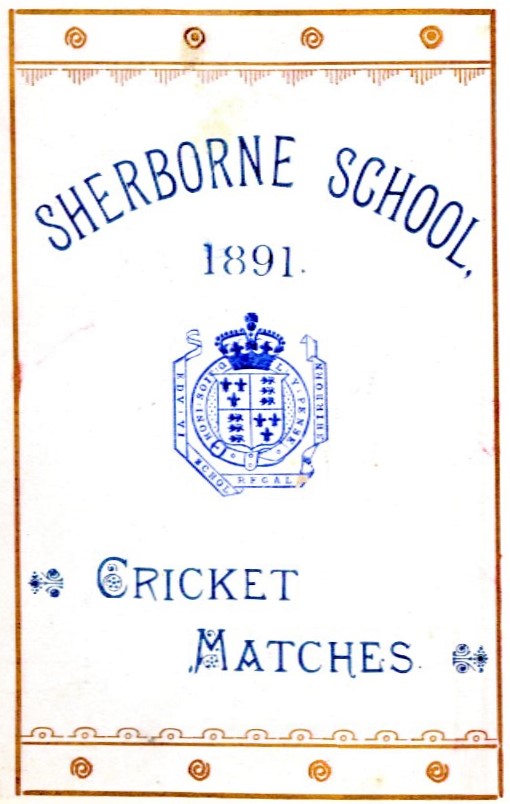
A list of known cricket coaches, also known as cricket professionals, who have coached Sherborne School’s cricket teams.
Henry Broughton Dakin (1840-1909)
Cricket professional and groundsman at Sherborne School, August-September 1859.
Played for Nottinghamshire (1845), The North (1840-1851) and the MCC (1847-55).
Henry Broughton Dakin and his twin sister Emily Sabina Dakin were born at John Street, Derby, on 15 December 1840 to Samuel Dakin (1808-1876), a silk weaver, and Eliza Julia (née Broughton) (1805-1893). In about 1850 Samuel Dakin moved to Cambridge where he was later joined by his family. Alongside bowling and umpiring for the College cricket clubs and the Quidnuncs, Samuel Dakin made his living making cricket pads. He was also employed as a cricket professional, playing for teams including Nottinghamshire (1845), The North (1840-1851) and the MCC (1847-55).
Having developed his skills bowling to the undergraduates on the Piece in Cambridge, Samuel’s son Henry Dakin soon became a ‘very useful bowler’. In August 1859, aged just 19, he was appointed cricket professional and groundsman at Sherborne School. In 1858, Henry John Rawlinson (1840-1926) the captain of Sherborne School’s 1st XI had raised money for the levelling of the Upper playing field to create a proper cricket pitch, which probably led to Henry Dakin’s appointment in 1859. Although Henry appears to have spent just two months in Sherborne, during his brief term of management he introduced daily practises for the XI with the result that ‘visible improvement has been made in all points of the game’. On 10 September 1859 a match was played between the School’s 1st & 2nd XI, with Henry playing for the 2nd XI. The match ended in a victory for the 1st XI despite Henry’s bowling being ‘well on the spot.’ While at Sherborne Henry also turned out for the town’s amateur cricket club on their Lenthay ground, playing on 23 September 1859 in their last match of the season, which was followed by an excellent dinner at the Antelope Hotel!
In 1861, Henry Dakin was living with his parents at 42, Grafton Street in Cambridge and in the following year he married Mary Haynes. Henry and Mary did not have any children of their own and adopted a boy called Albert Edward Lee. For a season or two Henry was engaged as second bowler on the Old Trafford Ground under Frederick Reynolds (1833-1915) who was appointed ground bowler at Manchester CC in 1861. Later Henry became the recognised cricket umpire for Trinity Hall and other Cambridge colleges and often travelled with the I. Zingari Club to Eton, Harrow and in Ireland. In the last few years of his life he suffered from poor health and died in January 1909 at Addenbrooke’s Hospital. He was buried on 11 January 1909 at the Newmarket Road Cemetery in Cambridge. Henry’s obituary, which was published in the Cambridge Independent Press on 15 January 1909, stated that ‘he was always regarded as a “jolly good fellow”, a good, straight umpire who knew his business, and was absolutely fearless, though unfortunately for him, he was never well off.’
Caleb Robinson (1828-1906)
Cricket professional at Sherborne School 1862-1864.
Played for England Next XIV (1860), Marylebone Cricket Club (1861, 1862).
Described by Hampshire cricketer W.J. Kendle (School House 1859-64) as ‘a medium-pace, straight, round-arm bowler, and a first-class coach. He was also a good bat.’
Caleb Robinson was born at Otley, Yorkshire, on 13 May 1828, son of John Robinson (1804-1852), a wool sorter, and Anne (née Dawson) (1806-1831). Caleb’s mother died in December 1831 and his father remarried on 2 December 1834 to Amelia Harrison (1809-1883). On 1 January 1851, Caleb, a wool comber, was married at Otley, Yorkshire, to Mary Ann Irvin (1832-1881), daughter of James Irvin, a mason. They went on to have six children.
Caleb became a professional cricketer making his first first-class appearance in 1860 with England Next XIV. In 1861 and 1862 he played for the MCC against Oxford University, Sussex, Hampshire and Middlesex. He also stood as an umpire in four first-class matches from 1861 to 1874. The 12 February 1862 issue of Sporting Life announced that Caleb Robinson had been engaged for the coming season at Sherborne School. In January 1863, the Sporting Gazette announced that Caleb had been appointed permanently as bowler at Sherborne School and would not return to Lord’s. He returned to Sherborne for the 1864 season, which saw the birth in Sherborne of his daughter Emily Ann/Hannah Robinson on 14 June 1864.
In 1865, Caleb was engaged for the season at Eccles in Lancashire, but something seems to have gone wrong for Caleb and he was forced to write to W.J. Kendle, who had been a member of the Sherborne School 1st XI in 1863 and 1864, asking him for financial assistance. Kendle forwarded the letter to Sherborne’s Headmaster H.D. Harper who evidently helped to sort out Caleb’s affairs, for which Caleb wrote the following letter of thanks to Kendle:
‘Dear Sir, Many thanks for your cindnes to me you heaved as will to me as H.P. Price Esq. or the two Mr Henley and if I have not the Pleshuer of seein you at aney other time I Hope I shall see your name amongst the Gentlemen Players of England from your obt. Servant. CALEB ROBINSON. P.S. Dear Sir, Please till next Capten about me.’
(This letter was quoted in ‘A few reminiscences’ by the Rev. William James Kendle, The Shirburnian, June 1903)
By 1871, Caleb was living and working as a cricketer at Baildon, Yorkshire. He remained at Baildon, later finding work as a domestic gardener.
Caleb Robinson died of apoplexy on 12 September 1906 at 20 Park, Baildon, Yorkshire, aged 78, and was buried at the church of St John the Evangelist, Baildon, on 15 September 1906.
James Chatterton (1836-1891)
Cricket professional at Sherborne School 1865-1867.
Played for Nottinghamshire (1856-65).
Right-hand batsman and occasional right round-arm bowler (slow and ‘twisting’).
James Chatterton was born at Newark in Nottinghamshire on 1st April 1836 to James Chatterton (1806-1852), a tailor, and Charlotte (née Barton) (1801-1870).
Between 1856 and 1865 James Chatterton played in six county matches for Nottinghamshire. He also had a number of professional engagements, including at Tenbury, Birkenhead, Radley College (1861), Horsham, and Burnley. From 1865 to 1867 James Chatterton was cricket professional at Sherborne School, when cricket matches were played on Lenthay Common. The Shirburnian (13 June 1865) records Chatterton playing for Sherborne School against Salisbury and scoring 67 runs in the second innings.
On leaving Sherborne James was appointed cricket professional at Rossall College (1868-1876). In 1859-60 and again in 1867 he was at Lord’s and played for the MCC in major matches during those seasons, his last match being MCC v Lancashire at Lord’s in July 1867. He also umpired in first-class and representative cricket from 1867 until 1890.
James Chatterton died in his hometown of Newark on 13 February 1891.
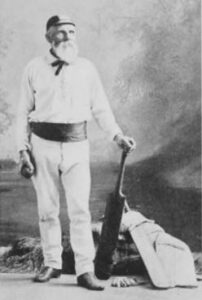
Samuel Barnes Morley (1828-1915)
Cricket professional at Sherborne School 1867-c.1877.
Cricket professional at St Paul’s School, Concord, New Hampshire, USA, 1882-1902.
Samuel Barnes Morley was born in May 1828 at Skegby, Sutton in Ashfield, Nottinghamshire, son of John and Mary Morley. In 1851 Samuel was living with his parents at Fullwood, Sutton in Ashfield, where they were all working as framework knitters. In 1854 Samuel, then a saw maker living in Carlisle Street, Sheffield, was married to Mary Ann Wharmly (1833-1897). In 1861 we find Samuel and Mary Ann living in Brook Street, Sutton in Ashfield, where Samuel was working as a cotton framework knitter and Mary Ann as a dress maker, they had by then two children, Agnes Mary (b.1857) and Samuel (b.1860). It is not clear when Samuel became a cricket professional, but he is said to have coached at Aston near Birmingham, and in the 1860s and 70s, captained teams of the Sutton & District Colts.
In 1868 Samuel Morley was appointed cricket professional at Sherborne School. His impact on the standard of cricket at the School was recognised later by an old boy who wrote to The Shirburnian in 1888, ‘cricket at Sherborne has gone steadily downhill since the days of Morley – a most successful coach, witness the cricketers he turned out at Sherborne from the same material – and it seems to me the present downfall must in some ways be attributable to the coaching, or lack of it.’ Amongst the schoolboy cricketers to emerge from Sherborne during Samuel Morley’s time were Derbyshire and Dorset cricketer A.F.E. Forman (Abbey House 1863-69), and Surrey cricketer W.H. Game (School House 1865-72) who in 1871 made the highest ever individual score on the Upper, making 281 and taking 5 wickets against Motcombe House. In August 1874 Sherborne made their only appearance at Lords where they beat Rossall by an innings and 25 runs.
While living at Sherborne, Samuel and Mary Ann had two more children, Barnes Herbert Morley (1868-1870) and Mabel Ellen Morley (born 1872), and on 28 December 1876 they saw their eldest daughter Agnes married in Sherborne Abbey to George Day. Mary Ann earned her own income by keeping a refreshment room at the grounds where Samuel worked and at Sherborne she had a fancy goods shop in Cheap Street.
In 1882, Samuel and Mary Ann emigrated to Concord, New Hampshire, where on 22 April 1882 Samuel was appointed cricket and racquets coach at St Paul’s School, Concord, New Hampshire. During his time at St Paul’s School Samuel was responsible for laying out the school’s golf links, enlarging the running track, and building playgrounds.
It appears that Samuel did not believe in banks, preferring to hide his money at his home and also in the foundations of the old cricket house and in a barn, and when Mary Ann left him in 1892 and returned to England on her own she took all their savings with her!
Samuel Morley retired in 1902 and died on 11 February 1915 at 20 Mills Street, Concord, and was buried in St Paul’s School cemetery.
Davis
Cricket professional at Sherborne School 1871.
Little is known of Davis’s time as cricket professional at Sherborne School, but he is mentioned in two letters written by assistant master Mungo Travers Park (1843-1908).
In a letter written to his sister on 8 May 1871, M.T. Park writes: ‘We have just hired another professional, said to be very good, but I don’t think much of his style of play as far as I’ve seen hitherto’.
And on 23 May 1871 he writes to his father, ‘Cricket is in full swing here now, but as yet I have made no runs worth speaking of, however my day is, I trust, coming. This week we Masters, with the two professionals [Morley and Davis], play our XI. I think we shall get beaten this year, we beat them well last year and I made 52, which I hope to repeat.’
Frederick Green (1843-1891)
Cricket professional at Sherborne School 1878-1881.
Played for Dorset (1880).
Professional at Kingston Park Cricket Club and Sherborne Cricket Club.
Frederick Green was born at Lincoln in 1842 (christened 21 July 1891) and buried at Lincoln on 21 July 1891.
From 1878 to 1881 he was cricket professional at Sherborne School but, according to Harry Hammond House (School House 1878-82), was not ‘a man of very good reputation’.
Hartley
Cricket professional at Sherborne School 1881-1882.
According to Harry Hammond House (School House 1878-82), Harley was a Yorkshire man, ‘a useful practice bowler, but of not much use as a coach.’
John Thomas Parmenter (1851-1933)
Cricket professional at Sherborne School 1883-1886.
Played for Dorset (1878-85), Wiltshire (1890), Cambridge Town (1874-77).
Umpire in first-class matches: Cambridge University v. Yorkshire, 1881; Cambridge University v. Lancashire, 1882.
John Thomas Parmenter was born on 28 August 1851 at Broad Street, Cambridge, the only son of Thomas Parmenter (b.1821) and Sarah (née Covell) (b.1819). At the time of John’s birth his father was a baker but by 1856 he was groundsman at Fenner’s cricket ground, Cambridge, later becoming custodian of Trinity College Cricket Ground, Cambridge (c.1857-c.1871) and of St John’s Cricket Ground, Cambridge (1871).
By 1881 John was ground bowler at Cambridge University cricket ground, a position he also held from 1887 to 1889. He supplemented his income working as a musician and is known to have performed with the Cambridge Christy Concert Company. From about 1881 John was also ground bowler (‘with a fast swinging left-hand’) and cricket professional at Kingston Park in Dorchester, Dorset, where he father also worked as groundsman.
In 1883 John was appointed cricket professional at Sherborne School, where his father joined him as groundsman and remained until at least 1891. John and his father were famous at Sherborne for their dogs, a family of black and tan collies which fielded and retrieved cricket balls at the practice nets. It was reported that John had such faith in his dogs’ abilities that he was ready to play a single cricket match with any two players in the neighbourhood!
John divorced his first wife in 1884 and left Sherborne in 1886. He later remarried and by 1911 was rearing poultry at Taunton. He died on 5 February 1933 at ‘Miltons’, Chipstable in Somerset, aged 80.

Thomas Gothard Selby (1851-1924)
Cricket professional at Sherborne School 1886-1888.
Played for Derbyshire (1885).
Professional at The Leys School, Cambridge, 1889-1890.
Right-handed batsman, right-arm fast bowler.
The son of a blacksmith, Thomas Selby was born in 1851 at North Wingfield, Derbyshire. In June 1885 heplayed for Derbyshire against the MCC at Lords.
From 1886 to 1888 Thomas Selby was principal bowler at Sherborne School, where he was assisted by King from the Parks at Oxford.
He was engaged as cricket professional at The Leys School in Cambridge for the season in April 1889 and April 1890, but by 1891 was back in Derbyshire working as a blacksmith at Pilsley near Bakewell, later moving to Radford in Nottinghamshire, and then to Shirebrook in Derbyshire, where he was engaged as a colliery screw hand and pick sharpener at the Warsop Main Colliery near Mansfield.
Thomas Selby died on 6 November 1924 at 186, Station Road, Shirebrook, leaving a widow but no children. His cause of death was given as sciatica and bronchitis.
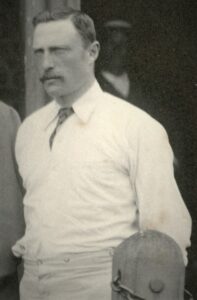
John Richard Painter (1856-1900)
Cricket professional at Sherborne School 1889-1893.
Played for Gloucestershire (1881-97), South (1884), Lord Sheffield’s XI (1885), England (1888).
Right-handed batsman, right-arm fast bowler.
John Painter was born on 11 November 1856 at Lansdown Villa, Bourton-on-the Water, Gloucestershire. The son of a timber dealer, he worked in the family business while playing cricket for Bourton-on-the Water Cricket Club. He went out as a professional in 1881 and 1882 when he was with the Clitheroe Cricket Club in Lancashire. Between 1881 and 1897 he played in 198 first-class matches, 192 of them for Gloucestershire. In 1883 he was appointed cricket professional at Cheltenham College.
In 1889 John Painter was appointed as cricket professional at Sherborne School.
On 17 February 1899, W.G. Grace wrote a letter to J.R. Painter on official Gloucestershire County Cricket Club headed notepaper, ‘Have you got the post at Sherbourne [sic], & when do you go there. Let me know of any Colts who could come down and are good enough.’
The 1889 season results were for Sherborne the best ever!
During John Painter’s time at Sherborne the XI began to play matches against other schools. In 1890 they drew against Wellington and in 1891 they beat Bradfield by ten wickets.
Littleton Powys, who was a pupil at Sherborne School from 1886 to 1893, wrote of J.R. Painter in his autobiography, The Joy of It (1937), ‘Jack Painter, our School professional, had a most inspiring personality; his influence was great and always for good… Painter was forever preaching the privilege of being alive, and the importance of keeping fit so as to enjoy life more. I remember how at the beginning of my last term he said to me: ‘Hitherto others have been carefully guarding you and doing all they can to help you; at the end of this term you will go out into the world and all will be changed; there will be difficulties in all directions and you will have to depend on yourself alone. So make the most of this, your last term, before these responsibilities fall upon you.’ It was good sound advice which I believe I took. But all too quickly those happy months passed and the time came for me to say good-bye to Sherborne.’
In July 1893, Sherborne Headmaster F.B. Westcott sent out an appeal to Old Shirburnians asking them to make an annual subscription to a School ‘Bowling Fund’ with the object of raising £50 or more a year which would allow them to make John Painter a permanent cricket instructor and groundsman at the School and to provide the 1st XI with ‘efficient and regular coaching’.
The appeal, however, did not tempt John Painter to stay at Sherborne and the following year he was appointed cricket professional at Clifton College, where in August 1894 a benefit match was played for him between Gloucestershire and Middlesex, and in 1895 he opened a cricket and athletic store in Clifton.
John Painter had married Florence Jane Sigley (1871-1955) in 1893 and they went on to have two children, John Sigley Painter (1894-1918) and Lionel Herbert Painter (1895-1964). Their eldest son John Sigley Painter was killed at Kantara, Egypt, during the First World War when serving as a Lieutenant in the 7th Bn. Worcester Regiment (attached to the 12th Bn. Norfolk Regiment).
John Painter died on 16 September 1900 at Bourton-on-the Water, Gloucestershire, aged 43.
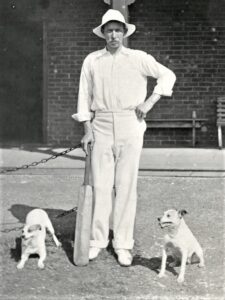
Tom Bowley (1857-1939)
Cricket professional at Sherborne School 1894-1910.
Played for Northamptonshire (1880-84), Surrey (1885-91), Dorset (1896-1902).
Right-handed batsman, right-arm fast bowler.
‘In his day he was the best bowler in England and is said to have got W.G. Grace out three times in 20 minutes.’
Thomas Bowley was born on 28 February 1857 at Basford, Nottinghamshire, where his parents both worked in the hosiery industry, his father as a bleacher and his mother as a hose welter. His father died the year Tom was born and by the age of 14 Tom was helping bring in money working as a hose trimmer. In 1879 Tom married Lucy Ann Riley (1857-1947).
While continuing to work as a trimmer (bleacher) Tom was engaged by Northamptonshire Cricket Club where he was regarded as an exceptionally good all-round cricketer. He appeared for Northamptonshire between 1881 and 1884, playing against Australia in 1882, and against Essex at Wellingborough in 1884 when he took all the wickets with the exception of one run out in the first innings. It was while playing with Northampton that he came to the notice of W.G. Grace, and on one occasion while practising at the nets he cleaned bowled W.G. Grace three times in 20 minutes. In 1885 Tom joined Surrey and during seven years took 386 wickets for just over 15 runs apiece. One of his best performance was six Derbyshire wickets for 13 runs at Derby in 1889.
In 1894, Tom was engaged at Sherborne School as groundkeeper and professional for the year, but he ended up staying for 17 years. During his time at Sherborne Tom oversaw the early promise of a number of young cricketers, including future Derbyshire captain Reginald Rickman (Abbeylands 1894-1900), future Dorset captain H.M. Greenhill (Abbey House 1898-1900), Philip Hope (Harper House 1905-06) who played for Dorset and Somerset, Wilfred Jesson (Harper House 1901-05) who took the wicket of the great Jack Hobbs while playing for Hampshire, and A.W. Carr (School House 1907-11) who went on to play for Nottinghamshire and to captain England. Tom was also congratulated for improving the quality of the pitches at Sherborne which were described as ‘almost too good’!
In June 1905 Tom found time to take part as ’19th Dane’ in the Sherborne Pageant when he had to mock fight the Master of the Workhouse, but said ‘I’m not going to hit him. I may be in the workhouse one day.’
After his retirement in 1910, Tom became landlord of the Castle Inn in Long Street, Sherborne, where in 1931 the exiled cricket-mad author Alec Waugh (School House 1911-15) dreamt of visiting for ‘a sandwich and a pint of beer and gossip with Tom Bowley about the legendary past.’
Tom Bowley died at Sherborne on 9 November 1939, aged 82, and was buried in Sherborne Cemetery.
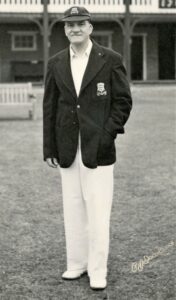
Edward John Freeman (1880-1964)
Cricket professional at Sherborne School 1910-1947, Head Groundsman 1910-1949.
Played for Essex (1904-12), Dorset (1913-28).
Played football for Essex.
Ted Freeman was born on 16 October 1880 at Ladywell in Lewisham, Kent, to Edward Charles Freeman (1861-1939), the Essex cricketer and later chief groundsman at Leyton. Ted played for Essex (1904-1912) but never fully fulfilled expectations as a batsman, and in his first-class career he hit only 1,280 runs. His cousins John Robert Freeman (1883-1958) and Thomas Marychurch Freeman (1863-1927) also played for Essex, and another cousin, Alfred Percy ‘Tich’ Freeman (1888-1965), played for Kent (1914-36) and England (1924, 1929).
Prior to coming to Sherborne in 1910, Ted was for six years head cricket coach at Leyton, and also coached boys of Merchant Taylors’ and Bancroft School, Woodford. In 1910 he was appointed coach at Lords, but chose instead to come to Sherborne where he took over from Tom Bowley as cricket professional and head groundsman. On 3 October 1913 Ted and his family moved into the newly-built Cricket Lodge in the south-west corner of the Upper.
During Ted’s time at Sherborne he oversaw the development of a number of future county cricketers: J.A. Nunn (Lyon House 1919-25) went on to play for Middlesex, R. Eglington (Lyon House 1922-27) who played for Surrey, and E.R.K. Glover (Harper House 1925-29) who played for Glamorgan; as well as five future Somerset players: L.H. Bean (Harper House 1920-23), Patrick Mermagen (Abbey House 1926-30), Mike Earls-Davis (School House 1935-39), G.W.L. Courtenay (School House 1935-40), and D.P.T. Deshon (School House 1936-41). He also helped to develop the talent of the School’s second Test player, David Sheppard (Lyon House 1942-47), who also captained Sussex.
During the First World War, Ted served as a Bombardier with 479 Siege Battery, R.G.A. In May 1918 he was admitted to hospital with Trench Fever and was discharged to draft on 18 October 1918. From 1917-1918, Ted’s father, Edward Charles Freeman (1816-1939), took his place at Sherborne School. After Ted’s return from the war his father coached at a school in Bournemouth and died at Cricket Lodge in Westbury, Sherborne, on 16 October 1939 and was buried in Sherborne Cemetery.
After the war, Ted set to work on the new School playing fields, now known as Carey’s, levelling 82,000 square yards of ground and laying two thousand yards of drains.
Ted retired as cricket professional in 1946 and as head groundsman in 1949. He moved his sports equipment shop from Cricket Lodge to no. 40 Cheap Street, outside which he displayed Tom Bowley’s former shop sign of wickets, bats and balls. In 1953, the shop moved to no.22 Cheap Street where it was renamed The Sports House and Ted’s daughter Alice Freeman sold sports equipment and clothes.
Ted Freeman died at Sherborne on 22 February 1964, aged 83, and was buried in Sherborne Cemetery. His funeral service was held in Sherborne Abbey on 26 February 1964, at which the Headmaster of Sherborne School, R.W. Powell, paid tribute to Ted, saying, ‘He taught boys to play cricket, and taught them well, because he loved the game and loved boys. But without realising it, by being the Ted Freeman that he was, he was a valuable part of their general education.’
An area of the school playing fields is named ‘Freeman’s’ in Ted’s memory.
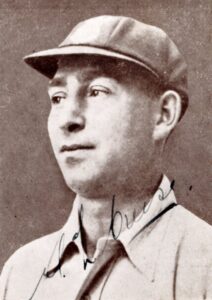
William Charles Leonard Creese (1904-1974)
Cricket professional at Sherborne School 1948-1954.
Played for Hampshire (1928-39) and Dorset (1949-51).
Left-handed batsman, left-arm medium pace bowler.
Len Creese was born on 27 December 1907 at Park Town North, Johannesburg, South Africa, the son of the umpire and Transvaal and Monmouthshire cricketer William Henry (Bill) Creese. Len came to England as a young man to make a career as a professional cricketer, and between 1928 and 1939 represented Hampshire in 278 first-class matches. In 1931 he married Emily Doris Hibberd (1902-1961).
Len’s career at Hampshire was cut short by the Second World War, during which time he spent time coaching in Argentina and served in the army as a Lance-Corporal. In 1947 he was appointed Cricket Professional at Sherborne School, a post he held until 1954, during which time he ran the school sport shop and also played for Dorset (1949-51). Len’s time at Sherborne overlapped with that of the young David Sheppard (Lyon House 1942-47) who went on to play for Sussex (1947-62) and England.
Len Creese left Sherborne at the end of the summer term 1954. The following tribute was paid to him in recognition of his time at the School (The Shirburnian, Michaelmas 1954):
‘Before next term, Creese will have left the School to take up an appointment elsewhere, and our community will thereby experience a great loss. In his various capacities – drill instructor, head groundsman, cricket professional – Creese has exerted a considerable influence on the life of the School, and his cheerfulness always met with a ready response. During his seven years here, he achieved a mastery of the peculiarities of the playing fields, and although often handicapped by a dry April or a wet Summer, he never failed to have the grounds at their best – and this the result of hard and willing work. Few people realize that a school’s playing fields, in daily use as they are for three months at a time, make the most exacting demands upon the ground staff.
But it is probable that Creese will best be remembered as a cricket coach. He was a fine player, and his beautiful bowling action was a model for all young cricketers. But he had other assets – more important ones. Chief among these was the fact that he was as happy coaching junior teams as he was the 1st eleven – and only those who know the average runs of cricket professional will realize how fortunate we were in this. He also knew how to handle temperamental batsmen and bowlers, and was full of patience and understanding for the difficulties of small boys. His belief was that the ball was to be hit, and more than one promising batsman has been summed up – “All very nice, Sir, but he can’t hit it past mid-off.” He himself would strike with frightening power, and, on the rare occasions he could be persuaded to have a net, would soon have balls whistling to distant parts of the Upper.
We shall, indeed, miss him very much, and to him and Mrs Creese we wish every success and happiness in their new sphere.’
In January 1955, Len was appointed groundsman at the Central Ground at Hastings, Sussex, where on 31 August 1963 his 23-month-old grandson was tragically killed having run onto the pitch after A.E.R. Gilligan’s XI declared against the West Indies and being hit by a heavy motor roller.
Len later served as Head Groundsman at the Sussex County Ground at Hove. He died in hospital at Dover on 9 March 1974, aged 66.
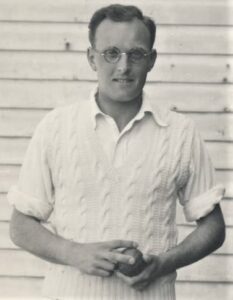
Raymond Randall Dovey (1920-1974)
Cricket professional at Sherborne School 1955-1959.
Played for Kent (1938-54), Dorset (1955-59), Commonwealth XI (1950/51).
Left-handed batsman, right-arm off-break bowler.
Ray Dovey was born on 18 July 1920 at Chislehurst, Kent, son of George Alfred Dovey (1885-1957) and Annie (née Randall) (1888-1978). He joined the staff at Kent CCC in July 1936 and had his first game for the County two years later, at the age of 17.
His cricketing career was interrupted by the Second World War during which time he served in the RAF as a wireless mechanic, but also found time in 1940 to marry Catherine Anstruther (1920-2009) and to play for Glamorgan sides. Ray, who played wearing glasses, was awarded his county cap in 1946 and in 1950-51 toured India and Sri Lanka with the Commonwealth XI. In August 1954 he made his final first class appearance for Kent, having taken nearly 800 wickets in first class cricket, including 102 in 1950.
In 1955 Ray was appointed cricket professional at Sherborne School, during which time he played five seasons for Dorset in the Minor Counties competition.
In March 1959, Ray and his family returned to Kent where, alongside taking charge of Halstead Post Office, he served as cricket professional at Tonbridge School, replacing Peter Hearn who had left in 1958. Ray was credited with the high standard of cricket at Tonbridge and for developing young cricketers.
Ray Dovey died suddenly at his home in Tunbridge Wells on 27 December 1974, aged 54.
William Lander (1920-2002)
Cricket coach at Sherborne School 1959-1976.
Played for Dorset (1960-62), Nottinghamshire Second XI (1947).
Slow left-arm orthodox.
William (Bill) Lander was born on 17 May 1920 at 15 Club Row, Rainworth, Nottinghamshire, son of George Lander, a coal miner (hewer) at Rufford Colliery, and Caroline Lander (née Jepson). By 1939 Bill was working as a nurse at Mapperley Hospital, a mental health facility in Porchester Road, Nottingham, and in 1942 he married Noreen Madge Donegan (1922-1997).
Bill was appointed cricket professional at Sherborne School in 1959, living with his family at Cricket Lodge in the southwest corner of the Upper. During preparations in June 1959 for an inspection on the Upper of the School’s CCF by Field Marshal Viscount Montgomery of Alamein, no one thought to warn Mrs Lander that a Royal Artillery Gun Salute would be fired from the corner of the Upper outside Cricket Lodge. The result was that Mrs Lander, who was preparing a meal for her husband, ‘jumped out of her skin’ and dropped a carton of eggs on the floor. The CCF accounts for that month included cash for a bunch of flowers and half a dozen eggs for Mrs Lander!
During the ‘Great Drought’ of 1976, the School groundsmen were not allowed to water the square on the Upper and the 1st XI were unable to play. This caused some local controversy when it was discovered that both Sherborne Town Cricket Club and Sherborne Golf Club were allowed to water their greens.
On his retirement in 1976, Bill ran a sports shop in Sherborne School’s new Sports Centre, which was officially opened on 28 September 1976 when Headmaster Robin Macnaghten dived into the swimming pool with ‘extraordinary elegance’.
Robert Wakefield Clarke (1924-1981)
Cricket coach at Sherborne School 1978-1981.
Played for Northamptonshire (1947-57).
Left-handed batsman, left-arm fast bowler.
Robert Wakefield Clarke was born at Finedon, Northamptonshire on 22 April 1924. He played for Northamptonshire from 1947 to 1957, appearing in 212 first-class matches, taking 484 first-class wickets, with a best performance of eight for 26, and scoring 2,745 runs with a highest score of 56, one of six half-centuries. He later coached at the Royal Naval College in Dartmouth, at Christ’s Hospital and, from 1978 to 1981, at Sherborne School.
Robert Clarke died at Sherborne on 3 August 1981, aged 57. His obituary in Wisden’s described him as ‘shortish and stocky’, adding that ‘he was prepared to bowl all day and was indeed in temperament a complete contrast to the volatile Nobby. But, though he could at times unleash that beautiful ball which pitches on the leg stump and whips across to the off, the real genius was lacking. He was also handicapped by cartilage trouble. Despite some fine performances, thirteen for 190 against Surrey at Northampton in 1950 and eight for 26 against Hampshire at Peterborough in 1951, his career figures of 484 wickets at 34.60 runs apiece tell their own tale. Apart from his bowling he was a useful, if unorthodox, tail-end hitter and a good fielder near the wicket.’

Christopher Stone
Cricket coach at Sherborne School 1982-1990.
Played for Bedfordshire (1974), Dorset (1982-90).
Right-handed batsman and a right-arm off break bowler. Bowled Viv Richards.
Christopher Stone was born on 11 May 1951 at St Neots, Huntingdonshire. He attended Beal Grammar School in Woodford, Essex and in 1974 made his county cricket debut for Bedfordshire. From 1982 to 1990 he represented Dorset in seventy-six Minor Counties matches and also played five List-A cricket matches for Dorset between 1983 and 1990. He has played for Ilford and Wanstead CC in Essex, Sou’westers CC, the Cryptics and ‘anyone else who would have me’.
Chris has worked as cricket coach at Harrow, Mill Hill, Sherborne School, and Tonbridge School. As youth coach at Kent he spent his last three seasons streamlining the Kent Youth set up, ensuring each of the county’s age groups sides had their own manager and coach. He went on to spend 22 seasons coaching in South Africa, including at Woodridge College, Rondebosch BHS, Grey HS, St Andrews College and St Stithians College, also at the University of Port Elizabeth and Eastern Province, and two seas in New Zealand. He is now happily retired playing golf at Canterbury GC.
A renown expert on batting techniques, he is also author of The Complete Book of Modern Fielding Practices (Robert Hale Ltd., 1992)
When Chris left Sherborne in 1990, Charles Allen paid the following tribute to him:
‘Since 1982 Shirburnian cricketers have indeed been exceptionally fortunate to have been able to enjoy the coaching skill and knowledge of Chris Stone. Chris had previously been coaching at Harrow and briefly at Mill Hill when he arrived. His early Sherborne winters were spent improving standards in South Africa, at Woodbridge College and at Rondebosch Boys’ High School. It is a measure of Chris’s talent that latterly he was Coach to the University of Port Elizabeth and that he was employed by the Eastern Province Cricket Union to look after their ‘B’ team – a brief that included looking after some of the stars of the ‘A’ side too. What marked Chris out as an outstanding coach was his ability to get the best out of the boys. In his two years in charge of the 1st XI, no match was lost, even though the sides were by no means as talented as more recent, beaten sides. His work with junior teams was of the same stock. No boy was allowed to be negative about his own ability; each member of each side had a specific role in the team’s success. The standards he set himself were expected of the boys too – dress immaculate, kit clean and in good repair. There was also his rapport with the boys – how many of them gained their nickname from Chris, how many of them had their legs pulled mercilessly, or were led along on the longest and most far-fetched of shaggy-dog stories! Dorset County Cricket also witnessed Chris’s talent. He made his debut and gained his County Cap in 1982, and since then he has filled an important niche in the county side. We hope that he will be able to serve under a fourth captain next year. Highlights of his career are manifold, but he did play for the Minor Counties representative side against Zimbabwe and the West Indies. How many people can claim that they have bowled the great Viv Richards? He would have played more if he had not been so committed to Sherborne cricket. Those who know Chris will remember a man of principles, who was not afraid to speak his mind, and who did not suffer fools gladly. There have been fewer more loyal supporters of Shirburnian cricketers, and they have a great deal for which to thank Chris Stone. We wish him well in his trip to the new pastures of Nelson, New Zealand, where I am sure he will be able to find new and more challenging walks, more obscure wines made by itinerant Bulgarians, and more raw material to turn into talented, confident and above all successful cricketers.’ The Shirburnian (Michaelmas 1990)
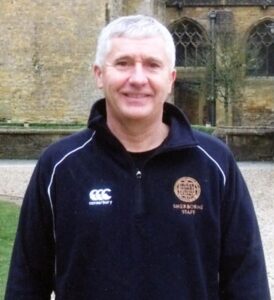
Alan Willows
Cricket coach at Sherborne School 2010-2016
Played for Sussex (1980-83), Dorset (1990-97).
Right-handed opening batsman who bowled slow left-arm orthodox.
Alan Willows was born at Portslade, Brighton, Sussex, on 24 April 1961 and made his first-class debut for Sussex in 1980. In 1990 he made his debut for Dorset in the 1990 Minor Counties Championship against Wiltshire and represented Dorset in 51 Minor Counties Championship matches from 1990 to 1997. He made his List-A debut for Dorset against Lancashire in the 1st round of the 1991 NatWest Trophy, and represented Dorset in 4 List-A matches from 1991 to 1995, with his final List-A match for the county coming against Glamorgan in the 1st round of the 1995 NatWest Trophy.
Alan was appointed Director of Cricket at Sherborne School in March 2010 and also served as Head Coach at Dorset County Cricket Club from January 2009 until 2016.
In January 2016 Alan was appointed cricket professional at South African College School (SACS) in Cape Town, having previously coached at SACS from September 1988-March 1993 and September 2003-March 2004.
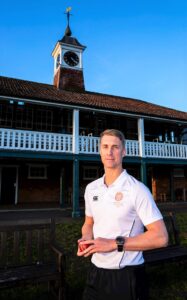
Matthew Graham Pardoe
Director of cricket coaching at Sherborne School, January 2016-2023.
Played for Worcestershire (2011-14), Herefordshire (captain) (2015-).
Left-handed opening/middle order batsman.
Matt Pardoe was born on 5 January 1991 at Stourbridge, Worcestershire. He went to Haybridge High School and, having progressed through Worcestershire’s youth academy system, played for Worcestershire’s Second XI, making his first-class debut against Yorkshire at New Road, Worcester at the start of the 2011 season, scoring 26 and 0. In his second first-class match, against Warwickshire at New Road, he scored 54, his maiden first-class half-century. He went on to make his second half century against Nottinghamshire finishing on 74 before being caught off the bowling of Samit Patel. Matt scored his maiden first-class century against Glamorgan in a county championship game in 2013, scoring 102 off 235 balls before being caught off the bowling of Dean Cosker. Since 2015 he has played Minor Counties cricket for Herefordshire, and in 2017 was county captain.
An ECB Level 3 qualified coach, Matt joined Sherborne School in January 2016 where he worked with all age groups in both the winter and summer cricket programmes. Using experiences in professional sport, including sport psychology training from Dr David Alred MBE and Steven Sylvester, Matt also helped to develop the all-round skills of the School’s Sports Scholars as part of the School’s High-Performance Programme.
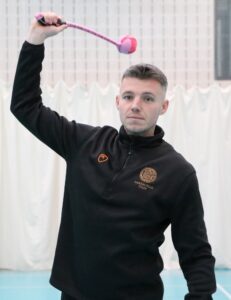
Ryan Sean Buckley
Director of cricket coaching at Sherborne School, August 2023-; Housemaster of Abbeylands 2025-.
Played for Durham (2013-2015).
Right-hand bat, right-arm Off break bowler.
Ryan Buckley was born on 2 April 1994 at Darlington, County Durham, and attended Hummersknott Academy and Darlington Queen Elizabeth Sixth Form College. As a player, Ryan represented Durham CCC, making a memorable debut for Durham against Surrey at The Oval in May 2013, claiming Vikram Solanki as his maiden first-class wicket, and winning the LV County Championship in 2013, before retiring in 2015 to pursue a coaching career.
An ECB Advanced Coach with experience working within performance (Durham CCC, Somerset CCC, Dorset CCC & Western Storm) and development (Millfield School & Hong Kong Cricket Club), Ryan Buckley joined Sherborne School as Director of Cricket Coaching in August 2023.
At Sherborne the cricket programme runs through the academic year, including a pre-season camp during the Easter holidays to help prepare the boys for the summer term. There is a weekly house indoor cricket competition for the boys to develop who are outside the winter performance programme, alongside coaching at Sherborne Prep School during the winter months. The holistic programme is designed to challenge the boys on and off the field. On a Wednesday afternoon, the cricket scholars have an individually designed programme to allow them to reach their individual potential. In 2025, Ryan was appointed Housemaster of Abbeylands.
See also:
- Cricket at Sherborne School
- 1st XI team photographs
- Tribute to E.J. Freeman by Headmaster R.W. Powell
- W.G. Grace, J.R. Painter and cricket at Sherborne (pdf)
- Playing Fields and Pavilions
- Shirburnians who have represented their country in sport
- Sports & Games at Sherborne School
Further Reading:
- A.B. Gourlay, A History of Sherborne School (Sherborne, Sawtells Ltd., 1971)
- D.F. Gibbs, A History of Cricket at Sherborne School (Sherborne School, 1980)
- W.F. Mandle, ‘The Professional Cricketer in England in the Nineteenth Century’, Labour History, no.23 (November 1972), pp.1-16.
- Tony Percival, Dorset Cricketers 1845-2016 (ACS Publications, 2017)
- B. Pickering Pick (ed.), The Sherborne Register 1550-1950 (Winchester, Warren & Son Ltd., 4th ed., 1950)
For further information about the Sherborne School Archives please contact the School Archivist.
Return to the School Archives homepage.