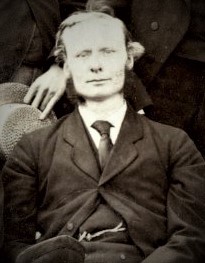
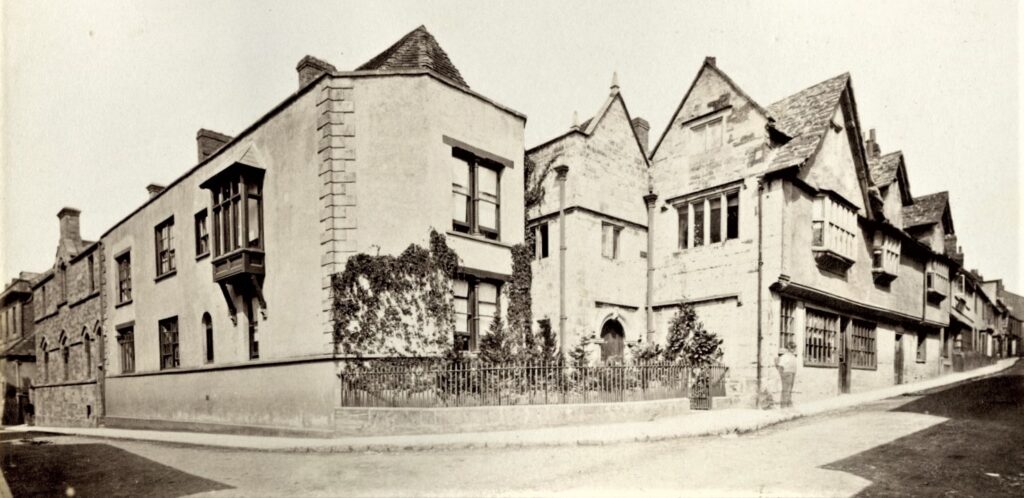
On 25th January 1872, Abbeylands was opened as a School boarding house under housemaster William Lonsdale Hetherington (1845-1912).
William Hetherington was born in Carlisle on 5 March 1845 and attended Durham Grammar School. In 1864 he went up to Trinity College, Cambridge, where he was captain of the 2nd Trinity Boat Club and in 1868 he was awarded a double first (22nd Wrangler).
In March 1868, Hetherington was appointed assistant master at Sherborne School by Headmaster Hugo Harper, where he remained on the staff until Easter 1880. After leaving Sherborne he went on to serve as examiner to the Admiralty and as classical lecturer at King’s College, London, and died on 17th February 1912 at the house he had built at no.3 Broadlands Road, Highgate. An obituary written by a former Sherborne School pupil described him in his prime:
‘He was unlike any other man I had ever seen. He was long and lean of body, with arms that suggested a fine reach forward to the oar; he had a peculiar way of standing, with his head thrown back, and one arm behind him, which gave an impression of alertness and force; but it was the head and face that were most attractive; the fair flaxen hair, the keen and kindly eyes, the wide, thin-lipped mouth, always ready to expand with the most irresistible of smiles; and then would come the wise or tender saying, the apt quotation, always helped by just a touch of the broad Northern accent… we loved him both as Master and as man. Never shall I forget my first lessons under him in the Fifth Form, how he made us enjoy the quaint humour of Herodotus, how he made us feel the majesty and beauty of the Sixth Aeneid. Speaking for myself, I feel that I owe to him the first glimmerings of literary interest and appreciation.’ (Obituary by A.W. Upcott, The Shirburnian, April 1912)
On 3rd February 1871, Hetherington was lucky to escape when a fire broke out in the School House studies [now the Headmaster’s building] where he had a room. Unable to descend the staircase he was forced to exit the building through a barred upstairs window. When asked how he had squeezed himself through the bars he said, ‘I got my head through, and then I knew my body could follow’. His lucky escape probably explains the study rules he later drew up for Abbeylands:
- There is to be no cooking of any kind whatever, or feasting in the studies; no uses of plates or knives; the woodwork is not to be cut, pictures are not to be pasted or gummed up, but hung framed from proper hooks, and no other nails are to be driven in the walls or woodwork.
- A boy may not work in another’s study without permission, nor enter it without his leave. Boys may not congregate in any study at any time. The chairs, table, bookcases, curtain rods, locks, keys, pokers, coal boxes, scoops, hat pegs and oilcloth table covers belong to the studies, and must be left in good repair. The occupants are liable for the repair of the above, and also for all damage to fenders, grates, mantelpieces, walls, windows or woodwork; and are required to apply for an order for such repairs at once.
- The gas is to be left turned down when a study is left unoccupied; the gas turned out and fire raked out on going to bed; and care is to be exercised in the use of matches and spills.
- Infringement of any of the above rules will lead to the deprivation of the occupant.
By December 1871 Sherborne School was thriving and all of the boarding houses were full. That month the School Governors granted Hetherington permission to set up an additional boarding house, and the following January he opened Abbeylands (on the corner of Abbey Road and Cheap Street) with nine boys. Later that year he announced his engagement to Mary Gaskell (1851-1888), who was said to be a relative of the author Elizabeth Gaskell. They were married at Highgate on 3rd January 1873 and their first child, Roger Gaskell Hetherington, was born at Abbeylands on 10th February 1876.
Who were the first nine Abbeylands boys and what became of them?
T. Boucher – a man of mystery.
Boucher attended Sherborne School (Abbeylands) from 1872 to 1873. Nothing more is known about him. It is possible that he was Thomas Boucher (1855-1935) of Greenway House, Wiveliscombe, Devon.
Ernest Arthur Briggs (b.1857) – a gentleman of independent means.
Ernest and his brother Robert Briggs (see below), both attended Sherborne School (Abbeylands) from 1872 to 1875. In 1881, Ernest (gentleman) and Robert (architect) were living together at 76, Wellington Buildings, St George Hanover Square, Westminster.
Robert Alexander Briggs FRIBA (1858-1916) – architect known as ‘Bungalow Briggs’ who designed the clock turret for the Pavilion on the Upper.
Robert attended Sherborne School (Abbeylands) from 1872 to 1875. He studied architecture and in 1883 won the Soane Medallion for his design of an Academy of Music. In 1891 he published Bungalows & Country Residences, which resulted in a craze for bungalow building in Britain and earned him the nickname ‘Bungalow Briggs’. In 1913 he designed the clock turret for the Pavilion on the Upper at Sherborne School.
Benjamin Donisthorpe Alsop Donne CB (1859-1907) – army officer.
Benjamin attended Sherborne School (Abbeylands) from 1872 to 1874. He served with the Royal Sussex Regiment in Egypt, the Sudan, the Tirah Campaign, and the South African War. In 1901 he was made a Companion of the Order of the Bath.
Francis William Galpin FLS DLitt (1858-1945) – antiquarian musicologist.
Francis and his brother Arthur Galpin (see below) both joined Abbeylands in 1872. Francis left Sherborne in 1877 and went on to Trinity College, Cambridge. He is remembered for his outstanding contributions to the study of the history of music and of musical instruments. His collection of 560 antique musical instruments is held at the Museum of Fine Arts, Boston, Massachusetts.
Arthur John Galpin (1861-1926) – Headmaster of King’s School, Canterbury.
Arthur attended Sherborne School (Abbeylands) from 1872 to 1879 and was the first Head of House. After leaving university he served as Assistant Private Secretary to the Governor General of Canada, Henry Charles Keith Petty Fitzmaurice, 5th Marquess of Lansdowne. From 1896 until 1910 he was Headmaster of King’s School, Canterbury, where Galpin’s boarding house is named after him.
Francis William Harding (1858-1918) – managing director of St Anne’s Well Brewery.
Francis attended Sherborne School (Abbeylands) from 1872 to 1875. He joined the family firm of St Anne’s Well Brewery in Exeter, becoming managing director.
Stanley Bruce Kennard (1855-1939) – JP for Queensland and Lord of the Manor of Marnhull.
Stanley attended Sherborne School (Abbeylands) from 1872 to 1873 and was a member of the 1st XI cricket team. For 33 years he was a successful stock and station agent in Queensland, Australia, where he played for the Queensland cricket team and served for 24 years as JP. On inheriting his father’s estates in Marnhull, Dorset, he returned to England, becoming Lord of the Manor of Marnhull.
Gilbert Boys Smith (1859-1937) – army officer taken prisoner at the first Battle of Kut.
Gilbert attended Sherborne School (Abbeylands) from 1872 to 1877 and was a member of both the 1st XV rugby & 1st XI cricket teams. He served with the Royal Artillery in the Afghan War, the Zhob Expedition, and the Burma Expedition. As a Brigadier-General he was the most senior of the three Old Shirburnians taken prisoner in 1916 during the siege of Kut-el-Amara in eastern Iraq.
See also:
History of Abbeylands
Mr Hetherington and the Sherborne School Weather Station
Sherborne School’s boarding houses
For further information please contact the School Archivist
Return to the School Archives homepage