
For members of the Church of England, confirmation is a special church service in which a person confirms the promises made on their behalf by their godparents when they were baptized as a baby. The person being confirmed must be of an age when they can answer for themselves, which is generally considered to be over the age of ten. During the service the local bishop lays their hands on the head of the person being confirmed and ask God’s Holy Spirit to give them the strength and commitment to live God’s way for the rest of their life.
Alan Turing was born on 23 June 1912 and baptised fifteen days later on 7 July. From 1926 until 1931 Alan was a pupil at Sherborne School. Sherborne School was re-founded in 1550 by King Edward VI and has strong links with the Anglican church, supplying ‘a liberal education in accordance with the principles of the Church of England’. This connection is further strengthened by the School’s close physical proximity to Sherborne Abbey church.
Although being confirmed is a choice not a requirement, it was, as Andrew Hodges says in Alan Turing: The Enigma (1983), ‘one of those duties for which everyone had to volunteer.’
Alan’s name had been put down for confirmation on 26 November 1926, but his name was later crossed out, possibly because he was not considered mature enough, as Alan’s housemaster wrote on his school report at the end of that term: ‘Slightly less dirty & untidy in his habits: & rather more conscious of a duty to mend his ways. He has his own furrow to plough, & may not meet with general sympathy: he seems cheerful, though I’m not always certain he really is so.’
By November 1927, Alan was a year older and described by his housemaster as ‘In personal appearance he is more clean & self-respecting.’ The Headmaster added ‘I hope he takes his confirmation seriously. If he does, he will not be content to neglect obvious duties in order to in indulge his own tastes however good in themselves.’ This was obviously written in response to a comment made about Alan by his form master, A.H. Trelawny-Ross, who wrote on his end of term report ‘I cannot forgive the stupidity of his attitude towards sane discussion on the New Testament’, which apparently referred to his having caught Alan doing algebra during divinity lesson.
The School chapel was part of Alan’s daily routine at Sherborne. Chapel attendance was then compulsory for all pupils, with daily prayers before lessons and two services on Sundays (morning prayer at 11.15 am and evensong at 6.3o pm). In 1926 and 1927 Alan was also a treble in the chapel choir and Musical Society, which had the added attraction that its members were given an extra half-holiday per term.
On Monday, 7 November 1927 at 2.30 pm, Alan Turing was confirmed in the chapel at Sherborne School by the bishop of Salisbury. Fifty-seven boys were confirmed that day, including Alan’s school friends Christopher Morcom, John Noel Patch Bennett and Peter Hogg.

The School’s honorary chaplain was then retired schoolmaster the Revd. Henry Robinson King (1855-1935), who noted that day in his diary: ‘7 November 1927: Cold. Overcast. Confirmation in chapel. The Bishop afterwards addressed the parents by themselves – a new thing.’
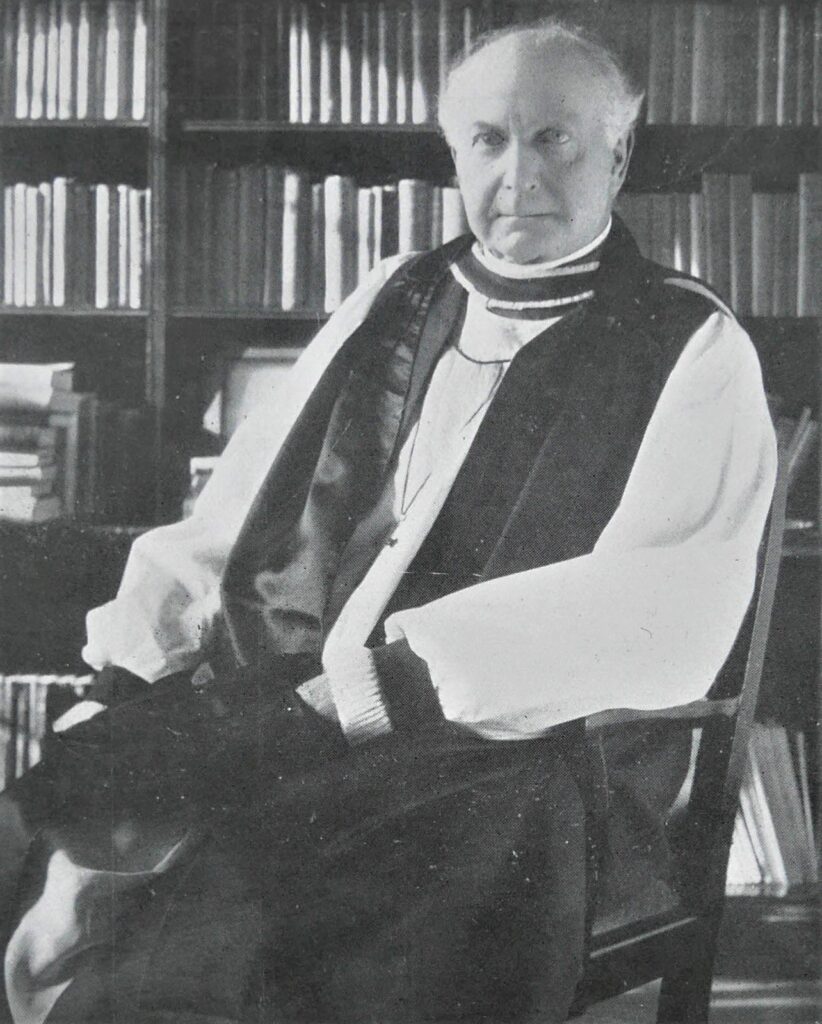
The bishop of Salisbury who confirmed Alan Turing was St Clair George Alfred Donaldson (1863-1935). The son of Sir Stuart Alexander Donaldson of Pangbourne, Berkshire, the first premier of New South Wales, he was educated at Eton College, Trinity College, Cambridge, and Wells Theological College. In 1905 he was created the first archbishop of Brisbane, Australia, a post he held until 1921 when he was created bishop of Salisbury. In 1925 he was responsible for reviving the suffragan see of Sherborne. He died at the Bishop’s Palace in Salisbury on 7 December 1935 and was buried in Salisbury Cathedral on 11 December.
When Alan’s school friend Christopher Morcom died unexpectedly in February 1930, Alan wrote from Sherborne to his mother saying, ‘I feel sure that I shall meet Morcom again somewhere and that there will be some work for us to do together, as I believed there was for us to do here. Now that I am left to do it alone I must not let him down but put as much energy into it, if not as much interest, as if he were still here. If I succeed I shall be more fit to enjoy his company than I am now.’ Two years later, Alan wrote, while staying with the Morcom family, ‘Nature of Spirit’ in which he stated his beliefs about the relationship between the spirit and the body.
According to Paul Backhouse’s Alan Turing: Guildford’s Best Kept Secret (2016), Alan’s mother regularly worshipped at St Nicolas’ church in Guildford, where Alan would accompany her at Christmas and Easter. His mother later recalled that she often heard Alan singing hymns while studying, particularly when his research was going well.
On 7 June 1954, Alan Turing took his own life. His body was cremated at Woking Crematorium on 12 June 1954 and his ashes scattered in the garden where his father’s ashes had been scattered in 1947.
Rachel Hassall
Archivist, Sherborne School.
See also:
- Alan Turing at Sherborne School
- Alan Turing and the ‘Nature of Spirit’
- A Guide to Confirmation (Church of England website)
For further information about the Sherborne School Archives please contact the School Archivist
Return to the School Archives homepage