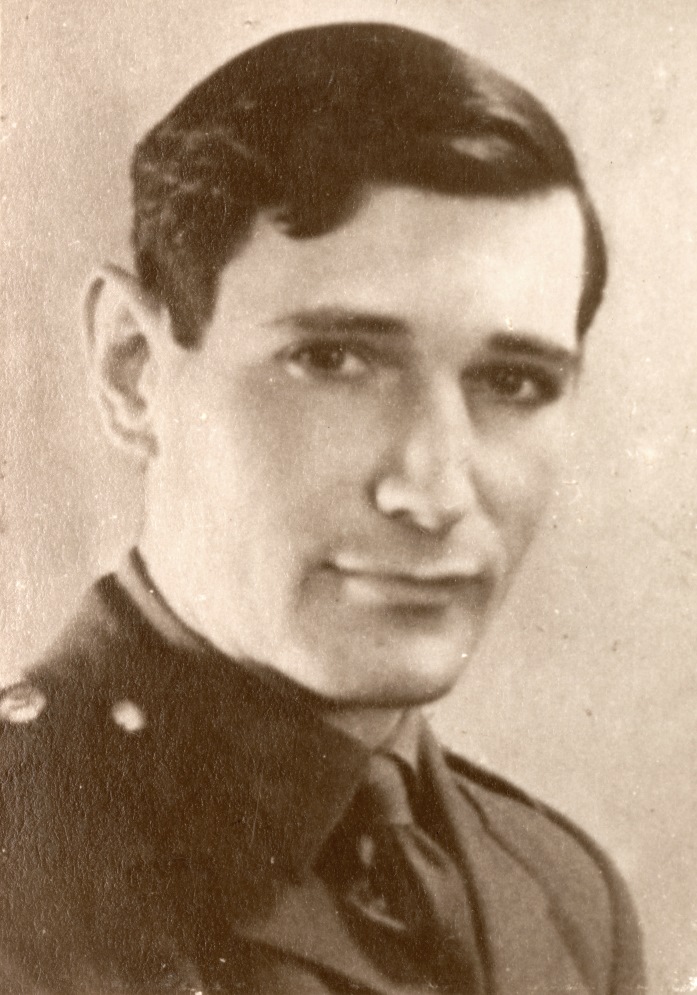
Five Shirburnians have been awarded the Victoria Cross, the highest military decoration awarded for gallantry in action. Their names are commemorated on the plaque at the entrance to the School chapel.
During the Second World War, one Victoria Cross was awarded to a Shirburnian, Abbey House’s Lieutenant Jack Grayburn, who was killed in action at Arnhem on 20 September 1944 during Operation Market Garden.
The story of the failed Allied operation to seize nine bridges over the River Rhine was told in the 1977 film A Bridge Too Far, in which the actor Christopher Good played Major Carlyle, a composite character of Lieutenant Jack Grayburn and Major Digby Tatham-Warter.
Operation Market Garden was described by historian Antony Beevor as ‘quite simply a very bad plan right from the start and right from the top. Every other problem stemmed from that.’
The following account of Jack Grayburn’s bravery during the operation appeared in the London Gazette on 23 January 1945:
‘Lieutenant Grayburn was a platoon commander of the Parachute Battalion which was dropped on September 17th, 1944, with orders to seize and hold the bridge over the Rhine at Arnhem. He, with his platoon, was to capture the southern end. Lieutenant Grayburn was wounded in the shoulder almost immediately, but he directed and pressed the assault until casualties became so heavy that he was ordered to withdraw. Later, he successfully organized the occupation of a house vital to the defence of the bridge. Although heavily attacked throughout the next day and night, thanks to Lieutenant Grayburn’s courage, leadership, and skill in disposing his men, the house was held until it was set on fire on September 19th, and had to be evacuated. Lieutenant Grayburn then formed a fighting force of elements of all arms, including the remainder of his company. Although wounded again, this time in the back, he refused to be evacuated. When tank attacks, against which he had no defence, finally forced his retreat on September 20th, he stood up in full view of the enemy and directed the withdrawal of his men to the main defensive perimeter. He was killed that night. For nearly four days, despite pain and weakness from his wounds, shortage of food and lack of sleep, Lieutenant Grayburn displayed supreme and unflagging gallantry and determination. Without his inspiring leadership, the Arnhem bridge could not have been held for so long.’
During the battle, over a thousand men of the British 1st Airborne Division and Polish 1st Independent Parachute Brigade were killed.
On 24 January 1946 Jack’s remains, which had been recovered from the ruins of a building at Arnhem, were reburied at Arnhem Oosterbeek War Cemetery where the inscription on his headstone reads ‘YET SHALL HE LIVE. ST JOHN XI.25.’
Jack Grayburn was awarded a posthumous VC ‘for supreme courage, leadership and devotion to duty’. His was one of five VC’s awarded for Operation Market Garden. Jack’s widow received his VC at a special investiture held at Buckingham Palace on 19 December 1945. In 1987 Jack’s son presented his father’s VC and other medals to the Parachute Regiment and they are now on display at the Airborne Assault Museum at IWM Duxford
Jack Grayburn’s Victoria Cross citation reads as follows:
 ‘Victoria Cross citation for Lieutenant John Hollington Grayburn, Parachute Regiment, Army Air Corps. Act of Bravery on 17-20 September 1944. For supreme courage, leadership and devotion to duty.
Lieut. Grayburn was a platoon commander of the Parachute battalion, which was dropped on 17th September 1944 with the task of seizing and holding the bridge over the Rhine at Arnhem. The north end of the bridge was captured early in the night, Lt. Grayburn was ordered to assault and capture the southern end with his platoon. He led his platoon on to the bridge and began the attack with the utmost determination, but the platoon was met by a hail of fire from 2 20 mm quick firing guns and from the M.Gs of an armoured car. Almost at once Lt. Grayburn was shot through the shoulder. Although there was no cover on the bridge, and in spite of his wound, Lt. Grayburn continued to press forward with the greatest dash and bravery until casualties became so heavy that he was ordered to withdraw. He directed the withdrawal from the bridge personally and was himself the last man to come off the embankment to comparative cover. Later his platoon was ordered to occupy a house which was vital to the defence of the bridge and he personally organised the occupation of the house. Throughout the next day and night, the enemy made ceaseless attacks on the house, using not only infantry with mortars and M.Gs, but also tanks and self-propelled guns. The house was very exposed and difficult to defend and the fact that it did not fall to the enemy must be attributed to Lt. Grayburn’s great courage and inspiring leadership. He constantly exposed himself to the enemy’s’ fire while moving among and encouraging his platoon, and seemed completely oblivious to danger.
On the 19th September 1944, the enemy renewed his attacks, which increased in intensity as the house was vital to the defence of the bridge. All attacks were repulsed, due to Lt. Grayburn’s valour and skill in organising and encouraging his men, until eventually the house was set on fire, and had to be evacuated. Lt. Grayburn then took command of elements of all remains, including the remainder of his own Company, and reformed them into a fighting force. He spent the night organising a defensive position to cover the approach to the bridge.
On 20th September 1944 he extended his defence by a series of fighting patrols which prevented the enemy gaining access to the houses in the vicinity, the occupation of which would have prejudiced the defence of the bridge. This forced the enemy to bring up tanks which brought Lt. Grayburn’s positions under such heavy fire that he was forced to withdraw to an area further north. The enemy now attempted to lay demolition charges under the bridge and the situation was critical. Realising this, Lt. Grayburn organised and led a fighting patrol which drove the enemy off temporarily and gave time for the fuses to be removed. He was again wounded, this time in the back, but refused to be evacuated. Finally, an enemy tank against which Lt. Grayburn had no defence approached so close to his position that it became untenable. He was killed that night.
From the evening of September 17th until the night of September 20th 1944, a period of over 3 days, Lt. Grayburn led his men with supreme gallantry and determination. Although in pain and weakened by his wound, short of food and without sleep, his courage never flagged. There is no doubt that, held it not been for this officer’s inspiring leadership and personal bravery, the Arnhem bridge could never have been held for this time.’ (London Gazette, 25 January 1945)
Jack Grayburn and Sherborne School
John ‘Jack’ Hollington Grayburn was born on Manora Island (now in Pakistan) on 31 January 1918 to Lionel Markham Grayburn (1878-1945), a banker, and Gertrude Grayburn (née Hollington) (1879-1967), and was baptised in St Paul’s church, Manora on 5 May 1918.
Jack attended Sherborne Prep School (1926-1928) and Walton Lodge Prep School in Clevedon, Somerset, and in September 1931 followed in the footsteps of his elder brothers, William Echlin Hollington Grayburn MC (1912-1988) (Abbey House 1925-1930) and Patrick Hollington Grayburn (1913-2002) (Abbey House 1927-1932), and joined Sherborne School.
Although not particularly athletic in appearance, in 1935 Jack was made Captain of Boxing at Sherborne and was later described by Headmaster A.R. Wallace as ‘a most resolute fighter in the ring’. He was also a House Prefect in Abbey House, a keen rugby player and swimmer.
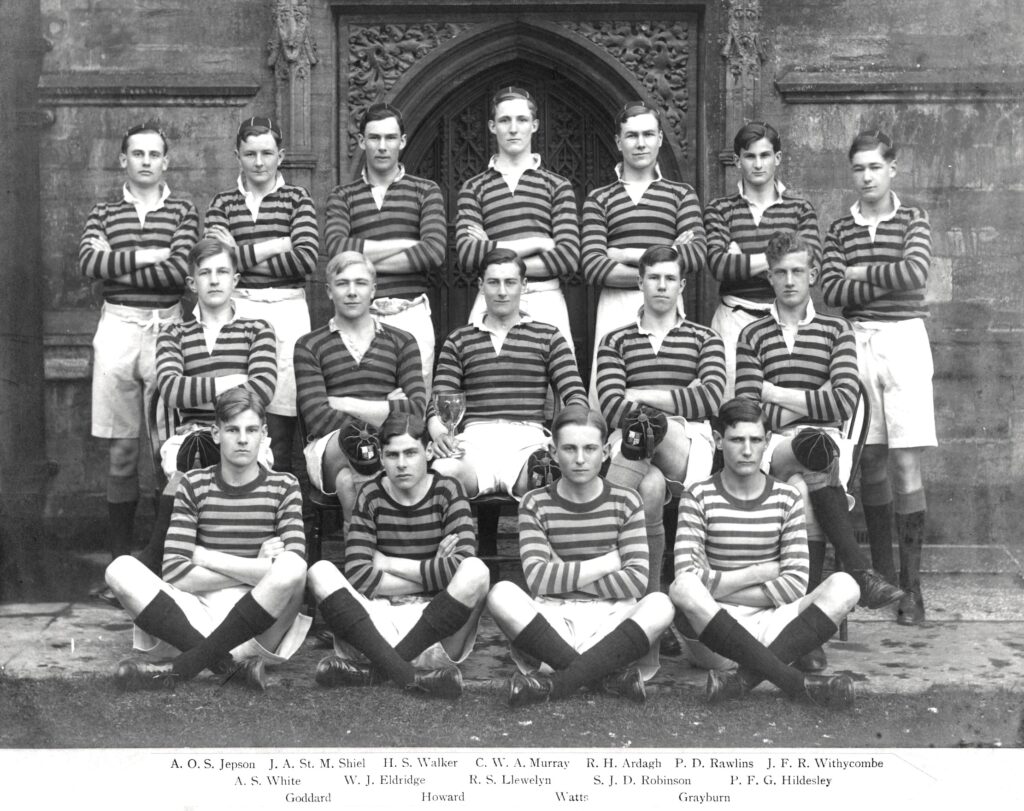
On leaving Sherborne in December 1935, Jack joined the London office of the Hong Kong and Shanghai Bank and spent his spare time volunteering at Sherborne House in Southwark, a cadet unit officered largely by Old Shirburnians and providing activities such as boxing, shooting, drill and camps, for local boys. He also played for the Chiltern Rugby Club.
In September 1940 Jack was given an emergency commission to Second Lieutenant and was posted to the Oxfordshire and Buckinghamshire Light Infantry, and in 1942 was promoted to war substantive Lieutenant. In June 1943 he transferred to the 7th (Light Infantry) Parachute Battalion, and in 1944 transferred to the regiment’s 2nd Battalion, under the command of Lieutenant Colonel John Dutton Frost, and took command of 2 Platoon, A Company.
In 1942 Jack was married at St Cross, Winchester, to Dorothy Constance Marcelle Chambers (1919-1964), daughter of Lt.-Col. Charles Ernest Chambers and Frances Dorothy Chambers, and their son John was born in March 1943.
Following news that Jack had been awarded a posthumous VC his mother wrote on 1 February 1945 to R.S. Thompson, one of Jack’s teachers at Sherborne School, thanking him for his letter of sympathy and congratulations, saying:
‘I shall keep your letter & show little John when he is older, for I think it will help him to realise that Arnhem was no flash in the pan, as you put it, but the result of a very fine character. Our loss is very great, Jack was a wonderful son, always trying to help his parents in every way he could think of. We shall miss him terribly, but I’m grateful that he has not come back to us with injuries that would mean a life of pain & inactivity. Better far that the loss & sorrow is ours, than that he should suffer so.’
The following tributes to Jack were published in the July 1945 issue of The Shirburnian:
‘Now that Jack Grayburn has gone, it may be fitting to recall an incident of eighteen months ago. He arrived for training as a parachute volunteer from a well-known regular battalion, where he had commanded the carrier platoon. It had not been easy for him to get away. On arrival he found that he would be posted to the Airborne Division then forming at home, which had no early prospect of active service (it had to wait a year, until the battle of Normandy). He at once applied for the posting to be cancelled, so that he could be sent on a draft to the division, which had already been fighting for some months in North Africa and Sicily. He was told that this could only be done with the written consent of his prospective C.O. After several telephone calls and a hurried journey south, he wrung consent out of a reluctant C.O. He then asked if he might have a few days leave with his wife and infant, and after that he would be very glad to go. Going on draft is less attractive than joining a new unit, and most men avoid it as far as possible. But to him only one thing mattered, to get to grips as soon as he could, since it had to be done. Such singleness of purpose was rare even among parachute troops, and it came as no surprise to learn recently that it finally won him the V.C.’ G.G. Green (assistant master at Sherborne School 1928-1966)
‘I take it as a great privilege to be asked to write a few words in appreciation of Jack Grayburn. Jack and his brother, Pat, were friends of our boys, and spent much of their free time with us. Jack was always cheerful and very good company; “a most lovable boy.” Starting with his work amongst the Southwark Cadets, his great capacity for duty and leadership developed, until at Arnhem his outstanding courage, devotion and endurance won him the V.C. All honour to Jack.’ C.L.B.
‘My memories of Jack Grayburn take me back to the early days of my headmastership at this School. Many figures have passed before the screen of one’s mind in ten years and alas many gallant ones for the last time, and it is not very easy to distinguish even such a notable one as this with all the detail which one would wish for under the present circumstances; but I do remember him clearly, particularly as Captain of Boxing, and a most resolute fighter in the ring, and remember particularly the keenness which he showed under ‘P.J’s’ [P.E.H. Parry-Jones, Abbey House housemaster 1928-1942] inspiration in training up the young idea in that House as well as in the School in general. There was nothing particularly outstandingly athletic in his appearance. I think the most arresting features were his eyes, very steady and grey and calm in their expression, and a resolute jaw which expressed clearly enough the determination and resolution which formed the keynote in his character. I remember too, a long conversation I had with him while he was going to bed in the Sanatorium where he had obtained temporary hospitality during a visit to Sherborne shortly after he had left. He was describing to me his manner of life in London and I remember the details to this day. His working day consisted then of full hours at the Bank, morning and afternoon, training for his future career in the Hong Kong and Shanghai Bank, home to supper at about 7, then three hours slogging in preparation for his banking examination, bed at 12.30 and up again at 7, next morning. He took one evening off a week and spent this regularly lending a hand at Sherborne House, Southwark, where his assistance, as I was told at the time, and have since heard from many sources, was absolutely invaluable. I expostulated with him, I remember, for a long time telling him that it was too much and that he could not keep up this pressure for long, but he laughed it off and assured me that I need not worry. He had been down two or three times since the outbreak of war as a subaltern in the Oxford and Buckinghamshire Light Infantry, and very glad indeed everyone was to see him. Shortly after he wrote and told me that he was going to be married and then a year after he wrote to say that his wife had presented him with a son and ‘would I please enter him for School.’ I forget how old the boy was at this time, I think perhaps two or three days. Such was the boy who was destined to bring to his old School the great honour of having gained the first Shirburnian VC in the war. No one who knew him here will be in the least surprised; indeed, it is just what one would expect from such a resolute and high principled man as Jack Grayburn. My great regret now is that ‘P.J.’ is no longer with us to write as he alone could have written a full account of this boy when he was at Sherborne. Let me just add as the School’s representative a word, however inadequate to express to all his relatives and friends the pride which we all feel in reading of his gallant exploits at Arnhem. We shall see, too, that his memory is kept ever green, and that his young son when the time comes for him to follow his father at Sherborne will find that the School is neither forgetful nor ungrateful. Requiescat in pace.’ Alexander Ross Wallace (Headmaster at Sherborne School 1934-1950).
Jack Grayburn is commemorated at Sherborne School on the War Memorial Staircase, in the Book of Remembrance, on the Victoria Cross plaque, and on the Abbey House roll of honour.

Find out more about Operation Market Garden at Arnhem: Legacy of Liberation (CWGC)
See also:
- Sherborne School and the Second World War
- Shirburnian Victoria Cross Recipients
- Sherborne School Roll of Honour
- Patrick Francis, Old Yet Ever Young. A New History of Sherborne School (Exeter, Short Run Press, 2020). Photography by David Ridgway.
- Lieutenant J.H. Grayburn (Pegasus Archive)
- Lieutenant John H. Grayburn (ParaData)
- John Hollington ‘Jack’ Grayburn VC (VictoriaCrossonline.co.uk)
- Lieutenant John Hollington Grayburn VC (CWGC)
For further information about the Sherborne School Archives please contact the School Archivist
Return to the School Archives homepage