 Japan’s surrender on 15 August 1945 was accompanied by an announcement from Prime Minister Clement Atlee of a two day national holiday on the 15 & 16 August 1945 to celebrate VJ Day.
The end of hostilities was received by many with a sense of gratefulness and relief, but also of sadness for the huge loss of life. King George VI summed up these mixed feelings in his radio broadcast to the nation:
‘Our hearts are full to overflowing, as are your own. Yet there is not one of us who has experienced this terrible war who does not realise that we shall feel its inevitable consequences long after we have all forgotten our rejoicings today.’
The dropping of the two atomic bombs on Hiroshima and Nagasaki are credited in part with bringing about Emperor Hirohito’s decision to surrender. In his book The Second World War in 100 Objects, military historian Major General Julian Thompson CB OBE (School House 1948-52) dedicates the final entry to the atomic bomb:
‘On 6 August [1945], the first-ever nuclear attack in history took place when the atom bomb codenamed ‘Little Boy’ was dropped on the Japanese city of Hiroshima. This was followed three days later by the dropping of ‘Fat Man’ on Nagasaki. Japan surrendered on 15 August 1945. The Japanese Instrument of Surrender was signed on 2 September 1945, bringing the Second World War to an end… Some 70,000 people, mostly civilians, died in Hiroshima, and around 40,000 in Nagasaki… To this day the debate continues on the morality of using atomic bombs on Japan… hundreds of thousands of Asians in labour camps, and Allied prisoners of war, would have been put to death had the Japanese not been taken aback by the suddenness with which the war ended – thanks to the two atomic bombs.’
One POW whose life was possibly saved as a result of the dropping of the atomic bombs was John Durnford (1920-1995) (School House 1934-38). John was one of 100,000 Allied troops captured by the Japanese at the fall of Singapore on 15 February 1942 and was sent as a prisoner of war to Thailand to work on the infamous Thai-Burma ‘death railway’, so named because its construction cost the lives of more than 12,000 Allied troops and 90,000 conscripted civilians. John later told the story of his three year ordeal as a POW in his autobiography Branch Line to Burma (1958).
While interned as a POW John Durnford managed to write poems at night by the light of a lamp made from a tin filled with coconut oil. In his poem ‘VJ Day, Khanburi’ he describes the shock and disbelief of the prisoners at Khanburi POW Camp (also known as Kanburi, Kan’buri, or Kanchanaburi) who, on being told that Japan had surrendered, sat in silence, some in tears, thanking God that the war was over:
“Gentlemen!” he said in tears, “the war is over”,
Looking towards a yellow hurricane light,
Held up by someone in the struggling crowd,
I glimpsed your face, its usual smile
Checked in bewilderment at so much joy,
So you must once have looked, when, as a boy,
They gave us gifts at Christmas – now, this Freedom.
Silent, the men sat on in darkness, bowed and still,
As though at prayers, or sleeping after death.
Then slowly, one by one, as a great crowd
Of ransomed spirits might attend their Lord,
Began impulsive moments towards the door.
Stars filled the jagged hills, the village slept.
The shuffling feet paused. Then someone sang,
Timid at first, their voices, gathered in strength,
Sounding a great hymn from the ragged lines,
While all night long, drums beat in the darkened shrines.

John Durnford was one of thirty-three Shirburnians known to have been held as POWs in the Far East (FEPOWs) during the Second World War, five of whom sadly died in captivity. Adrian Huxtable (1920-1943) and George Maclure (1911-1943) of Westcott House, and Thomas Nash (1913-1943) of School House, died from dysentery or cholera in POW camps in Thailand while constructing the Thai-Burma railway. A memorial window for Thomas Nash was installed by his parents in the Sepulchre Chapel in Sherborne Abbey.
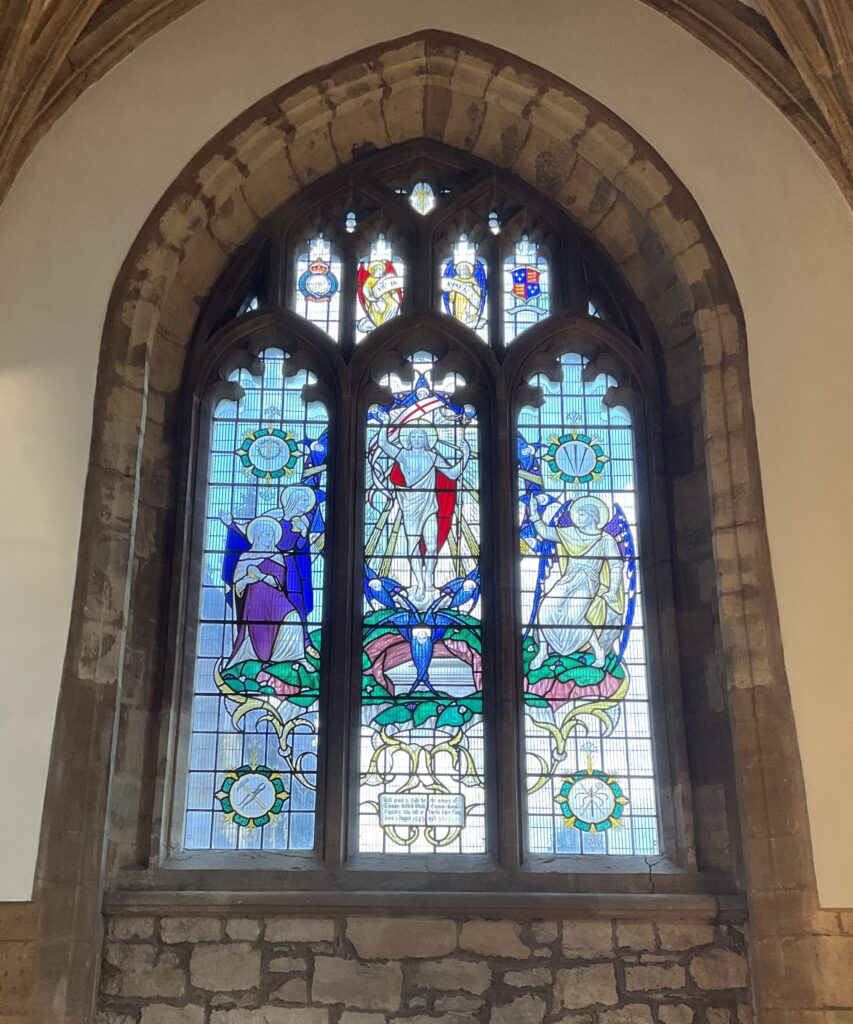
John Noon (1916-1943) of Abbeylands died from dysentery and cardiac failure while being held as a POW at Kokopo, Papua New Guinea, where prisoners were used to build fortifications for the Japanese military; and James Whitham (1907-1942), also of Abbeylands, drowned when the Japanese freighter in which he and other POWs were being transported was mistakenly torpedoed by an American submarine.
For those FEPOW who did return home many never recovered from the physical and emotional scars of their brutal captivity.
VJ DAY CELEBRATIONS IN SHERBORNE
Events in the UK to celebrate VJ Day with a two day national holiday were instigated by the Home Office who sent a circular to local authorities suggesting that public rejoicing and festivities should be promoted with music and dancing, the lighting of bonfires and the ringing of church bells.
The two day national holiday was celebrated across the West Country with a particular emphasis on making it special for the children.
At Sherborne news of the town’s celebrations were announced from loud speakers on vans that drove around the streets. Services of thanksgiving were held on 15th August in Sherborne Abbey, the Pageant Gardens, and in the wards at the Yeatman Hospital. Families in the Coldharbour area of the town arranged a children’s fancy dress parade followed by a tea, and in the evening sports, dancing and a bonfire. The ladies of Barton Gardens arranged a tea for the children of the Yeovil Road and Bradford Road area which, because of the inclement weather, was held indoors in the Yeovil Road Garage. By the evening the rain had stopped allowing sports to be held in the field behind Barton Gardens where a large bonfire, dancing and singing continued until the early hours of the morning. For those living in the Westbury area of town four coaches were arranged to take the children to Weymouth for the day where they were each given 7s. 6d. spending money and a packed lunch. Other festivities included music and dancing in the Pageant Gardens, a bonfire on Dancing Hill, and the floodlighting of Sherborne Abbey. Later in the year a circus show was arranged for local children in the fair field at Quarr Lane.
For the boys and staff at Sherborne School, VJ Day fell in the school holidays and with the boys not returning until 21 September 1945 their celebrations were delayed. A joint dance and supper with the Sixth form of Sherborne Girls’ School was arranged by the Headmaster in return for the girls having invited the boys to a VE Day dance and supper the previous term. In October both schools took part in the town’s Thanksgiving Week, helping to raise over £140,000 towards the post-war reconstruction of the country, and on 11 November 1945 a Memorial Service was held in the School Chapel for all Old Shirburnians who had fallen in the two Great Wars, at which the Rev. Carter, Vicar of Horsington, was the preacher.
On a practical level, the end of the war brought with it the removal of the blackout from windows in the School buildings and boarding houses, which the School’s art mistress Mrs Gervis ingeniously repurposed as canvases for the boys to paint on. The windows of the Big Schoolroom which had been blown out during the bombing of Sherborne on 30 September 1940 and boarded up ever since, were reinstalled. The blast walls and air raid shelters built around the School premises were gradually removed and the trenches on the Upper and Carey’s were filled in. Eleven members of the teaching staff returned from war service and, despite the continuation of rationing, the boys noted that the food seemed to be a little better and that the classrooms a little warmer.

That term the Headmaster was able to report to the School Governors:
‘It is with a sense of profound relief and gratitude to Almighty God that after an interval of six years I am able to report that the School has successfully weathered the storm of war and is now moving towards calmer waters.’
Perhaps the last word should go to one of the FEPOW, John Durnford (1920-1995) (School House 1934-38), who was liberated on 2 September 1945 and arrived back at Southampton on 8 October 1945 on the P&O liner Corfu, the first of 22 ships carrying FEPOW to dock there. John ends the preface of his autobiography Branch Line to Burma (1958) with the following words of hope for the future:
‘Why, lastly, after all this time should we choose to remember such things? Not any more for self-pity. What I wish to remember, for myself and others, is that life can never be so cruel again. Let those who remain to read this take heart from the suffering and loneliness they endured without complaint, and remember with pride the endless cheerfulness and kindness one man gave another. Let them keep this and take it into their present lives, where the world is in need of it.’
Rachel Hassall
School Archivist
See also:
- VJ Day 80 events in Sherborne
- OS Prisoners of War & Internees in the Far East during the Second World War
- S.J.H. Durnford: OS Second World War Poet
- Sherborne School in the Second World War
- Online Exhibition: Sherborne School and the Second World War
- Sherborne School WW2 Roll of Honour
Visit Sherborne School Archive News for more stories from the archives.
Posted 13 August 2025 by Sherborne School Archives