
On Tuesday, 8 May 1945, Prime Minister Winston Churchill announced that the war in Europe had come to an end, following Germany’s surrender the day before. Victory in Europe Day – or VE Day – was celebrated across the UK with street parties, bonfires, and church services.
People in Sherborne celebrated too. The Western Gazette reported that, ‘Not for many along day had Sherborne looked so gay as it did on VE Day. The Rotary Club installed amplifiers in the Pageant Gardens to relay the Prime Minister’s speech, and also the King’s speech… the streets were filled with laughing and smiling people. Children looked in wonderment at a sight such as they had never seen before. Cheap Street presented a mass of colour with flags of the Allied nations. The feeling of thankfulness was shown by the large attendances at the church services. Victory bells called the people together for prayer at the Abbey in the morning and there was another service in the afternoon, followed by a special service in the evening, conducted by Canon J.P.W. Lovett, the lesson being read by the Rev. Beddows with Mr W. Edward Wearden at the organ. Other evening services were held at all the churches in the town. At the Yeatman Hospital the Matron conducted services in all the wards. In the brilliant sunshine, many with VE Day holidays, spent the welcome break from work in the public and their own gardens. In the evening a bonfire was lit in Bristol Road and there was dancing. Part of the Abbey was floodlit.’
The following night, Teddy Rowe’s Band, which is usually associated with Sherborne’s Pack Monday Fair, assembled in Ludbourne Road and marched around the town making as much noise as possible. By the time the band reached Greenhill it comprised about 4,000 people who then made their way to the Pageant Gardens where music and dancing continued until the early hours of the morning.
Three nights of celebration were held in the Bristol Road, Vernalls Road and Simons Road, organised by Mr Kemp, an evacuated Londoner. The roads were decorated with flags, and tables were arranged in the street, with teas and refreshments provided by the housewives. Later in the evening there was music and dancing and a huge bonfire.

Sunday, 13th May 1945, was declared Thanksgiving Day and saw thousands of people lining the streets to cheer the march past of members of the Services. This was followed by a service in Sherborne Abbey conducted by the Rev. J.B. Pim (Royal Navy), the Rev. T.E. May, and the Vicar, Canon J.P.W. Lovett, after which a collection was made for the reconstruction of destroyed and damaged churches in Europe. On leaving the Abbey the units marched past the town’s war memorial in Half Moon Street where the salute was taken by Colonel McDonald of the US Army.
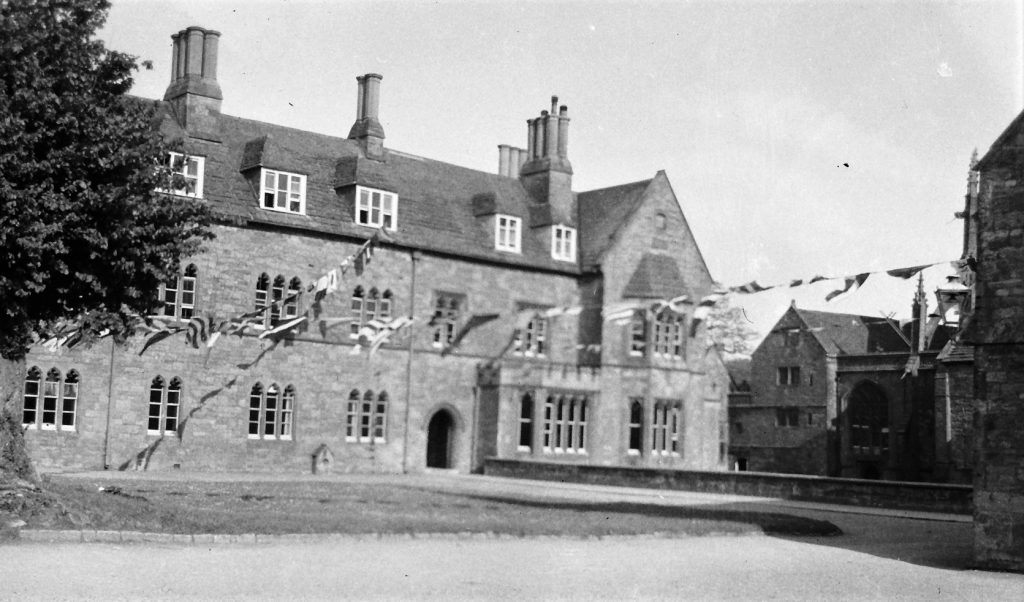
15-year old Peter Teale (Abbeylands 43-47) wrote to his parents describing how VE Day and VE Day+1 were celebrated at Sherborne School:
‘Flags were put out of all the windows and soon Cheap Street was a mass of red, white, & blue. Instead of chapel we had a special Thanksgiving Service the pamphlet of which I enclose. Then we had ordinary lessons for the rest of the morning. After lunch we were told that there would be a combined picnic between ourselves and Barlow’s [Harper House]. So after the Prime Minister’s speech, John [John Charles Travers Clark (Abbeylands 43-47)] and I went up onto the top of West Hill with the advance party and built a huge bonfire about 20 feet high and five cooking fires. Then when the rest of the people and the food had arrived, Djirdjirian [Haig Garabed Djirdjirian (Abbeylands 43-46)] and I cooked bacon and fried potatoes, while Barlow’s [Harper House] had sausages and spuds. We also had bread and butter, ginger biscuits, meat pasties, and ginger pop. After tea we lit the bonfire with great ceremony and placed on top effigies of Hitler, Musso, and Himmler, filled with thunder flashes and blanks, which as the flames rose went off with resounding bangs. When we had listened to the King’s speech at 9 pm we went home. At prayers the Colonel [J.H. Randolph, housemaster of Abbeylands] read a speech of Pericles which he gave after the Athenians-Spartan war.
The next day [9 May 1945] after chapel, as we had the whole day off, John, Heywood [Claude Henry George Heywood (Abbeylands 43-47)], and I started off on our bike ride. We went to Frome and back going through Wincanton and Bruton. It worked out at about 51 miles altogether… About 10 pm we heard an awful din going on in the street and on looking out saw about half the population coming up the street en masse with a motley band of men dressed in pyjamas and all kinds of rig blowing horns and banging tins and shouting at the top of their voices. They were followed by a fire engine with a searchlight on it, which was being flashed all over the place. This is known as Teddy Rowe’s band and generally performs on Pack Monday in the Winter term, but I suppose it was brought out specially for the occasion.’

The staff at Sherborne School had mixed feelings about VE Day. Headmaster Alexander Ross Wallace was only too well aware that many Old Boys were still fighting ‘in the swamps of Burma and in the Pacific and Indian Oceans’ and declared that, unlike a number of other schools, Sherborne School would not celebrate peace until it came to all. Alick Trelawny-Ross, housemaster of Lyon House, also had mixed feelings, writing, ‘I, who have done less than nothing to win the war, and have known so well these splendid boys who have fallen, have no heart for merrymaking, though thankful beyond words that so many have been spared.’

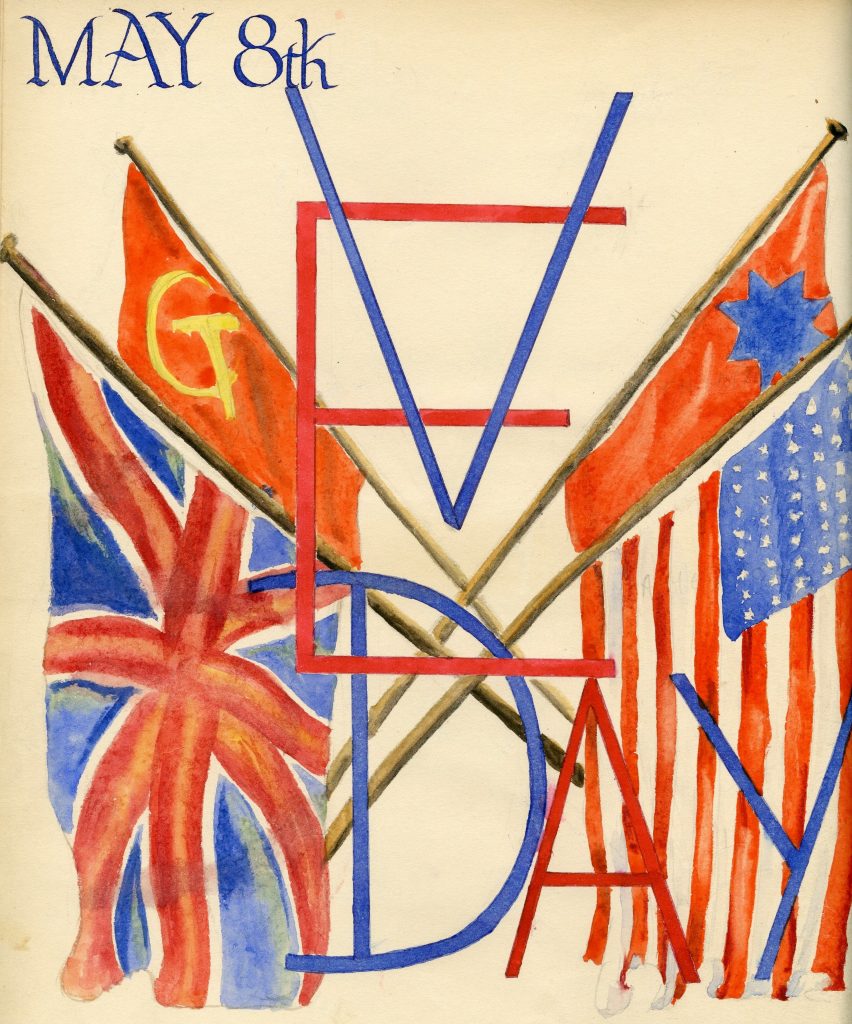
On Saturday, 12 May 1945, history was made when the first-ever joint dance between the girls and boys of Sherborne Girls’ School and Sherborne School was held. A hundred boys were invited by Sherborne Girls’ sixth form to a Victory Dance in their School Hall, a rather tongue-in-cheek report of which appeared in the July 1945 issue of The Shirburnian:
‘We, at any rate, are progressive. We have had a dance. We may not have danced very well and we may not have known quite what to do, but we did have a dance. It was on the Saturday following VE Day. A mass of Britain’s youth bore down upon the Girls’ School, laughing loudly and looking very nervous, resolved valiantly to dance or die. There was some hesitation about who was to go first, and all the funny men were extremely funny about this. Everybody commented wittily on everybody else’s tie, and some of the ties were so supremely horrible that we should have liked to add our own comments. but that common politeness and lack of space prevents us. Eventually we danced; the less said about this bit the better. Half way through there was food, and some gallants surpassed themselves by the old world courtesy with which they invited our fair hostesses to partake of their own dishes. Perhaps a word of sincere thanks may be expressed here for this superb feast. Then, on with the dance! We waltzed, we fox-trotted, we quick-stepped, we bumped into each other; occasionally we-apologised. At about 11.30 we staggered home. We are still talking about it. The suggestion that we should give a return dance has been made very often; but it is worth putting into print. The difficulties are great; but what woman has done, man can do.’
A service of thanksgiving was held in the School chapel on Sunday, 13 May 1945, at which assistant master Mr Meredith Thomas gave a VE Day sermon. Meredith’s son Lieutenant Robert Thomas (Sherborne Prep 1931-36 & Abbey House 1936-41) had been killed in action in Italy the previous year, and in his sermon he remembered those who had died – ‘our fathers, our brothers, our friends, our sons. We may pause to thank God for them and to think where the world would be without their sacrifice’.
In October 1945, Headmaster Alexander Ross Wallace recounted the many and varied pressures that he and the School had faced during the war years:
‘It is with a sense of profound relief and gratitude to Almighty God that after an interval of six years I am able to report that the school has successfully weathered the storm of war and is now moving towards calmer waters. It has been… a time of great stress and strain for all of us in this place, and in particular the years 1940-1941 must ever remain in the history of the school as the very apex of crisis. Had there been, for instance, a heavy casualty list at the time of the air raid on Sherborne on September 30th, 1940 (we were spared from this by a matter of yards), it is difficult to say what the repercussions might have been. Parents were in an unstable and agitated frame of mind at that moment. Even apart from casualties any pressure which might have driven us to evacuation of our premises might have been almost disastrous from the school’s point of view, and I am now free to admit that the responsibility for drawing up the A.R.P. instructions to cover every possible contingency both by day and by night for the whole of the school did weigh extremely heavily at that time.
In point of fact the most serious threat came, not from the Nazi but from the British Government. On three occasions the School was under threat of requisition, once by the War Office, once by the Admiralty and once by the Ministry of Health. The first was only a passing cloud; the second from the Admiralty much more serious involving for me a telephone call to Field Marshal Sir Claud Jacob in the early hours of the morning. But in the event his prompt assistance mercifully turned the scale. The last has only just been removed since V.E. Day. I have since heard from one of the masters engaged in document hunting in Germany [Major G.J.B. Watkins who, amongst other duties, translated Hitler’s personal will] that Sherborne would have been right in the middle of the proposed drive from the Dorset coast to Bristol had Hitler’s invasion plan been put into operation. This we had guessed already, indeed a glance at any shilling atlas makes it fairly obvious. But it did nothing to ease our mental and spiritual strain between the years 1940 and 1942. In point of fact the only building which was commandeered was the School Tuckshop, and it was possible to strike a bargain with the authorities over this that if we gave this up gracefully they would not make any further demands upon our accommodation. And in fairness to the Government it is true to say they made no further demands during the war.’

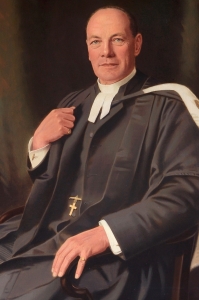
On leaving Sherborne School in 1950, Headmaster A.R. Wallace reflected on the war years, remembering the nightly blackout, the false alarm when the Home Guard thinking there was a genuine invasion proceeded up Long Street with fixed bayonets “looking for Huns, sir”, a gas alarm caused in Sherborne by a manure heap in Sturminster Newton smelling like Lewisite (a chemical weapon with a distinctive odour similar to geraniums), the appointment of female members of teaching staff who in their fashionable high heels ‘went tap-tapping down our stone passages’, and the School Roll of Honour hanging at the foot of the chapel steps that ‘lengthens seemingly without end from week to week, sometimes from day to day.’
By VE Day 1945, 228 Shirburnians had died on active service, with four more dying before Japan announced their surrender on 15 August 1945. By the end of the Second World War approximately 242 Shirburnians had died either on active service or as a result of wounds.
We will remember them.
Rachel Hassall
School Archivist
See also:
- Sherborne School Thanksgiving for Victory and Dedication Order of Service, 8 May 1945
- VE Day sermon given by Meredith Thomas in Sherborne School chapel, 13 May 1945
- Official Thanksgiving for Victory Order of Service, 1945
- Effigy burning in Somerset & Dorset on VE Day 1945 (SDNQ)
- Sherborne School and the Second World War
- Sherborne School WW2 Roll of Honour
- Online Exhibition: Sherborne School and the Second World War
- Prisoners of War and Internees in the Second World War
For further information about the Sherborne School Archives please contact the School Archivist
Return to the School Archives homepage