
Abbey House has been in continuous use as a school boarding house since 1868, but was also used for a brief period from 1835 to 1849.
The area where Abbey House stands originally lay within the precinct of Sherborne Abbey, founded in 998 as a Benedictine institution, hence the house’s modern name.
Abbey House is the combination of two separate properties. On the east, the private side of the house was built in the 1820s by William Simmonds (1771-1826) on the site of a barn which for many years he had used as a fuel house for his confectionery business in Cheap Street. William Simmonds retired in 1825 and died the following year, leaving the property to his son Benjamin Hann Simmonds (1795-1842), a surgeon. From 1835 to 1849 the School Governors rented the property to accommodate the Rev. Thomas James (the School’s usher) and a few boarders. In 1851, Benjamin Hann Simmonds’ widow Susan Palmer Simmonds sold the property to Sir Brook Kay (1780-1866), 3rd Baronet, whose sons William Algernon Kay (1837-1914) and Henry Monckton Kay (1839-1904) attended Sherborne School as Foundationers (day boys) from 1851 to 1854. In 1856 Sir Brook Kay sold the property to George Digby Wingfield Digby (1797-1883) of Sherborne Castle who in 1860-61 rented it to Headmaster H.D. Harper and his family while School House was being built.
The adjoining building to the west was formerly the National School, also known as the Abbey School for the Poor. When in 1857 the school moved to newly-built premises in Horsecastles the building became the HQ of the 7th Dorset (Sherborne) Rifle Volunteers.
In 1868 the School Governors combined the east and west properties, pulling down the coach house and stables and building new studies and dormitories. In Michaelmas term 1868 the house was opened as a school boarding house with 32 boarders under housemaster Arthur Mapletoft Curteis (1833-1922), a former Fellow and Classical Lecturer of Trinity College Oxford, who taught at Sherborne School from 1860 to 1876.
In 1887 a west wing (by architects Carpenter & Ingelow) was added, followed in 1935 by a Reading Room and in 1958 by studies (on part of Abbey Grange’s garden given by Geoffrey O’Hanlon). In 1996, a new west wing was opened by Michael McCrum (1924-2005) (Abbey House 1937-42), Vice-Chancellor of Cambridge University.
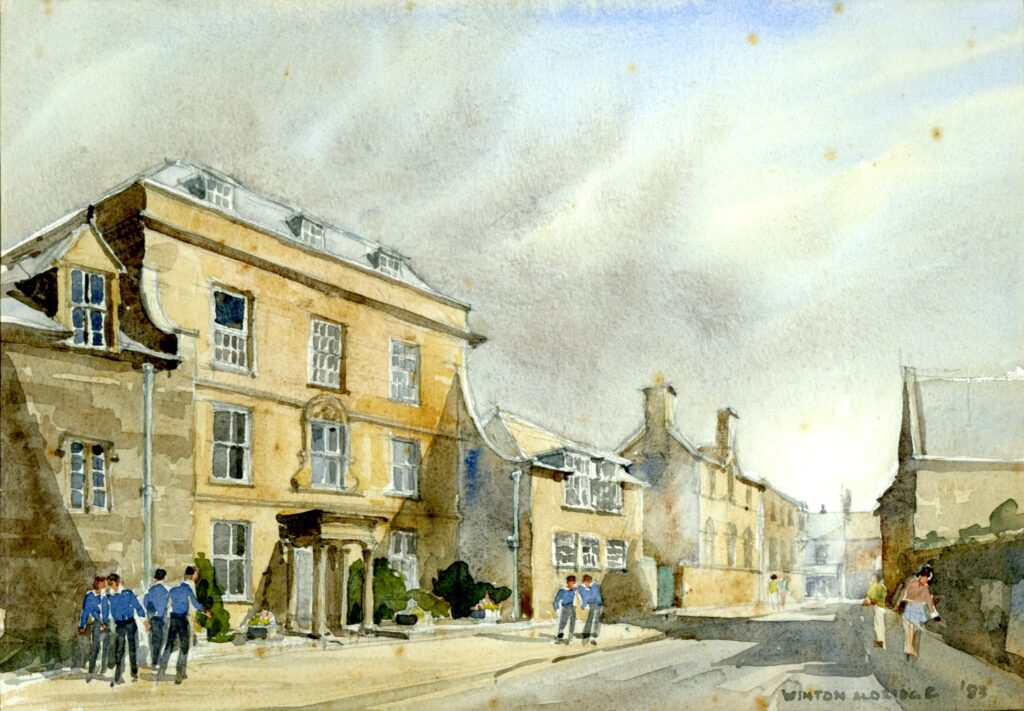
In 1931, the School Governors purchased Abbey House from Colonel Digby for £3,110.
On the night of 7/8 July 1962, a fire swept through the western end of Abbey House destroying a large section of the roof and a second-floor dormitory.
Abbey House is a Grade II Listed Building.
Former Abbey boys includeWilliam Bowring (England Hockey International & Barbados Cricket XI), Tom Bradby (journalist and novelist, presenter of ITV News at Ten and The Agenda), John Buchanan (Ireland Rugby International), Norman Campbell (Scotland Rugby International), Peter Candler (England Rugby International), Warren Chetham-Strode (author and playwright), Jamie Coreth (artist), Tony Fox (Olympian rower), Jack Grayburn VC, Robert Hands (journalist, Executive Managing Editor, The Times and Sunday Times), Jeremy Irons (actor who has appeared in The French Lieutenant’s Woman, Brideshead Revisited, The Mission, The Lion King), David Leakey (Gentleman Usher of the Black Rod), Michael McCrum (Vice-Chancellor of Cambridge University), Robert McCrum (writer, journalist, broadcaster, Associate and Literary Editor of The Observer, Editor-in-Chief of Faber & Faber), Littleton Alfred Powys (priest), Littleton Charles Powys (author and Headmaster of Sherborne Prep School), Henry Raby VC, Mark Randolph FRS (geotechnical engineer), Theophilus Aneurin Rees (Wales Rugby International), Peter Richards (Reuters’ correspondent in Manila), Mack Rutherford (in 2022 became the youngest person to circumnavigate the world solo in an aircraft and also the youngest person to circumnavigate the world solo in a microlight), Dyne Fenton Smith (England Rugby International), David Spedding (MI6 Chief), Harold Temperley (historian, special adviser to Arthur Balfour at the 1921 League of Nations, founder of The Cambridge Historical Journal), Robert Dalzell Dillon Thomas (poet), William Eldon Tucker (England Rugby International), Peter Twiss (test pilot and the first man to break the 1,000 mph speed barrier), Leonard Watkins (Wales Rugby International), Michael Wright (journalist).

House letter: b.
House colours: purple and black (formerly blue and white).
House motto: Uno Fraternum Corde Sodalicium.
House magazine: The Purple Band.
House cricket team (played local villages): The Duckhunters.
Housemasters:
1835-1847 Thomas James (1794-1866)
1868 Arthur Mapletoft Curteis (1833-1922)
1876 Rev. Alexander Wood (1839-1917)
1888 Charles Selby Whitehead (OS) (1852-1934)
1893 William Beauchamp Wildman (1852-1922)
1908 Godfrey Mohun Carey (OS) (1872-1927)
1928 Percival Edward Holland Parry-Jones (OS ) (1892-1942)
1942 Max Westlake (OS) (1895-1987)
1955 Michael Walford (1915-2002)
1971 Christopher Knott (OS)
1986 Peter Wellby
1998 James Murphy-O’Connor
2005 Mark Pryor
2009 Ben Ryder
2011 Michael McGinty
2019 Hugh Tatham

Online Resources:
- Abbey House photographs
- Abbey House roll of honour
- Victoria Cross Recipients
- E.J. Bolton, Some Memories 1916-17 – a personal account of serving as a Lieutenant in the Dorset Regiment, 3rd Bn. (Reserve), attached 5th Bn. (pdf)
- Warren Chetham-Strode and The Guinea Pig
- John Bowater Vernon: Chelsea Flower Show Silver Cup winner, 1925
- Peter Candler v. Charles Dick & the battle for the Calcutta Cup, 1938
- Abbey House boys’ accounts of the bombing of Sherborne on 30 September 1940
- Lieutenant Jack Grayburn: Sherborne’s A Bridge too Far hero
- Bob Thomas (1922-1944): A Sherborne soldier’s home thoughts from abroad
- Peter Clifton Richards, civilian internee at the Santo Tomás Internment Camp, Manila
- Peter Twiss: first man to fly faster than 1,000 mph
- The Abbey House fire, July 1962
- The 2nd Battalion Scots Guards and the Battle of Tumbledown Mountain
- History of Sherborne School’s boarding houses
For further information about the Sherborne School Archives please contact the School Archivist
Return to the School Archives homepage