‘The Empire has lost one of her most devoted servants; and it is left for us to maintain the high standard of service set by hm. When the time comes for us to play our part his memory will live as an inspiration to persevere in pursuit of duty; we will say no more than to wish long life and prosperity to his son and successor, Edward VIII.’
This was how The Shirburnian reported the death on 20 January 1936 of King George V and the succession of his son Edward VIII. Two days later, one period of work was excused so that the School could listen on the radio to the proclamation of Edward VIII and on the 28 January a service was held in the School chapel in memory of George V.
However, Edward VIII’s reign was to last just ten months, ending with his abdication on 10 December 1936 in favour of his brother who was crowned King George VI at Westminster Abbey on 12 May 1937, the date originally set for Edward VIII’s coronation.
As Prince of Wales, Edward VIII had visited Sherborne School twelve years previously on 19 July 1923. After his visit, the Headmaster reported to the Governors that ‘H.R.H. the Prince of Wales paid a very brief and informal visit to the School, and was received, as was only natural, with cordial enthusiasm. At his gracious request two days were added to the summer holidays.’
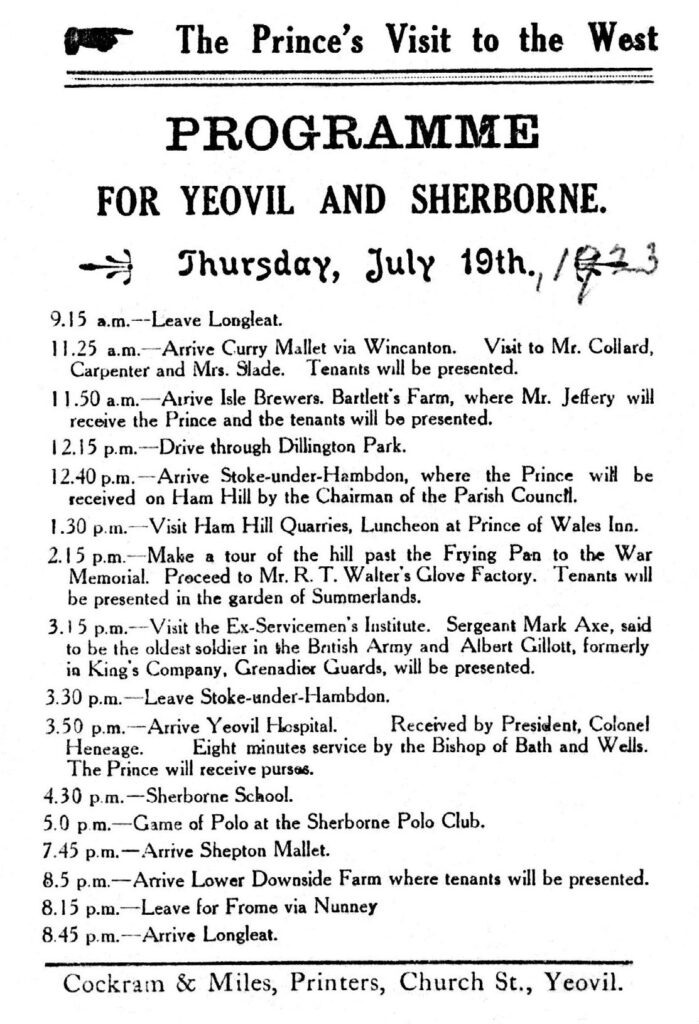
The Prince’s visit to Sherborne was indeed brief. It was part of a three-day tour of the West Country during which he visited tenants of his Duchy of Cornwall estates and carried out a number of public engagements. The Prince’s tour had begun on 18 July in Bath, after which he had spent the night at Longleat House, the home of the Marquess of Bath who, as Lord Lieutenant of Somerset, accompanied the Prince during his tour.
On the day the Prince visited Sherborne he had a packed schedule. Leaving Longleat at 9.15 am, he visited some of his tenants and arrived at the Ham Hill quarries by 1.30 in time for lunch at the Prince of Wales Inn. At 2.15 he proceeded to Mr Walter’s glove factory, met some more tenants, visited the Ex-Servicemen’s Institute and at 3.50 arrived at Yeovil Hospital where the Bishop of Bath and Wells conducted an eight minute service.
On leaving Yeovil, the Prince made his way to Sherborne, where he was greeted in the Bradford Road by members of the Girls’ School who ‘forgot for a brief while the bonds of convention which gird them about’ and ‘roared’ a welcome!
The Prince’s cavalcade proceeded down Kitt Hill to Greenhill and to Cheap Street, where a floral arch and the words ‘Welcome to our Prince’ stretched across the road from Mr Anstey’s shop (now the offices of Greenlade Taylor Hunt) to the White Hart Inn. To the sound of tumultuous cheering, the Prince proceeded down Cheap Street and along Half Moon Street into the Abbey Close, where the way was lined by ex-service men and the matron, hospital staff and patients from the Yeatman Hospital. Inside the Abbey the Prince was shown around by Head Verger George King who reminded the Prince that the interior of the Abbey was built of stone from Ham Hill, which was owned by the Duchy of Cornwall. The Prince was also shown the restoration work being carried out in the Lady Chapel (in 1925 the Prince donated five guineas towards the restoration fund) and signed the visitors’ book ‘Edward P.’, using the same pen as his mother, then the Princess of Wales, had used during her visit in 1908.
At 4.30 the Prince arrived at Sherborne School, making his entrance from the north door of the Abbey accompanied by Headmaster Nowell Smith, where he was presented to the Headmaster’s wife, the vice-chairman of the School Governors Canon E.W. Goodden, and to senior master the Rev. Henry King (Abbeylands housemaster 1900-19), who afterwards wrote in his diary:
‘The Prince of Wales visited the School with Lord Bath. I was presented and graciously smiled on. But he was terribly tired and distrait and the boys were disappointed, tho they cheered him finely. Is he ut ferunt ebriosus? India has made him jumpy.’
The Prince was also presented to the Head of School Alastair Thomson (Abbey House 1917-23) and to the captain of the 1st XI cricket team Donald MacDonald (Abbey House 1917-1923), to whom he expressed his pleasure at hearing of the successes of the cricket eleven (that season the 1st XI won 8 of the 12 matched played). The Prince then crossed the Courts between two ranks of cheering boys.


On exiting the School, the Prince stopped and watched the workmen building the new classrooms and gate tower entrance on the north side of the Courts (the scaffolding for which can be seen in the photograph below), having earlier visited the Ham Hill quarries where he had seen portions of the stone panels being prepared for the building. Thanking the Headmaster, the Prince said how glad he was to have been able to see the School and asked him to give the boys two extra-days’ holiday.

The Prince’s cavalcade left the School and moved off, passing along by the Carrington Buildings into the Abbey Close where the Prince got out of his car to shake hands with the ex-service men lining the route, including two ex-soldiers (Crabb and Warry) who had had limbs amputated, and spoke with ex-Sergeant-Major A.P. Hatt, RAMC, who had been awarded the Military Cross.
At the Digby Hotel (now The Digby) the Prince had tea and changed into his polo kit before being driven along Half Moon Street and Long Street to the Sherborne Polo Ground, where he arrived at 5 pm and presented the silver challenge cup, which he had given to the Blackmore Vale Hunt for the best couple of hounds walked for the recent puppy show, to Mr J. Eavis of Tut Hill Farm. A crowd, said to number in the thousands, then watched the Prince, riding ponies lent him by Captain C. Ward-Jackson, play in a polo match between teams representing The Cavalry (The Prince of Wales, D. Osborn, Major S. Watt, Lieut.-Col. R. Lee) and the Blackmore Vale (P. Osborne, Capt. D. Evett, Lieut.-Col. G. Ing, V. Kennard). The game of six chukkas was won by The Cavalry by six goals to two, and the Prince ‘in spite of a very exhausting day played a vigorous game, riding splendidly and hitting freely.’ The Prince left soon after 6 pm and visited some more tenants before arriving back at Longleat at 8.45 pm.

The following day, the Prince visited Dorchester where he met tenants and opened the new Territorial Drill Hall in Poundbury Road, after which he lunched privately with the author Thomas Hardy at Max Gate. During the afternoon the Prince visited Maiden Castle (where he threw himself full length on the grass and admired the view), Upwey Wishing Well (where he confessed he had forgotten to make a wish), and Weymouth, where he had tea at the Gloucester Hotel before catching the train back to London.

Afterwards, the Prince wrote to the Marchioness of Bath at Longleat thanking her for her hospitality, adding ‘I am only sorry I was out all day and saw so little of your lovely place. I only hope you are none the worse for having sat up so long in the evenings, and also that Lord Bath is not too tired after those long and strenuous days with me.’
Rachel Hassall
Archivist, Sherborne School
See also:
For further information about the Sherborne School Archives please contact the School Archivist
Return to the School Archives homepage