‘We could deal [with children] in large numbers, provided they were sponsored by responsible bodies and responsible individuals. Here is a chance of taking the young generation of great people… a chance of mitigating to some extent the terrible sufferings of their parents and their friends.’
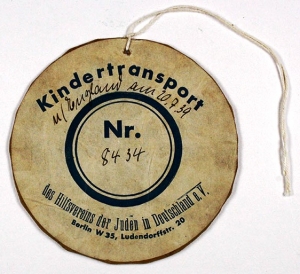
These words, spoken by the Home Secretary, Samuel Hoare, to the House of Commons on 21 November 1938 led to some 10,000 mostly Jewish children being brought to Britain from Nazi Germany, Austria, and Czechoslovakia. Kindertransport, or Children’s Transport, was the name given to the rescue movement which between December 1938 and September 1939 arranged for the safe movement and sponsorship in Britain of these children.
Of the 10,000 Kindertransport children who came to Britain, three were taken in by Sherborne School, one by Sherborne Girls, and one by Lord Digby’s School.
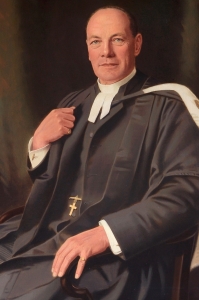
Following a meeting held at Clayesmore School in March 1939 the Dorset Committee for German Refugee Children was formed. Among the founder members were the headmasters of Bryanston School [Thorold Francis Coade (1896-1963)], Clayesmore School [Evelyn Mansfield King (1907-1994)], and Sherborne School [Alexander Ross Wallace (1891-1982)], together with the Bishop of Salisbury [Ernest Neville Lovett (1869-1951) who attended Sherborne School (School House) 1882-86], the Vicar of Cranborne [Lancelot Farquharson Addison (1886-1955)], the Bishop Suffragan of Sherborne [Harold Nickinson Rodgers (1881-1947)], the Mayor of Blandford [C.S. Tripp], D.P. Burke, and Mrs Alice Noel Herbert Atkinson (1885-1953) of Holway Cattistock, Dorset [whose three sons had attended Sherborne School]. The committee issued a four prong appeal – to employers to take on and train some of the young men, to people who could provide them with homes, for donations to their funds, and to boarding schools for boys ‘whose abilities justify their further education.’
At a meeting of the School Governors held on 9 June 1939, the Headmaster A.R. Wallace announced his intention to take some of the boys, stressing that because they had absolutely no money the School would be financially responsible for them until the age of eighteen.
The first two Kindertransport boys to arrive at Sherborne School in the Summer Term of 1939 were Ernst Fuchs and Lothar Markiewicz, both aged 15. Ernst joined The Green (then run by housemaster Sam Hey) and Lothar went to School House (run by the Headmaster A.R. Wallace).
Ernst Werner Fuchs was born in Berlin in 1924, the son of Dr Herbert Fuchs, a lawyer, and Grete Else Fuchs (née Lewin), of Meinekestraße 4, Charlottenburg, Berlin. He had an elder brother and sister, Günter and Vera, and had previously attended the Wilmersdorf Bismarck Gymnasium but had to leave when after 15 November 1938 Jewish children were banned from attending public schools. With Ernst’s father no longer allowed to practise as a lawyer, it was decided that Ernst should be sent to England, where he arrived alone on 21 June 1939.
Lothar Hermann Markiewicz was also born in Berlin in 1924. He was the son of Max Markiewicz of Courbiere Strasse GA, Charlottenburg and Lotte Markiewicz (née Goldstein) of Berlin Friedenau, Fregestraße 78. Lothar had previously attended the Holdhein Schule in Berlin, but when he and his younger sister Ellen were no longer allowed to attend school their mother got passes through the Kindertransport (permit numbers 4401 & 4402) to get them to England. On 19 April 1939, Lothar and Ellen left Hamburg on the SS Manhattan with a group of 39 boys & 49 girls. On their arrival at Southampton on 21 April, the Port Health Authority reported to the Ministry of Health that they had all been medically examined before disembarking and found to be healthy. In the charge of ‘The Movement for the Care of Children from Germany’ they were sent by train to Liverpool Street Station in London where they were separated, each going to live with a different family.
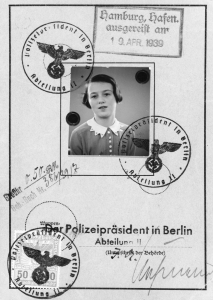
It is impossible to imagine how these children felt on their arrival in Britain, separated from their parents and family and living in a country where they did not speak the language. Through their Quaker sponsors in England, a place was found in May 1939 for Lothar at Sherborne School and the next year Ellen joined Sherborne Girls’ School. Amazingly, some of Lothar’s school reports survive which reveal how he adapted to life in England. His first school report, dated 6 June 1939, suggests he was a bright boy who was quickly mastering English, and in October 1939 his form master wrote of him, ‘Good. Now that he has mastered the language he should go ahead quickly’.
Although by Michaelmas term 1940 Lothar’s sister Ellen was at Sherborne Girls’ School, this did not mean that they were now able to see each other, because in July 1940 Lothar (now aged 16) had been taken from class at Sherborne and arrested as an enemy alien. He spent three days in a prison cell in Dorchester before being taken to Liverpool and put on the now infamous HMT Dunera bound for Australia. The Dunera left Liverpool on 10 July 1940 carrying 2,542 male ‘enemy aliens’, mostly Jewish refugees aged between 16 & 60, along with 451 German and Italian Prisoners of War. Curiously, another prisoner on the ship was Heinz Brack who had taught at Sherborne School from 1936 until his arrest in September 1939 on suspicion of being a Nazi spy.
During the 57 day journey, later described by Winston Churchill as ‘a deplorable and regrettable mistake’, Lothar contracted rheumatic fever and nearly died. The ship was hugely overcrowded and the prisoners’ conditions were appalling with men kept below deck for all but 30 minutes a day and fresh water supplied only two or three times a week. When HMT Dunera arrived in Sydney on 6 September 1940, the Australian medical army officer was shocked by the conditions he found on the ship and his subsequent report led to the court martial of the officer-in-charge.
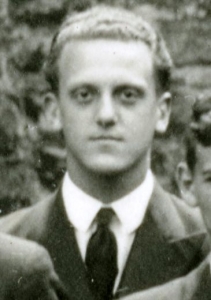
On arriving in Australia, Lothar was transferred to the Hay Internment Camps in New South Wales, where he was the second youngest internee. Thankfully, however, through the agency of one of his Quaker sponsors in England and the Headmaster of Sherborne School, Lothar’s case was raised in the Houses of Parliament and his release was authorised, but due to fear of German U-boat attacks Lothar’s return to England was delayed. He eventually travelled back to England on board the troopship Stirling Castle, arriving at Liverpool on 28 November 1941 and returned to Sherborne School, where he remained until July 1942. Lothar’s return to Sherborne meant that he and Ellen were finally able to meet, although only occasionally, on Sundays. In spite of having undergone such a traumatic time since leaving Germany in April 1939, in July 1942 Lothar passed the Oxford and Cambridge School certificate and matriculated.
Meanwhile, after spending a year at Sherborne, Ernst Fuchs left in Summer Term 1940 to attend Dean Close School in Cheltenham, where A.R. Wallace reported to Lothar ‘He seems to be getting on very happily’ and in December 1941 he passed the Oxford and Cambridge School certificate. However, the British Enemy Alien Regional Advisory Committee had also been checking Ernst’s credentials and in September 1940 his case was heard before a tribunal, which reported: ‘This boy is a Jew, and has recently attained 16 years of age. His father was a lawyer, and was forbidden to practise by the Nazis. The parents and two other children are in Berlin. The boy was not permitted to continue his education in Germany, and was brought to England on 21 June 1939. He lived for a short time at the house of the Bishop of Sherborne. He is now being educated at Dean Close School, Cheltenham, the headmaster of which establishment – Mr Elder – attended as referee before the Advisory Committee, and vouched for the boy’s reliability from a security point of view. He undertook to keep close supervision upon the alien’s correspondence as it was disclosed the boy has written to friends in Portugal and obtained news of his parents.’ The Advisory Committee came to the conclusion that Fuchs was ‘reliable from a security point of view’
Ernst’s place at The Green was taken by another Kindertransport boy, 13 year-old Ludwig Calvelli-Adorno. Ludwig was born in 1927 at Frankfurt-on-Main, the son of Franz Wilhelm Calvelli-Adorno (1897-1984), a District Judge in Dortmund who had been dismissed in 1933 as a ‘half-Jew’, and Helene Luise Franziska (née Mommsen) (1895-1988), a music teacher. On 27 June 1939, Ludwig and his elder sister Elisabeth Martha Calvelli-Adorno (b.1925) escaped Germany with the Kindertransport and were given a home in England by a childless couple with whom they stayed for a couple of years. Ludwig attended Sherborne School from September 1940 to July 1942, and in 1941 won the School’s Halliday Cup for Music (Junior). He subsequently attended Watford Grammar School before finding employment as an accountant’s assistant. He was also investigated by the British Enemy Alien Regional Advisory Committee who reported that ‘Nothing detrimental reported either by police or by M.I.5. Given good report by person with whom he is living, and although a poor report was given by a previous landlady, there was nothing to show that alien was likely to be a menace to this country’.
Another Kindertransport child who arrived in Sherborne in 1939 was Henny Esta Riegelhaupt, who was born in Berlin on 9 June 1924 to Selig and Debora Riegelhaupt. During her escape to England Henny lost her passport but thankfully was waved through the frontier, leaving Hamburg on 30 January 1939 on board the SS Washington and arriving in Southampton on 1 February 1939. Following an appeal by the headmistress of Lord Digby’s School Miss Margaret Billinger (1883-1942) for parents to take in German Jewish schoolchildren, Henny was taken in by Maurice and Winifred Welcher who lived at The Lorne in Newland, Sherborne. Henny was described in the LDS magazine as ‘a jolly girl of fifteen years of age, spoke English extraordinarily well, and quickly found her feet in Form Vb.’ During the summer holiday in 1939 Henny was allowed to visit her parents in Geneva where she was interned with them and did not return to Sherborne.
What became of Sherborne’s Kindertransport children after the war?
- Ludwig Tycho Calvelli-Adorno (1927-2009) (The Green 1940-42) began work as an accountant’s assistant at Rickmansworth, Hertfordshire, where he lived with his sister Elisabeth Martha Calvelli-Adorno (1925-2016) who attended a local school. In September 1945 Ludwig and Elisabeth were informed that their parents Franz Wilhelm Calvelli-Adorno (1897-1984) and Helene Luise Franziska (née Mommsen) (1895-1988), and their younger sister Agatha Wilhelmine Calvelli-Adorno (1930-2019) had all survived the war, and in 1947 they were able to meet in England. On 9 October 1948 Ludwig was issued with his naturalisation certificate and in 1949 he qualified as a Chartered Accountant, later working in Germany for Price Waterhouse & Co. Ludwig’s three sons all attended Sherborne School: Francis (Wallace 79-84), Michael (Wallace 82-87) and Julius (Wallace 86-87). Ludwig died in 2009, aged 81 years old. His sister Elisabeth married and returned to Germany, where she died on 10 June 2016.
- Ernst Werner Fuchs (1924-2008) (The Green 1939-40) left Dean Close School in 1942 and joined the Royal Inniskilling Dragoons as a Trooper, with whom he took part in Operation Market Garden. He later served as a translator for the British Reconnaissance Service in the interrogation of German soldiers. Ernst’s mother Grete Else Fuchs (née Lewin) (1893-1944) was transported from Berlin on 30 June 1943 and was cremated on 22 February 1944 in the Theresienstadt concentration camp at Terezin. His father Dr Herbert Fuchs (1886-1944) was deported to Auschwitz in early October 1944 where he was killed in a gas chamber immediately after his arrival. His brother Günter Edgar Fuchs (1920-1945) was deported to Auschwitz at the end of September 1944 and transferred to the forced labour camp at Golleschau. In January 1945 he was deported to Sachsenhausen and then to the Mauthausen concentration camp, where he died of pneumonia on 31 March 1945. Ernst’s sister Vera Ellen Fuchs (1926-1990) was deported to Auschwitz in early October 1944 and was later moved to the women’s labour camp at Merzdorf. After the camp was liberated on 9 May 1945 she returned to Berlin, where Ernst was able to meet up with her. In March 1947 she emigrated to the USA, where she died on 18 November 1990. On 14 May 1947, Ernst was issued with his naturalisation certificate, and in 1952 he married and went on to have two children, Judith and Ian. He worked as an advertising manager for Bertram Mill’s Circus, and died at Ely, Cambridgeshire in 2008, aged 84 years old.
- Lothar Hermann Markiewicz (1924-2014) (School House 1939-42) left Sherborne School in July 1942 giving his intended profession as ‘motor car engineeering’. His mother Lotte Markiewicz (née Goldstein) (1897-1966) remained in Berlin during the war to look after her mother and worked in a factory. She was one of a very small number of Jews who were never caught, and in 1947 came to England and then emigrated to the USA. Lothar’s father and grandmother both died under Nazi occupation: his father Max Markiewicz (1891-1942) was deported from Berlin on 24 October 1941 to the Lodz Ghetto in Poland and was murdered on 4 May 1942 at the Chelmo extermination camp in German-occupied Poland; and his grandmother Frieda Goldstein (née Schwartz) (1871–1943) was transported from Berlin on 10 September 1942 to the Theresienstadt Ghetto at Terezin, where she died on 2 February 1943. By 1946 Lothar was working as a schoolmaster at St Bede’s School, Bishton Hall, Staffordshire, and on 23 December 1947 he was issued with his naturalisation certificate. He married in 1950 and later sent his son Michael to Sherborne School (School House 1969-1974). Lothar worked for himself in the textile industry until his retirement in 1993, when he and his wife emigrated to Sydney, Australia to join their son Michael and his family who had moved there in 1981. In 2009, Lothar celebrated his 85th birthday with a three-generation sky dive with his son Michael and grandson Jeremy. Lothar Markiewicz died in 2014, aged 90 years old.
- Ellen Sara Markiewicz (1926-2018) (Sherborne Girls’, Wingfield 1940-43) left Sherborne Girls’ School in 1943 and worked in a children’s convalescent home until she was 17 ½ years old when she went to London and trained for three years to become a state-registered children’s nurse. In 1951 she joined her mother in the USA, where in 1959 she married Ralph Gerber and had two sons, Peter and Gary. Ellen died on 10 March 2018, aged 91 years old.
- Henny Esta Riegelhaupt (1924-2007) (Lord Digby’s School 1939) remained in Geneva after the war, working at the University and qualifying as an interpreter. Her parents did not want to return to Czechoslovakia, but could not stay indefinitely in Switzerland and hoped to obtain passports to allow them to go to America. Henny eventually emigrated to the USA, and on 12 July 1954 she became a naturalised citizen. She married twice and died in New York on 16 December 2007, aged 83 years old.
With very many thanks to Lothar’s son, Michael Markiewicz (a 74), for providing details about his father’s life and copies of the letters written to his father by A.R. Wallace when he was interned in Australia.
Rachel Hassall
School Archivist
(Revised 30 July 2026)
Further reading
Jewish Museum London
‘A wartime education’, by Ellen Markiewicz (Gerber), The Journal of Sherborne Old Girls’ Society, 2014 (pdf)
Ellen Markiewicz archive material held at the United States Holocaust Memorial Museum
USC Shoah Foundation Institute testimony of Ludwig Calvelli-Adorno, 11/11/1997, United States Holocaust Memorial Museum
Database of Holocaust Survivor and Victim Names, United States Holocaust Memorial Museum
See also:
Sherborne School and the Second World War 1938-1945
Herr Brack: temporary German master – and Nazi spy?
For further information about the Sherborne School Archives please contact the School Archivist
Return to the School Archives homepage