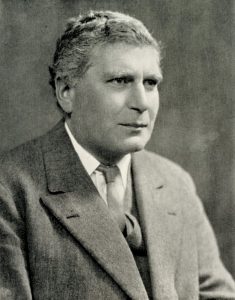
Albert Reginald Powys CBE, FSA, ARIBA (1881-1936) was born on 16 July 1881 at Rothesay House in Dorchester, the sixth of eleven children born to the Rev. Charles Francis Powys (1843-1923) and Mary Cowper Johnson (1849–1914).
Albert (‘Bertie’) first attended Sherborne Preparatory School (under headmaster William Heitland Blake), and from September 1895 to April 1899 he was a pupil at Sherborne School where he boarded at The Green, then run by housemaster T.W. Wilson. Unlike his brothers, John Cowper Powys (1872-1963) and Littleton Charles Powys (1874-1955), Albert did not progress beyond form VA, having spent much of his time learning carpentry in the school workshop under Mr Bishop. His schooldays were later described in the school magazine, The Shirburnian (June 1936): ‘He took no prominent part in School life; he was no great athlete; in fact, as has happened with many another, cricket meant little or nothing to him; but the beauty of the country round Sherborne, and the Abbey, the School buildings, the churches and old houses of the neighbourhood, and the workshop of the School meant much; and it was largely here that the seeds were sown which bore fruit in his valuable life’s work.’
On entering Sherborne School in September 1895, it was recorded in the admission register under ‘Proposed Pursuit in Life’ that Albert wished to become a civil engineer, but by the time he left the School in April 1899 he had decided to become an architect. He was articled for three years to C.B. Benson of Yeovil, and went on to work for Walter Frederick Cave (1863-1939) and then for William Weir (1865-1950) of SPAB who instructed him in the method of repair of old buildings, and from 1903 to 1908 he helped in supervising the repair of churches all over England. He attended Regent Street Polytechnic, passing the qualifying exam in 1904, and in 1905 was made an Associate of the Royal Institute of British Architects (ARIBA), supported by J. Slater, L. Solomon and G. Hubbard, In 1908 he set up in independent practice in London, and from 1925 was in partnership with John Eric Miers Macgregor FRIBA, FSA OBE (1890-1984). From 1912 until his death, Albert served as Secretary to the Society for the Protection of Ancient Buildings (SPAB), which had been co-founded in 1877 by William Morris and Philip Webb.
On 15 May 1910, Albert spent the evening at Abbeylands in Sherborne with his brother John and their former teacher, Henry Robinson King. The architect, Reginald Blomfield, was then in the process of building at Sherborne School the Westcott Art School and Carrington Building, however his design, which included such ‘Wrenaissance’ details as curved gables, sash windows and swags of fruit, was believed by many to be at odds with the Gothic style of the main School buildings. One of those who defended the design of the new building was A.R. Powys. Later that evening, Henry King wrote in his diary: ‘Architect Powys… appreciates the new buildings – marvellous in this stupid generation.’
During the First World War, Albert served with the 2/4th Yorkshire Regiment (Green Howards), a territorial unit. He was captured on the Somme on 23 March 1918 and interned by the Germans at Mainz POW camp, along with fellow Old Shirburnian Alec Waugh, whose father would later introduce Albert’s brother Littleton to the author Elizabeth Myers, who in 1943 became his second wife. Albert arrived back in England onboard the SS Porto which docked at Hull on 29 November 1918.

In 1924, Albert designed for his brother Littleton the Quarry House in The Avenue, Sherborne, which Littleton moved into on 1 January 1925. The house was built using Stalbridge stone and Ham Hill stone. Littleton described the Quarry House in his autobiography, The Joy of It (1937): ‘We had asked my brother A.R. to design the house; we had given him some idea of what we wanted, a house of simple design without gables and odd excrescences, which in those days seemed so prevalent, a house built of stone in a late Georgian style, with sash windows and large eaves and a good sloping slate roof; the sort of house connected in our minds with old country vicarages, the most comfortable of all houses to live in. He saw at once what we had in mind and soon produced his plans; these remained unaltered except for the addition of a walled terrace in front of the house.’ Littleton sold the Quarry House in June 1950 and in September 1950 moved to West Pennard.
When Albert left Sherborne School in 1899, he joined the Old Shirburnian Society and remained a member until his death. In 1934 he returned to the School to give two lectures. The first lecture he gave on 21 February 1934 in the Big Schoolroom to the School Archaeological Society on ‘Architecture – Old and New’, and the second lecture he gave on 23 October 1935 on the subject of ‘The Development of Church Architecture in England’.
Albert’s work as a conservation architect was wide and varied. Amongst the many projects he was involved with was the conversion of a number of buildings at Sissinghurst Castle in Kent for Harold Nicolson and Vita Sackville-West. This included the conversion of the stables into a library (known as the Big Room), and the conversion of the Priest’s House and the South Cottage. He also designed a brick wall for the Rose Garden, which is known as the Powys Wall.
In the counties of Somerset and Dorset, A.R. Powys supervised the repair and conservation of numerous buildings, including:
Somerset:
Bruton Pigeon Tower.
Brympton Priest’s House.
Cucklington church.
Lambrook church.
Langport church tower.
Montacute House and cottages on the estate.
Stoke-sub-Hamdon church.
West Coker almshouses.
Dorset:
Bradford Abbas church.
Cerne Abbas.
Lydlinch church.
Lytchett Matravers church.
Oborne chancel.
Sturminster Marshall cottages.
Trent cottages.
Winterborne Tomson church (the restoration work 1929-1931 was paid for by the sale of SPAB’s collection of Thomas Hardy’s architectural manuscripts and by a substantial contribution from the architect Lionel Brett Lord Esher. One of the replacement oak laths fitted at the church by A.R. Powys is marked ‘THOMAS HARDY 1930’),
War Memorials designed by A.R. Powys:
Milton Keynes Village War Memorial
Meanwood War Memorial, Leeds
Godalming War Memorial, Surrey
Blo Norton War Memorial, Norfolk
A.R. Powys wrote a number of books on architecture, including his influential study of conservation practice Repair of Ancient Buildings (1929), The English House (1929), The English Parish Church (1930). From the Ground Up: Collected Papers of A.R. Powys (1937), with an introduction by John Cowper Powys, was published posthumously.
Albert married twice, first in 1905 to Dorothy Mary Powys (1882-1956), they divorced in 1929, and secondly in 1930 to Faith Oliver (1897-1983). Albert had three children from his marriages, Isobel, Oliver, and Eleanor.
Albert Reginald Powys died on 9 March 1936 at Stoneycrest Nursing Home, Hindhead, Surrey.
He was buried on 12 March 1936 at the church of St Andrew, Winterborne Tomson, Dorset, where his wife Faith (1897-1983) was also later buried. The funeral was attended by Mrs A.R. Powys [Faith Powys] (widow), Mr John Cowper Powys (brother), Mr and Mrs Littleton C. Powys (brother and sister-in-law), Mr Theodore F. Powys (brother), Miss Powys (sister), Mrs Llewelyn Powys [Alyse Gregory] (sister-in-law), Mrs H. Penny (sister), Mr Herbert Marks (son-in-law), Miss Evelyn Powys (cousin). Florence Hardy, F.C. Eeles, Sir Sydney Cockerell, Norman Jewson, Detmar Blow, and Rivers Pollock also attended the funeral.
In 1962, Faith Powys commissioned a memorial stone for the church at Winterborne Tomson which was carved by Reynolds Stone with the following inscription:
‘In memory of Albert Reginald Powys 1881-1936 CBE. Architect & Writer, the devoted servant for over 25 years of the Society for the Protection of Ancient Buildings, who is buried in the churchyard as he desired. This church, greatly loved by Thomas Hardy, was saved from ruin by the sale of certain of his mss. which paid for work done here 1929-31. As they shared Life Love & Death this stone is set by Faith, wife of A.R. Powys.’
A memorial service was held for Albert Reginald Powys on 24 March 1936 at the City Church of St Magnus the Martyr by London Bridge.
Online resources:
Report of the funeral of A.R. Powys (Western Gazette, 20 March 1936) (pdf)
An Appreciation of A.R. Powys by Littleton C. Powys (pdf)
Obituary for A.R. Powys (The Shirburnian, June 1936) (pdf)
Obituaries for A.R. Powys (SPAB Annual Report, 1936) (pdf)
John Cowper Powys’s Introduction to From the Ground Up. Collected Papers of A.R. Powys, Architect, Writer, and Secretary of the Society for the Protection of Ancient Buildings 1882-1936 (1937) (pdf)
The Powys Family and Sherborne School
An insight into the Powys family through the diaries of Henry Robinson King by Rachel Hassall, 2020
Books written by or about Old Shirburnians (including by members of the Powys family)
Links:
The Powys Society
The Sundial Press
John Cowper Powys manuscripts and papers, National Library of Wales
The Powys Collection, Dorset History Centre
The Powys Family Collection, University of Exeter
Paintings of Gertrude Powys on the Art UK website
For further information about the Sherborne School Archives please contact the School Archivist.
Return to the School Archives homepage.