To get you in the mood for Christmas, we hope you might enjoy these festive offering from the School Archives:
Find out about the history of Sherborne School’s Festival of Lessons and Carols. First held in the School chapel on 7 December 1919, the service was adapted by the School’s Director of Music Archibald Tester (1882-1925) from Eric Milner-White’s Festival of Nine Lessons and Carols held on Christmas Eve 1918 at King’s College, Cambridge.
Discover Sherborne School’s connection with John Mason Neale (1818-1866) (Sherborne School 1833-35) who wrote some of our favourite Christmas hymns, including Good King Wenceslas, Good Christian Men, Rejoice, and O Come, O Come, Emmanuel.
‘Put out the lights now!
Look at the Tree, the rough tree dazzled
In oriole plumes of flame,
Tinselled with twinkling frost fire, tasselled
With stars and moons—the same
That yesterday hid in the spinney and had no fame
Till we put out the lights now.’
These lines are from The Christmas Tree poem, written by Sherborne School’s Poet Laureate Cecil Day-Lewis (Harper House 1917-23) and first published in The Shirburnian in December 1944. To read the entire poem and also listen to Cecil Day-Lewis reading the poem visit The Christmas Tree
Enjoy Ghosts of Christmas Past with the story of end of term Christmas celebrations in the the OSR in Christmas celebrations at Sherborne School in the 1870s
Watch a film made at Sherborne School on The Last Day of Michaelmas Term 1996. The film is narrated by Old Shirburnian Charles Collingwood (aka Brian Aldridge of The Archers!)
Sing-along-a-Sherborne Christmas with songs from the Sherborne School songbook:
- King Christmas – composed by Louis Napoleon Parker (Director of Music 1877-92) with words by James Rhoades (Abbeylands housemaster 1880-93), the song was first performed at the Musical Society’s Christmas concert in the BSR on 20 December 1886.
- A Solemn Carol for Christmastide – composed by Louis Napoleon Parker (Director of Music 1877-92) with words by James Rhoades (Abbeylands housemaster 1880-93), the carol was first performed at the Musical Society’s Christmas concert in the BSR on 20 December 1886.
- Yule-tide – composed by Berthold George Thorne (music master 1894-1903) with words by James Hamilton Francis Peile (assistant master 1895-99), the song was first published in the 1898 edition of The Songs of Sherborne School.
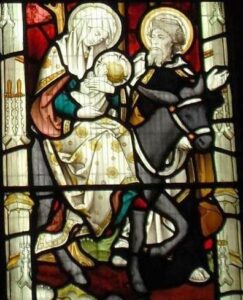
Visit the nativity window in the south aisle of the School chapel. This stained glass window by Clayton & Bell is dedicated to the memory of three former pupils: John Morgan Ley (1846-1866) (School House 1860-65), Herbert Waters Tanner (1854-1866) of The Retreat (now Harper House) (Foundationer 1866), and William Vaux Eade (1852-1868) (Foundationer 1863-68).
‘Marley was dead: to begin with. There is no doubt about that’ – on 21 December 1854 Charles Dickens gave a reading at Sherborne from his story A Christmas Carol. This year marks the 170th anniversary of Charles Dickens’ visit to Sherborne
Finally, why not try our new party game this Christmas by testing your knowledge on some old common entrance exam papers? Here’s a selection to whet your appetite:
- Algebra: A cyclist rides from P to Q a distance of x miles at 9 miles an hour and returns from Q to P at 8 miles an hour. Find in minutes how long he takes for each journey.
- Arithmetic: Divide £73. 2s. 6d. by 45; multiply 0.0708 by 92.5
- English Grammar: Point out the subordinate clauses in the following sentences: (a) he asked the boy if he liked cricket; (b) I will praise you if you do well; (c) he hit the ball so high that it went over the house; (d) the things which I have seen I now can see no more.
- English History: Give the name and number of the English King who (a) was killed hunting in the New Forest; (b) succeeded King John; (c) conquered and absorbed Wales; (d) met the rebel peasants at Mile End; (e) founded the Tudor dynasty; (f) was restored to the throne from exile; (g) was exiled and never returned; (h) made the Younger Pitt Prime Minister.
- French grammar: complete this sentence by adding the relative pronoun ‘L’accident, _ il lparle, est grave.’
- Geography: What are the chief goods traded between England and Canada? Why do most people in Australia live near the coast? At what time of year does the apple crop ripen in Natal and why? What is the importance of the position of Bombay?
- Latin: translate into Latin ‘My father gave me many books’; ‘the horse which we loved is dead’.
- Scripture: an airman is flying from Alexandria over Palestine to Syria. Mention one mountain, one river, one lake and any six towns famous in the Bible stories which he might expect to sight on his way.
Posted 11 December 2024 by Sherborne School Archives
Visit Sherborne School Archive News for more stories from the archives.